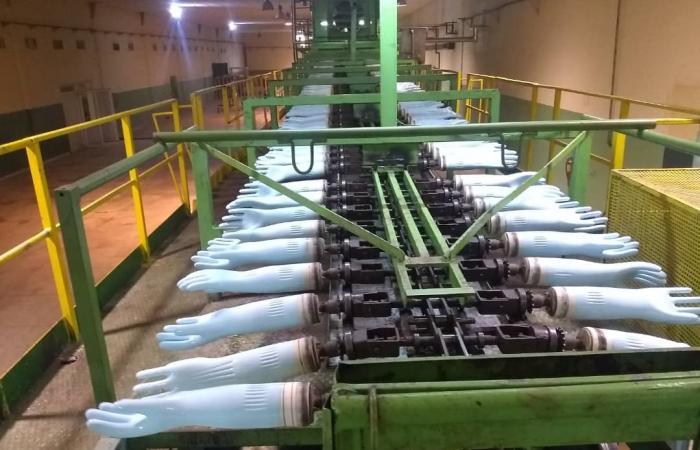
Las Tunas, Cuba – For nearly a full decade, Cuba’s sole dedicated latex manufacturing facility in eastern Las Tunas province has been unable to produce a single pair of sterilized surgical gloves, a critical medical supply that once sustained national public health operations at scale. The cascading fallout of this production freeze stretches far beyond the factory walls, rippling through hospital wards, surgical suites, national healthcare budgets, and the daily work of frontline medical staff across the island.
Prior to 2017, the state-run plant hit a historic production peak in 2016, churning out 6 million pairs of high-quality sterilized surgical gloves that eliminated the need for costly imports of this basic medical staple. Today, that milestone is a distant memory, as the intensifying U.S. economic, commercial, financial and energy blockade – a policy designed to strangle Cuban livelihoods in open violation of widely accepted international coexistence norms – has choked off nearly every supply chain and operational pathway the facility once relied on.
Milaydys García Aguilar, a veteran production specialist at the factory, walked through the layers of logistical and financial strain that now cripple operations. The plant’s longstanding natural latex supplier in Guatemala was forced to sever ties due to U.S. sanctions restrictions, pushing Cuban procurement teams to source the raw material from a far distant Asian market. That shift has triggered a cascading cost crisis: not only is the base latex far more expensive, but exorbitant long-haul freight fees, punitive tariffs, and extended shipping delays often result in batches of raw materials arriving expired, degraded, or non-compliant with medical manufacturing standards. Even minor supporting inputs required for surgical glove production, including potassium oleate, the vulcanization accelerator ZDBC, and specialized liquid color pigments, are now nearly impossible to source through regular, low-cost channels. A recent shipment of powdered pigments, for example, arrived without the specialized industrial milling equipment required to reduce the particles to a fine enough consistency to mix uniformly with latex – a gap that completely derailed all planned production runs for 2026.
Factory director Antonio Elio Nuñez Nojas detailed how the blockade has gutted far more than just the core surgical glove line. The facility’s auxiliary production lines, which once manufactured affordable household cleaning gloves, specialized membranes for bee venom collection, and custom latex cones for livestock artificial insemination, have all been shuttered for years. Even access to basic technical resources has been targeted: many international industrial technology servers block Cuban IP addresses, cutting off the plant’s engineering team from updated procedural guidelines and industry advancements that would allow them to upgrade their aging equipment. Nine U.S.-manufactured variable-frequency drives that regulate the facility’s entire conveyor and production line speed system are now required to keep operations running, but only two of the units are still functional. Without replacement parts or new units, the team cannot calibrate the precise speed parameters required to produce consistent, defect-free latex gloves, bringing the entire automated production workflow to a standstill.
George Cruz Ramayo, director of the Thaba Las Tunas business unit that oversees the factory, emphasized that the facility is sitting on underutilized infrastructure that could deliver transformative benefits to Cuban public health if sanctions were lifted. The site hosts one of the largest 10-cubic-meter ethylene oxide sterilizers in the entire country, a unit large enough to process millions of pairs of gloves and a vast range of reusable medical equipment for hospitals across the island. Today, the sterilizer remains idle, as the 34-kilogram cylinders of ethylene oxide it requires cannot be imported under current blockade rules. The facility’s on-site biochemical and physical-mechanical quality control laboratories are also non-operational, missing critical testing tools including tensile strength analyzers, calibrated pH meters, and laboratory reagents that are essential to validate the safety and consistency of any medical-grade latex products.
Rather than shutting down entirely, the factory’s dedicated 70-plus remaining staff have pivoted to a suite of small-scale, innovative alternative production projects to keep the facility afloat, support local communities, and sustain their own incomes. Teams have set up a small leatherworking workshop, a dedicated sewing room, and a repurposing program that turns leftover latex scraps into custom baseballs for local youth and professional sports teams, with sales going to the Cuban Ministry of Education and regional sports organizations. Staff also produce household cleaning gloves by hand, manually timing every step of the dipping and curing process to ensure consistent quality, even without the automated line controls that once supported mass production. The entire workforce continues to perform regular, meticulous maintenance on all the facility’s idle core equipment, keeping the production lines in ready condition in anticipation of a future where the U.S. blockade is finally lifted, and the plant can resume its role as a cornerstone of Cuba’s domestic medical supply ecosystem.