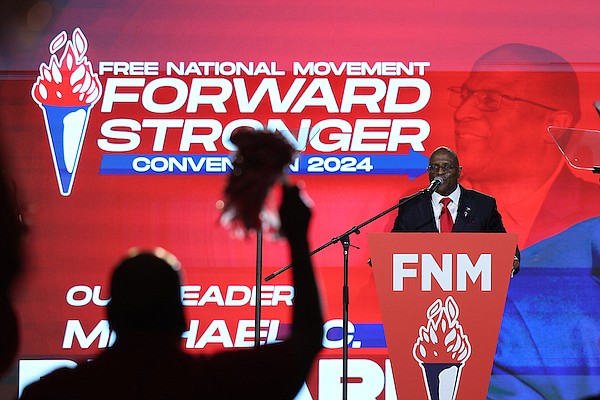
Nassau, Bahamas – The Free National Movement (FNM), one of The Bahamas’ longstanding major political parties, convened a landmark two-day closed-door weekend conclave that marked its first formal post-mortem review following a devastating May general election performance, where the party secured just 8 out of 41 parliamentary seats. Commissioned independent political consultants, affiliated with Jamaica’s Jamaica Labour Party, presented confidential polling data collected from Bahamian voters that laid bare deep internal vulnerabilities, as confirmed by anonymous meeting attendees who spoke exclusively to The Tribune’s chief reporter Leandra Rolle.
The polling data ranked FNM leader Michael Pintard as the least popular of the country’s three top party leaders, trailing behind sitting Prime Minister Philip Davis of the Progressive Liberal Party (PLP) and Coalition of Independents head Lincoln Bain, with respondents also describing Pintard as the “most petty” of the three. Crucially, the consultants emphasized that Pintard alone was not responsible for the party’s crushing electoral defeat, pointing instead to a campaign message that failed to resonate with everyday voters, severely limited public visibility for most FNM candidates, and the complete absence of a cohesive, actionable governing platform ahead of the May vote.
Breakdowns of the survey data showed Pintard carried relative name recognition and limited value as a campaign asset in Grand Bahama, but posted abysmally low favorability ratings in New Providence – the most populous island in the nation, whose electoral districts any party must overwhelmingly win to secure a governing majority. The analysis further warned that nearly all of the FNM’s currently held parliamentary seats sat on a “knife’s edge,” with zero safe constituencies, including Long Island, where incumbent FNM MP Dr. Andre Rollins has held office for consecutive terms. Official election results corroborated the fragility of the FNM’s Grand Bahama support base, showing the party earned a total of 8,969 votes across the island’s five constituencies – a razor-thin 14-vote lead over the rival PLP’s 8,955 total.
The presentation of these findings ignited tense, at times fiery debate during the closed sessions. Audio recordings obtained by The Tribune capture Dr. Rollins openly challenging the consultants’ research methodology, criticizing the team for failing to include granular comparative data breaking down exactly what motivated voters to cast ballots for the FNM, PLP, or Coalition of Independents, including full demographic percentage splits for each voter bloc. “We are here to do a post-mortem. We’re not here to do a prospective analysis going forward. This is retrospective,” Rollins stated during the session, with background murmurs of other members voicing agreement. “We’re looking at what happened before and, quite frankly, sir, I am concerned at why you decided to de-emphasise certain things and emphasise certain things.” Rollins further pushed back against the framing of Pintard as a Grand Bahama asset, noting that FNM vote share on the island had declined steadily across successive election cycles, leaving the party’s foothold there far more precarious than the consultants had suggested. Multiple party insiders who spoke to The Tribune on condition of anonymity described Rollins’ remarks as unnecessarily combative, while others praised him for pushing the consulting team to present unvarnished, full data sets to the membership.
Tensions spilled over beyond the formal conclave sessions on Saturday night, when witnesses reported a heated public exchange between Rollins and Pintard at Lumpy’s bar, a popular local gathering spot where a group of young FNM youth supporters were present. Rollins reportedly told Pintard during the confrontation that he was seriously considering mounting a leadership challenge ahead of the party’s upcoming convention, and that he wanted to make his intentions clear upfront to avoid lingering “bad blood” between the two men. Multiple onlookers noted the public setting, with young party members in attendance, made the exchange inappropriate. Attempts to reach Rollins for comment after the conclave were unsuccessful; back in September, the MP had publicly stated he had not made a final decision on a leadership run, and continued to recognize Pintard as the party’s legitimate sitting leader.
The conclave’s core consensus takeaway, shared by nearly all anonymous attendees, was that no single individual “saviour” could single-handedly rescue the FNM from its current political tailspin, and that replacing the party leader or rebranding its public image in isolation would never be enough to deliver electoral victory. Instead, the party would need to prioritize electing a unifying leader capable of bridging internal divides, addressing longstanding structural flaws, and rebuilding trust with the broader electorate from the ground up. As of now, the party’s leadership race landscape remains deeply uncertain: Pintard has publicly stated he will wait for the full post-mortem process to conclude before making a formal decision on his own re-election bid, but has previously asserted he is the best qualified candidate to steer the party through its rebuild. Deputy FNM leader Shanendon Cartwright has not yet announced whether he will enter the contest, while a growing faction of party members is backing Freetown MP Lincoln Deal, a first-term parliamentarian widely seen as a fresh, new face for the party’s next generation. A separate cohort of longstanding FNM supporters has also publicly called for former party leader Dr. Hubert Minnis to return to the fold, after Minnis ran as an independent candidate during the May general election. Pintard clarified during the conclave that Minnis automatically forfeited his FNM party membership by running against official FNM candidates in violation of the party constitution, and would need to submit a formal membership application that requires explicit approval from both the party’s national executive committee and full party council to rejoin.
FNM chairman Dr. Duane Sands framed the weekend conclave as a “good beginning” for the party’s rebuilding process in an official public statement, noting that the data presented had identified clear priority areas including retaining existing registered party members, re-engaging lapsed supporters who had grown disillusioned, and recruiting new, diverse voices particularly from younger generations of Bahamians. “A party is only as strong as the people who feel at home in it,” Sands emphasized, adding that the party would now shift to developing a simplified, voter-centric campaign message focused on tangible, practical solutions to the everyday economic and social challenges facing Bahamian households, to better align with the priorities of the modern national electorate. Sands confirmed the party will continue rolling out expanded internal member surveys as requested by attendees, and that the FNM national council will soon announce a formal date for its upcoming full leadership convention, with party sources indicating the event is targeted for early February. “Many organisations keep findings like these behind closed doors. We chose to hear them together because a party that cannot hear the truth about itself cannot ask the country to trust it,” Sands noted, thanking a record-breaking turnout of party supporters for their participation in the weekend’s sessions.