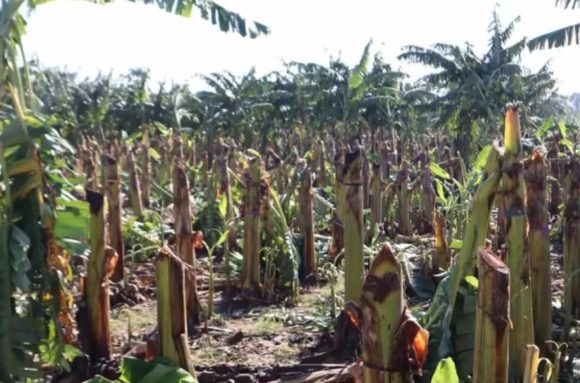
A sudden, localized weather event that local agricultural authorities and crop producers have classified as a minor tornado swept through Valverde Province in the Dominican Republic alongside torrential Wednesday afternoon downpours, leaving a trail of widespread damage that imperils hundreds of acres of staple fruit crops and the livelihoods of smallholder and commercial farmers across the area. The unexpected wind and rain struck at approximately 5 p.m. local time, tearing through the productive agricultural hub of Palo Amarillo, situated near the city of Mao, before extending its destructive reach to adjacent farming communities including Hatillo Nuevo and Hierba de Guinea, where large swathes of plantain and banana plots form the backbone of local economic activity. One of the most heavily hit commercial operations is a 330-acre export-focused banana farm owned by veteran agricultural producer Guarionex García, where roughly 150 acres of mature, harvest-ready crops were fully flattened by the ferocity of the gusts. García shared that the fully operational plantation had been generating a steady weekly revenue stream of approximately $10,000 prior to the disaster, meaning the sudden crop loss delivers a crippling financial shock not only to his own agricultural enterprise but also to the dozens of local workers who rely on the farm for their primary source of income. He characterized the blow to a large segment of his once-healthy crops as nothing short of devastating, noting that the combination of the tornado-force winds and lashing rain left almost no standing vegetation across the affected acres. In direct response to the unfolding crisis, specialized technical teams from the national Ministry of Agriculture have deployed to the Palo Amarillo agricultural zone to conduct on-the-ground assessments of damaged plantations, compile granular data on total losses, and lay the groundwork for targeted relief programs to support impacted local producers. The assessment mission is being led by Alfonso Antonio Rodríguez, the regional Agriculture director for the Northwest Cibao zone, who is collaborating alongside Valverde Province’s agricultural director Ernesto Castellanos and the regional head of crop production to document every damaged plot. Rodríguez confirmed that a separate farming operation belonging to local grower Arismendi Tolentino sustained catastrophic damage across a 50-acre banana plot, with preliminary field evaluations indicating more than 90% total crop loss at that site. He emphasized that the ongoing systematic surveys are critical to accurately quantifying the full scope of losses, measuring the cascading impact on household farmer incomes, and mapping out the resources needed to help local farms restart production and rebuild their operations. The cascading harm from the Wednesday storm system was not confined solely to agricultural zones, however. Across the municipality of Mao, dozens of residential neighborhoods reported widespread street and home flooding as the heavy downpour overwhelmed local drainage infrastructure. Further east in the populous province of Santiago, a rapid preliminary report from the Civil Defense agency documented at least 150 residential properties flooded across two densely populated neighborhoods overnight: 100 homes in the Hoya de Caimito sector, and an additional 50 in the Francisco del Rosario Sánchez area. Major arterial roads running through Santiago, including 27 de Febrero Avenue, Estrella Sadhalá Avenue, and the Circunvalación Sur ring road, were also submerged under standing floodwater, bringing regular vehicular traffic to a near-complete standstill for hours. The extreme rainfall event stretched well beyond Santiago’s urban core, reaching outlying municipalities including Puñal, Licey al Medio, Baitoa, Tamboril, Navarrete, Villa González, San José de las Matas, Jánico, and Sabana Iglesia. The storm also created a serious public safety hazard on the Circunvalación Sur ring road, when a woman attempting to traverse the flooded roadway fell into an uncovered open manhole, before quick-acting nearby bystanders intervened to pull her to safety. Francisco Arias, the regional director of Civil Defense in Santiago, explained that many manhole covers can be dislodged by the overwhelming force of fast-moving floodwater, compounding an existing public safety risk created by widespread theft of metal drain covers across the city. Arias issued a formal public advisory urging all residents to never attempt to cross flooded streets or deep standing puddles without first verifying the condition of the ground underneath, as murky, fast-moving water can easily hide open sewers, deep potholes, and other hidden hazards that pose severe injury risks. He also confirmed that local emergency and prevention agencies are conducting continuous real-time monitoring of evolving weather conditions, and urged all families residing in low-lying, high-vulnerability zones to remain closely tuned to official public safety announcements and evacuation guidance as needed. The dual crises of widespread agricultural damage in Valverde and cascading flood impacts across Mao and Santiago lay bare the far-reaching, multifaceted harm of the severe weather event across the Cibao region, ranging from catastrophic commercial crop losses to residential property damage, crippled urban mobility, and direct threats to the physical safety of local residents.