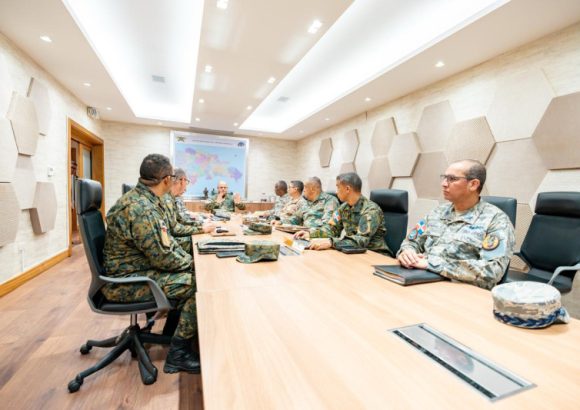
Dominican Republic Defense Minister Lieutenant General Carlos Antonio Fernández Onofre convened a high-level strategic security summit with the nation’s top military commanders and intelligence agency leaders to evaluate the rapidly shifting security crisis unfolding in neighboring Haiti, with a core mandate to safeguard national territorial sovereignty and public safety. The closed-door session brought together the heads of the Army, Navy, and Air Force, alongside leadership from the Specialized Corps for Land Border Security (CESFRONT) and the national Command, Control, Communications, Computers, Cybersecurity and Intelligence (C5i) Center, to review real-time field intelligence reports and assess potential spillover risks from Haiti’s escalating unrest. Following a full analysis of on-the-ground conditions, senior defense officials formally ruled out the implementation of extraordinary emergency measures or a full border closure, confirming that cross-border trade, civilian transit, and routine daily life for communities along the shared southern frontier will proceed without disruption. The Ministry of Defense emphasized that all Dominican national territory remains under rigorous, layered security oversight, and there is no justification to alter longstanding social and economic dynamics in border regions at this stage. While current conditions remain stable, the Dominican Armed Forces have committed to sustaining 24/7 granular monitoring of Haiti’s evolving situation, leveraging cross-agency real-time intelligence sharing and regular scenario planning drills to deploy targeted, proportionate preventive measures immediately if crisis conditions escalate to threaten national interests. Lieutenant General Fernández Onofre underscored that the security apparatus’ non-negotiable priorities are upholding national sovereignty, preserving full territorial integrity, and guaranteeing the safety and tranquility of all Dominican citizens, with operations guided by a balanced framework of firmness, prudence, and rapid, evidence-based response capabilities. Across the three southern provinces that share the border with Haiti, a calibrated, uneven security deployment is currently in place to align with localized risk assessments. In the provinces of Pedernales and Elías Piña, a reinforced combined security presence has been activated, with personnel from CESFRONT, the Dominican Army, the National Police, and the General Directorate of Traffic and Land Transportation Security (DIGESETT) conducting targeted inspections of people and vehicles crossing the border, alongside targeted enforcement operations targeting unregistered Haitian motorcyclists operating informal passenger transport services. Military checkpoints stretch across key border points in Elías Piña, spanning the communities of Macasía, Dos Bocas, and Cañada Miguel in the Hondo Valle district, though Haitian small business owners continue to cross routinely to purchase supplies in Dominican markets with no reported disruptions to regular commercial flows. Local residents in Comendador, Elías Piña’s capital, have been circulating unconfirmed rumors regarding the fate of four Salvadoran soldiers deployed as part of the UN-backed international security support mission in Haiti, who have been reported missing amid ongoing gang clashes; no official confirmation of their status, including widespread unsubstantiated claims of their deaths, has been released to date. In Jimaní, located in Independencia province, no extraordinary security reinforcements tied to recent anti-gang operations in Haiti have been formally authorized, per local journalist and community contributor Miguel Vólquez. A temporary uptick in agent presence observed earlier in the week was solely tied to an official visit by the Director General of Customs, rather than a new security mandate. Cross-border goods transit into Haiti fully returned to normal operations on Thursday, after Haitian trade and transport associations lifted three days of voluntary self-imposed restrictions that had limited commercial flows; the restrictions were resolved following a formal dialogue between Dominican authorities and Haitian private sector representatives, and the official border crossing never underwent a formal closure during that period. In Pedernales, security personnel maintain active monitoring at all high-traffic border points, as local communities prioritize both territorial safety and the continuity of binational trade that serves as a core economic lifeline for households on both sides of the frontier. The Dominican security posture comes as Haitian national police forces conduct active anti-gang operations in Croix-des-Bouquets, a township near Port-au-Prince located in close proximity to the Dominican border town of Jimaní; unconfirmed local reports indicate several gang members were killed during the operations, though no official, verifiable casualty toll has been released. Across all three border provinces, residents and local business operators are closely tracking developments in Haiti, balancing vigilance over potential spillover security risks with a commitment to preserving the cross-border commercial ties that underpin local livelihoods.
The Ministry of Defense is assessing the situation in Haiti and guaranteeing border security.