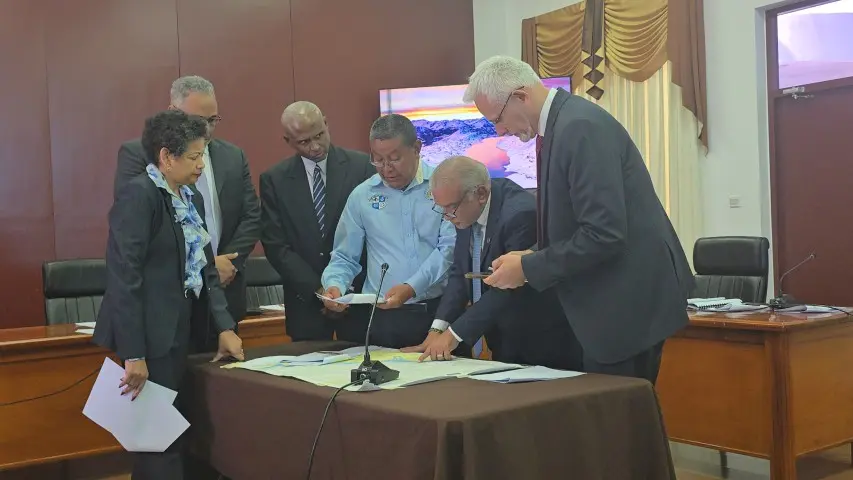
On Thursday, October 22, 2026, retired Captain John Flores, head of Guyana’s Maritime Rescue Coordination Centre (MRCC) under the Maritime Administration (MARAD), announced that the national maritime search and rescue agency will commission a cutting-edge direct satellite distress signal reception system next week. This upgrade will eliminate the need to rely on the Cheddi Jagan International Airport Control Tower to relay emergency alerts between vessels in distress and response teams.
Once the new infrastructure enters service, MRCC will no longer require third-party intermediaries to receive distress calls, Flores, a former commander of the Guyana Defence Force Coast Guard, confirmed to the ongoing Commission of Inquiry (COI) investigating the deadly July 18 capsizing of the MV Barima ferry.
Flores detailed that during the immediate search and rescue operation following the MV Barima tragedy, MRCC was forced to rely on a patchwork of outdated and fragmented communication tools: cellular phone networks, consumer Starlink internet, direct outreach to nearby commercial vessels, and coordination through the local Georgetown Lighthouse. Multiple witnesses have already testified before the inquiry about the critical communication gaps exposed by the disaster, including overreliance on basic Very High Frequency (VHF) radios, consumer messaging apps like WhatsApp, and the complete lack of dedicated VHF communication links between maritime rescue teams and aviation assets.
Contrary to assumptions that the upgrade was a direct response to the MV Barima incident, Flores clarified that the communication overhaul was mandated years earlier by an international compliance audit. The contract to upgrade MRCC’s radio and satellite infrastructure, which requires all technical components to meet strict standards set by the International Aeronautical and Maritime Search and Rescue Manual (IAMSR) and the International Maritime Organisation (IMO), was awarded back in March 2025. All required hardware, including new High Frequency (HF) radio systems and purpose-built satellite receivers, has already been shipped to Guyana. Up next, MRCC will conduct mandatory hands-on training for response staff to familiarize them with the new equipment. Flores noted that agency personnel are already fully certified to operate the Global Maritime Distress and Safety System (GMDSS), an existing international maritime emergency framework.
Beyond the core communication upgrade, the Guyanese government is also planning to establish a network of sub-regional MRCC hubs along the country’s full coastline to expand rescue coverage and cut response times. When asked by COI lead commissioner Retired Rear Admiral Hayden Pritchard for formal documentation outlining the communication improvement plans, Flores directed the inquiry to MARAD Director-General Stephen Thomas, who holds the full master set of agency-wide planning documents.
The catalyst for the upgrade dates back to a 2018 IMO mandatory compliance audit of Guyana’s maritime sector. The audit identified two major critical gaps: first, MARAD had failed to submit required updates to the IMO on the status and capabilities of the country’s national search and rescue infrastructure, and second, the government had not developed formal cooperation frameworks between national SAR services and passenger ferries that regularly operate out of Guyanese ports. The audit requested additional documentation to verify that Guyana had completed required corrective actions to address these gaps, but the requested materials were never submitted, meaning the IMO has not been able to confirm any progress on fixing the identified deficiencies.
Flores also told the inquiry that MRCC does not typically hold up-to-date contact information for crew and passengers on board government-operated ferry services, a revelation that adds another layer of scrutiny to the country’s maritime safety regulations ahead of the COI’s final report.