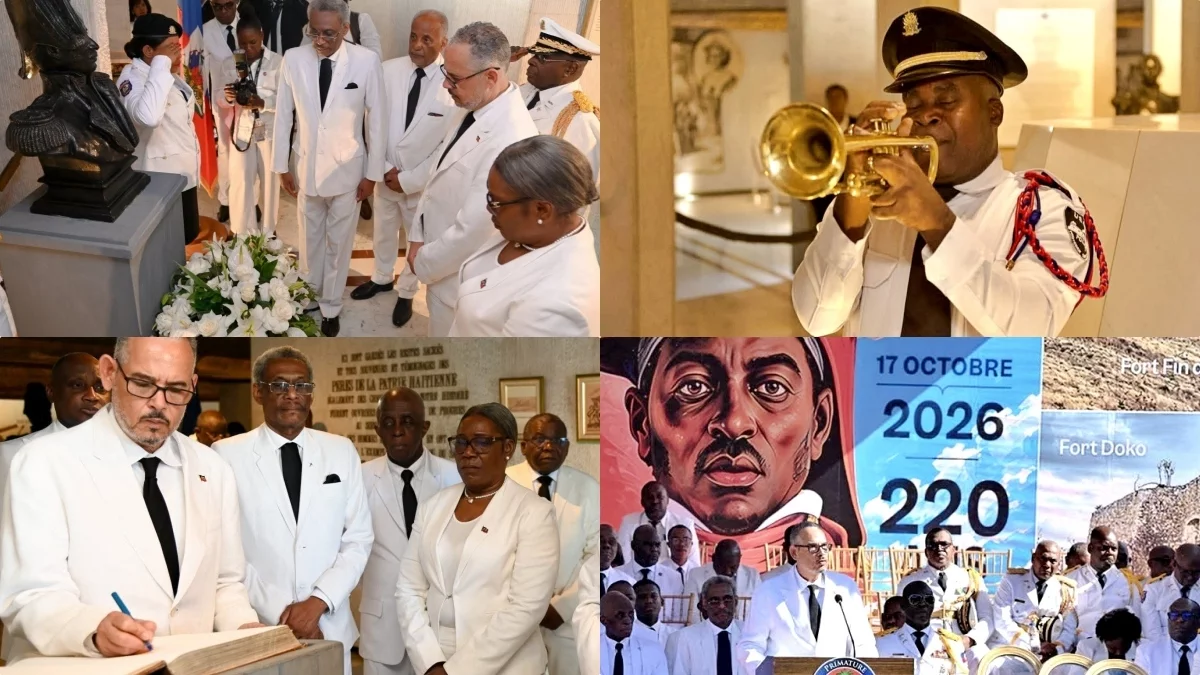
On October 17, 2026, Haiti came together to mark the 220th anniversary of the assassination of Jean-Jacques Dessalines, the revolutionary leader who founded the Haitian nation and declared independence from colonial rule. The official commemoration opened at the Museum of the Haitian National Pantheon (MUPANAH), where Prime Minister Alix Didier Fils-Aimé led senior members of the Haitian government in laying a ceremonial wreath at the foot of the marble bust of Emperor Jacques I, Dessalines’s imperial title.
Following the floral offering, the assembled gathering observed a formal minute of silence, capped by the haunting strains of the Last Post in a solemn tribute to the figure universally revered as the Father of the Haitian Nation. For the full duration of the observance, a reverent hush fell over the site as attendees honored the legacy of a leader who gave his life to secure the freedom and emancipation of Haiti’s people, the first successful mass slave revolt to create an independent nation in the modern world.
After the formal tribute, the government delegation joined a guided tour of MUPANAH’s permanent gallery of historical artifacts and Haitian fine art, which documents Dessalines’s role in the country’s 1804 revolution. Before departing the museum, the Prime Minister signed the institution’s official guestbook, leaving a message reflecting on the meaning of the anniversary: “On this day of remembrance, I bow before the memory of Emperor Jean-Jacques Dessalines, Founding Father of our Nation. Let us honor his sacrifice; it is to keep alive his ideal of liberty, sovereignty, and dignity. Let’s draw from his courage the strength to unite and give every Haitian a nation at peace, proud and strong.”
The commemoration continued with a second official ceremony at Haiti’s National Palace, where Fils-Aimé addressed the nation and issued a urgent call for collective national renewal. Amid ongoing widespread instability across Haiti, the Prime Minister urged a unified national awakening to rebuild the authority of the Haitian state, root out systemic impunity, restore public security across every region of the country, and deliver lasting peace to the Haitian people.
Speaking in Haitian Creole to connect his call to the lived experience of the population, the Prime Minister emphasized: “Onore Dessalines, se pa sèlman fè bèl diskou chak 17 oktòb. Se pran angajman pou fè vizyon l lan vivan epi pote revandikasyon pèp la sou zepòl nou.” Translated, the statement argues that honoring Dessalines requires far more than annual ceremonial speeches: it demands a sustained commitment to keep the leader’s founding vision alive and carry the demands of the Haitian people forward as a collective responsibility. The Prime Minister closed his address by reiterating his commitment to concrete, on-the-ground action that delivers tangible improvements to the daily lives of all Haitian citizens.