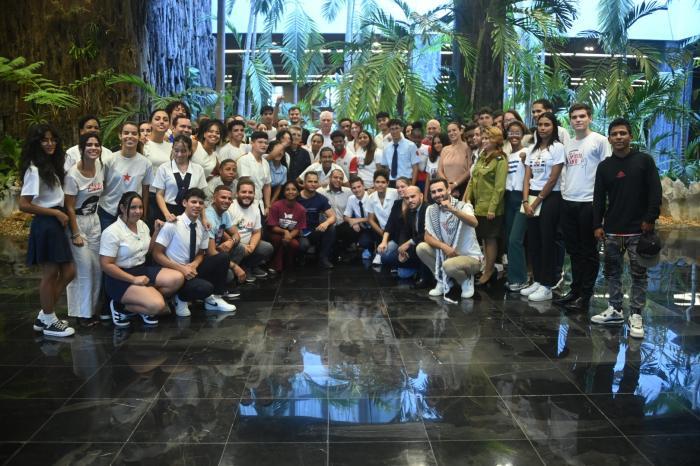
On the morning of Thursday, October 8, a solemn, emotionally charged gathering unfolded in Portocarrero Hall at Cuba’s Palace of the Revolution, bringing together senior Cuban government and party leaders alongside a cross-section of young activists to mark the anniversary of Ernesto “Che” Guevara’s death in combat decades ago.
Opening the intergenerational discussion, Meyvis Estévez Echevarría, First Secretary of the National Committee of the Young Communist League (UJC), framed the event as a commitment to keeping Guevara’s political ideology relevant and alive, in direct opposition to efforts by his opponents to erase his legacy. The gathering was also attended by other senior Cuban officials, including Roberto Morales Ojeda, member of the Political Bureau and Secretary of Organization of the Party’s Central Committee, and Deputy Prime Minister Inés María Chapman Waugh.
Carlos Tablada, a Doctor of Economic Sciences and president of Ruth Casa Editorial, shared insights from decades of rigorous research into Guevara’s economic thought, work first published in the 1980s that reshaped public discourse in Cuba and continues to challenge contemporary society. Addressing the young audience, Tablada urged attendees to embrace a rebellious spirit, reject complacency, and uphold Guevara’s unwavering commitment to ethics, noting that “the day we lose our ethics, we lose everything.” He also highlighted Guevara’s sharp analytical foresight, recalling that the revolutionary had predicted the collapse of the Soviet bloc 25 years before it unfolded.
Doctor of Historical Sciences Daily Sánchez Lemus followed, describing October 8 as a landmark date for national reflection, pointing to widespread tributes held across Cuban schools for each new generation. She emphasized that Cubans carry a historic responsibility to preserve Guevara’s legacy beyond symbolic statues and monuments, particularly as his anti-imperialist values and commitment to constant improvement grow more resonant amid growing geopolitical hostility toward the island. Sánchez also urged young Cubans to continually ask a critical question: In the current hostile global context, what would Che Guevara do?
The meeting’s “Guevarist Voices” segment showcased grassroots work led by young Cubans across the island, proving that Guevara’s legacy of solidarity and resistance remains active in daily life. Attendees heard from Leanet Proenza del Hoyo, lead coordinator of Farma Joven (Young Pharmacy), a UJC-led solidarity initiative that now connects more than 1,000 volunteers via digital platforms to deliver free medication to low-income communities, elderly residents, nursing homes, children’s shelters and maternity facilities, with donations sourced from youth organizations across the globe. Dr. Alejandra de la Cruz Moreno, a recent graduate and Farma Joven coordinator for East Havana, added that the network has expanded beyond regional borders, with 30 young medical volunteers recently supporting work at Centro Habana Pediatric Teaching Hospital, establishing an on-call contingency ready to respond whenever needed.
Other young representatives from the Community Youth Network shared accounts of their ongoing projects, including free meal delivery for children, mobile community cinema screenings, and professional training for social workers. They emphasized that as heirs to Guevara’s legacy, young Cubans maintain a spirit of resistance even amid sustained external pressure, without losing their core compassion for vulnerable communities.
A particularly moving testimony came from a Palestinian orthopedics resident and graduate of the Latin American School of Medicine (ELAM), who hails from the Gaza Strip. He recalled Guevara’s historic visit to Palestine, where the revolutionary recognized the unyielding, un-surrendering spirit of the Palestinian people. He expressed profound gratitude for Cuba’s open-arms welcome to him and hundreds of other Palestinian students, and shared that the Palestinian people have reciprocated that solidarity by donating medication to Cuban hospitals. He closed his remarks by embracing President Díaz-Canel, explaining that the gesture represented an embrace of the entire Cuban people.
Closing the gathering, Cuban President and First Secretary of the Central Committee of the Communist Party of Cuba Miguel Díaz-Canel Bermúdez noted that the tribute takes on special meaning in the centenary year of Fidel Castro Ruz, highlighting the deep principled friendship and mutual admiration between Guevara and Castro. He echoed the core sentiment of the day: “Che Guevara has not died; Che Guevara has multiplied,” noting that the young leaders in attendance are living proof that new generations carry forward Guevarist humanism, which remains the backbone of Cuba’s resilience amid difficult global and domestic challenges.
Díaz-Canel highlighted that Guevara’s legacy of resistance to external dominance is the core of Cuba’s ability to withstand ongoing pressure, noting that the revolutionary’s altruism, austerity, honesty and commitment to giving everything without expectation of reward continue to shape the country’s values. He revisited Guevara’s iconic concept of the “New Man” — a vision championed by Fidel Castro — stating that nurturing this ideal remains critical to building a better world, and that Cuba must continue to embed Guevara’s values into daily national life. “Being like Che is very difficult,” he acknowledged, “but even the aspiration to emulate him brings us much closer to his virtues.”
Reflecting on his own personal connection to Guevara’s legacy in his native Santa Clara, Díaz-Canel recalled the emotional national moment when Guevara’s remains were returned to the province for interment, remembering how even international revolutionary figures like Spanish dancer and communist militant Antonio Gades were overcome with emotion at the mausoleum. Closing his remarks with a distinctly Guevarist message, Díaz-Canel emphasized that Guevara remains present every day in the work of young Cubans across the island, declaring: “the present is a time of struggle; the future is ours.”