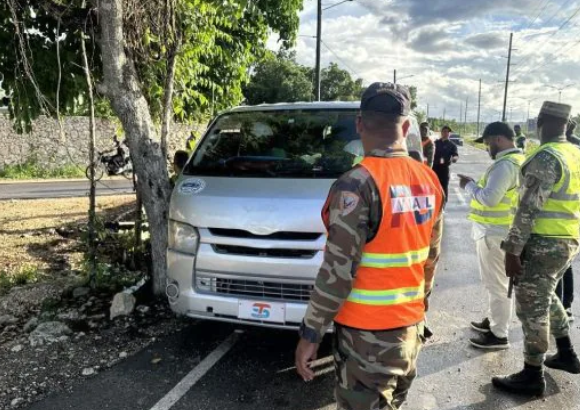
A coordinated law enforcement operation led by three Dominican transportation and security agencies has resulted in the seizure of 19 vehicles in the popular tourist hub of Bávaro-Punta Cana, targeting unregulated transportation linked to irregular migration. The operation, carried out jointly by the National Institute of Transit and Land Transportation (INTRANT), the General Directorate of Transit and Land Transportation Security (DIGESETT), and the Military and Police Commission (COMIPOL), focused on high-traffic locations across Bávaro and the Punta Cana International Airport in the La Altagracia province.
Over the course of the multi-day inspection blitz, authorities detained five passenger vehicles — two buses and three minibuses — operated by two Dominican citizens and three Haitian nationals who are currently in irregular migratory status. These vehicles were found to be actively transporting undocumented Haitian migrants across the region, authorities confirmed. In addition to the migrant-carrying vehicles, nine off-road buggies and four-wheel drive vehicles were also impounded, along with four unlicensed tourist buses that had been operating without the mandatory permits required by INTRANT. The unpermitted tourist buses were also documented creating major operational disruptions at the Punta Cana International Airport, a key entry point for millions of international visitors annually.
All seized vehicles have been transported to INTRANT’s La Conejita Detention Center in Friusa, where they will undergo full inspection before applicable administrative and legal sanctions are applied. INTRANT Executive Director Juan Manuel Méndez García emphasized that the targeted operation is part of a nationwide, long-term initiative to enforce the provisions of Law 63-17, the country’s landmark legislation on mobility, land transportation, transit, and road safety. The operation specifically targeted violations of Articles 44, 74, 321, and 323 of the law, which outline regulatory requirements for all transportation operators across the Dominican Republic. Looking ahead, institutional officials confirmed that similar coordinated inspection operations will be rolled out to additional regions across the country in a push to bring all transportation operators into compliance with national regulations, and crack down on unregulated activity linked to irregular migration.