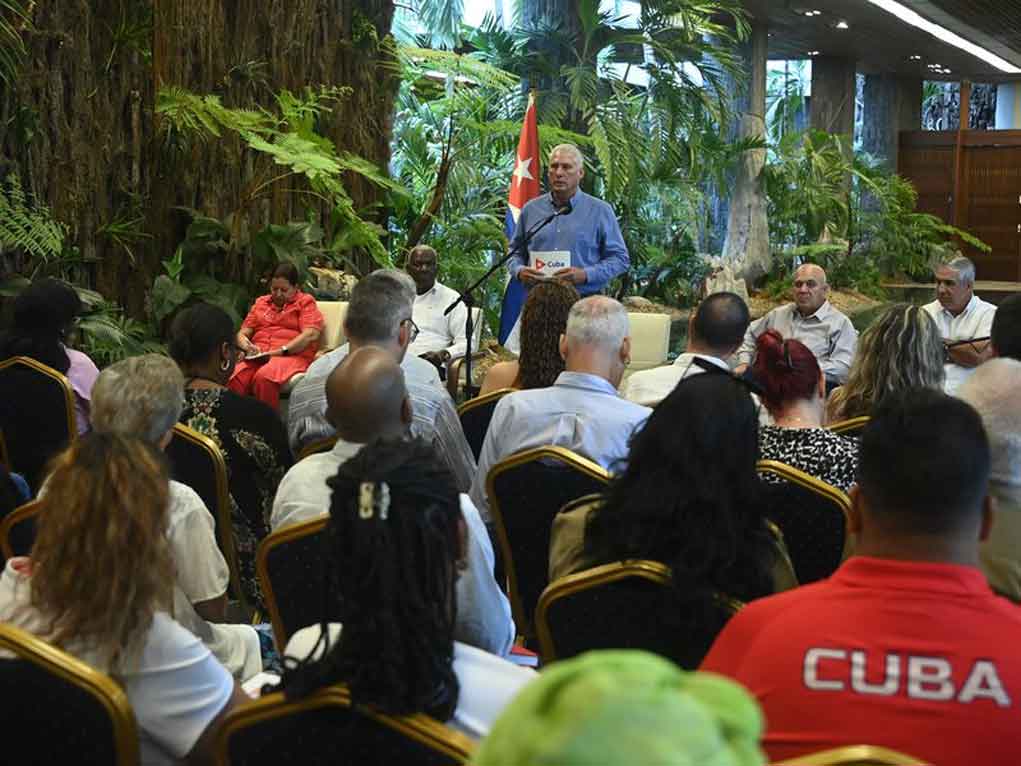
In an official meeting focused on the country’s ongoing development agenda, Cuban President Miguel Díaz-Canel Bermúdez has reaffirmed the Cuban government’s core governing philosophy: that economic expansion holds no genuine value unless it delivers tangible, broad-based improvements to national social development. The official statement of the meeting was published on the presidency’s official website.
In his remarks to participants, Díaz-Canel made clear that the accumulation of national economic wealth is an empty goal without two critical conditions: first, that it actively funds and advances widespread social programs that lift up vulnerable communities, and second, that all generated prosperity is distributed in alignment with the principles of social justice. “For us, it makes no sense to generate economic wealth if it does not impact and support social programs—and, above all, if that wealth is not distributed based on the concept of social justice,” he said.
The president underlined that this unwavering commitment to social justice is what defines the socialist identity of the 176 sweeping economic and social transformation initiatives currently being rolled out across the country. He drew a clear contrast between Cuba’s development model and the free-market shock policies pushed by capitalist systems, noting that these same capitalist governments are the ones responsible for the hostile actions targeting Cuba: including diplomatic attacks, long-standing economic blockades, and a punishing energy embargo that has strained the country’s resources.
Beyond framing the core ideological foundation of Cuba’s current reforms, the meeting also spotlighted two key pillars for successful implementation of these changes. First, participants emphasized that the Cuban people and their local grassroots organizations hold an irreplaceable, central role in rolling out transformation at the community level. Second, the gathering stressed that all economic actors—both entities managed by the state and emerging non-state business operations—share a collective obligation to uphold social responsibility as part of their operations.
Díaz-Canel also detailed the inclusive, bottom-up process that has shaped the current wave of reforms. He explained that the transformation planning process began with extensive consultation with members of the Communist Party of Cuba and the Young Communist League, before expanding out to workplaces and residential communities, where neighborhood organizations have played a fundamental role in shaping priorities and ensuring reforms reflect local needs.