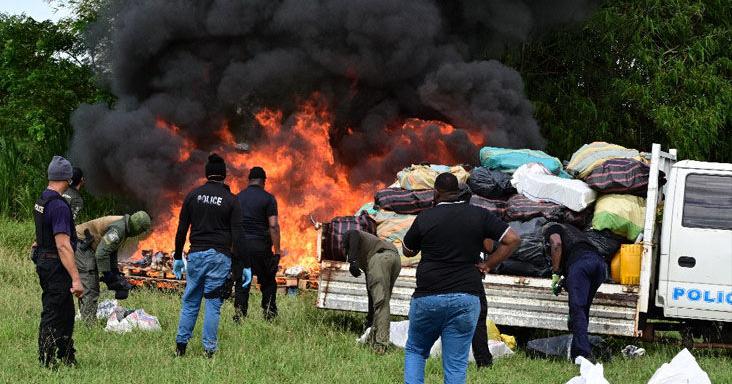
In a high-stakes public display of commitment to combating the transnational and local drug trade, the Trinidad and Tobago Police Service (TTPS) incinerated more than 8.3 tonnes of seized illegal narcotics at the Caroni Cremation Site on Wednesday. The haul, which includes cocaine, marijuana, heroin and a range of illicit synthetic drugs, carries an estimated street value of more than $1.6 billion — a sum equal to roughly 1% of the twin-island nation’s annual gross domestic product.
Prime Minister Kamla Persad-Bissessar, who leads the United National Congress (UNC) administration, hailed the operation in a public social media statement, crediting uniformed personnel for keeping the dangerous cargo off local streets. “These drugs never reached our communities to poison our young people and tear apart families, and that is entirely thanks to the relentless dedication of the brave men and women of our protective services,” she said. The Prime Minister went on to frame the operation as part of a broader, ongoing campaign against local drug trafficking networks, which she claimed were permitted to operate with impunity for a decade under the previous People’s National Movement (PNM) administration. “The era of the local drug mafia gaining unchecked power is over,” she stated, adding that law enforcement is targeting every layer of the trade: not just intercepting physical drug shipments, but also rooting out criminal accomplices embedded in local financial institutions, distribution rings and the public sector, with critical support from international law enforcement partners.
The operation unfolded shortly after 8 a.m., when a convoy of TTPS vehicles escorted two truckloads of contraband to the cremation site. The seized drugs had been collected across Trinidad between 2005 and 2024, with interdictions taking place at Piarco International Airport and across multiple policing divisions including Eastern, North-Eastern, and Southern. Once on site, roughly two dozen officers unloaded the narcotic-filled packages, cut open the bags to publicly display the contraband on pallets ahead of incineration.
TTPS Commissioner Allister Guevarro, who oversaw the event, noted that one shipment of drugs seized by Southern Division officers had not yet arrived when the fire was lit, but he later commended all participating personnel for their meticulous work and strong work ethic spanning every step of the process, from initial arrests to the final destruction of the contraband. To secure the event, the TTPS deployed a surveillance drone to monitor the perimeter and posted multiple armed officers around the site to prevent any unauthorized interference.
Guevarro used the public destruction to address long-standing public skepticism about how seized narcotics are handled by authorities, referencing a widely circulated past incident where missing seized drugs were claimed to have been eaten by rats. “Critics have long spread the narrative that seized drugs get leaked back onto the street instead of being destroyed. Today, the entire world can see these drugs burned to ash — they can’t be resold, and rats certainly didn’t eat them,” he said. He added that when narcotics are held for years as evidence during ongoing legal proceedings, they often deteriorate naturally: cocaine breaks down from solid blocks into fine powder, while marijuana eventually decomposes into dust. The public exercise was explicitly designed to eliminate any doubt about the fate of the seized contraband, he emphasized, reinforcing transparency and accountability in TTPS counter-narcotics operations.
Some of the destroyed narcotics dated back to a 2005 major cocaine bust on Monos Island, where nine men were detained and seven ultimately charged with trafficking, including two Trinidadian nationals, one Antiguan citizen and four Venezuelan citizens. Guevarro explained that the drugs remained in police custody for nearly 20 years as the legal process moved forward, a common timeline for high-stakes trafficking cases. Another large seizure destroyed during the event was a 1,500-kilogram marijuana shipment intercepted last year in the Caroni Swamp, which was cleared for destruction after no suspects were arrested in the case.
Speaking to reporters on site, Minister of Homeland Security Roger Alexander framed the event as an open declaration of war against the drug trade, which he blamed for devastating local communities. “Narcotics are tearing our communities apart, so we are destroying the narcotics before they can destroy us — this is war,” he said. Alexander called on parents to join the national effort, urging them to search their homes and eliminate any drugs they find, blocking contraband from entering households and neighborhoods before it can harm residents. “Every kilogram we destroy today could save millions of young lives. This is a fight that requires action from everyone, not just law enforcement,” he added. When asked how the current UNC administration’s approach to counter-narcotics differs from previous governments, Alexander highlighted unprecedented levels of coordinated support from Trinidad and Tobago’s international law enforcement allies. He also confirmed that all government agencies collaborated immediately to approve use of the Caroni Cremation Site for the destruction, with no bureaucratic delays.
Guevarro pointed to newly released data from the TTPS Crime and Problem Analysis Branch (CAPA) showing that cocaine seizures rose significantly between 2024 and 2025, while marijuana seizures have stayed relatively stable. He argued that the uptick in seizures is not a sign of more drugs entering the country, but proof that police operations are growing more effective at intercepting contraband before it reaches local communities. “When we seize more drugs, that means our operations are successfully pulling more poison off our streets — that is a win for public safety,” he said. He added that a large shipment of cocaine recently seized by the Trinidad and Tobago Coast Guard in a successful interdiction will be destroyed in a future public operation, noting that rising seizure counts are a promising sign that the national anti-drug strategy is delivering results.