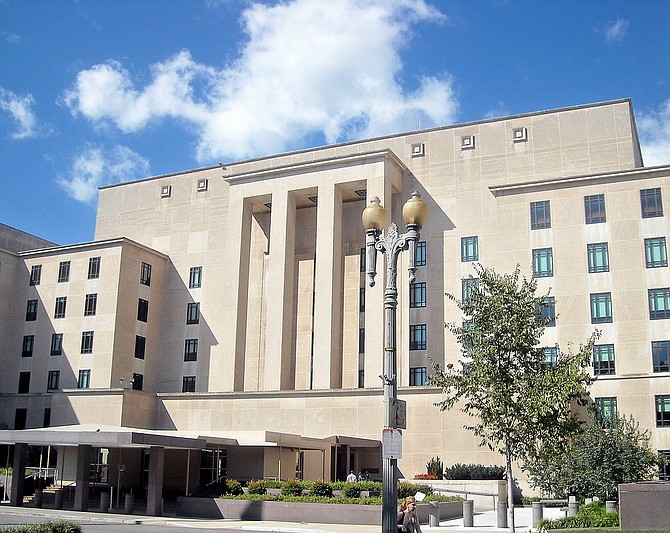
In its 2026 annual investment climate statement, the Trump administration’s State Department has issued a stark assessment of The Bahamas, warning that a string of high-profile corruption, fraud, and drug trafficking cases involving former politicians, elite society figures, and senior security forces personnel underscore deep-seated governance and rule of law failures that are harming the country’s investment appeal.
The report, which expands its dedicated section on corruption this year, references a series of active court proceedings on both sides of the US-Bahamas border, alongside recent convictions and guilty pleas, to illustrate the persistent threat of public sector graft. While the document does not name the individuals involved directly, the details align closely with public cases tracked by The Tribune.
One confirmed case cited involves Sonny Miller, a former assistant police superintendent, ex-leader of the Police Staff Association, and the highest-ranking law enforcement officer on Acklins. Miller was sentenced to six years in prison in February 2026 for smuggling operations involving $1.4 million worth of cocaine and $34,000 worth of marijuana. Another high-profile matter referenced is that of Elliott Lockhart KC, a former Supreme Court justice and Exuma member of parliament, who faces US arrest and asset forfeiture proceedings over allegations he misappropriated $3.6 million in client funds. Lockhart denies all charges.
The report also calls out Michael Johnson, former head of the Royal Bahamas Police Force’s criminal investigation department, who faces bribery charges tied to an armored car robbery, and Lanisha Rolle, a former Bahamian Cabinet minister, who is fighting $750,000 fraud charges in domestic courts. Two additional security force figures are named: Chief Superintendent Elvis Nathaniel Curtis, former head of The Bahamas’ airport police, and Darrin Roker, a chief petty officer with the Royal Bahamas Defence Force, both of whom are involved in New York-based drug trafficking proceedings. Roker has already accepted a plea deal and received a four-year prison sentence.
The final case highlighted is that of Adrian Gibson, former executive chairman of the Water & Sewerage Corporation and former Long Island MP, who faces 41 remaining charges including false declaration, conspiracy to commit bribery, bribery, and money laundering after prosecutors dropped 18 earlier counts. Gibson, like all other defendants except Miller and Roker, denies all allegations and is contesting the charges in ongoing proceedings.
Beyond individual criminal cases, the report flags a growing passport fraud crisis in The Bahamas. As of early 2026, investigations have uncovered nearly 100 suspected cases involving falsified documents, sham marriages, and fraudulent citizenship applications, with dozens of arrests already made. Internal reviews have also raised red flags over potential insider complicity within government offices, prompting Bahamian authorities to implement new policy reforms to strengthen verification rules and close vulnerabilities in the passport issuance process.
The timing of the report’s release has already added new strain to already tense US-Bahamas relations. In recent weeks, the Bahamian government has formally filed a complaint with US authorities over allegations that Drug Enforcement Administration (DEA) agents have been operating illegally on Bahamian soil. Those accusations stem from court filings in a US federal drug investigation linked to Jonathan Eric “Player” Gardiner, who was taken into US custody after being rescued from a plane crash on the 2025 Bahamian general election day and faces multiple drug charges. The DEA probe is also tied to the indictments of Curtis, Roker, and other co-defendants, making the State Department’s critical report particularly contentious.
A core criticism leveled by the US is that while The Bahamas has passed multiple anti-corruption laws on paper, the government has failed to follow through with the necessary regulatory frameworks, funding, and enforcement to make them effective. The most prominent example cited is the Public Disclosure Act, which requires all members of parliament, senators, and senior public officials to file annual public declarations of their net worth, assets, income, and liabilities. The report notes that the last time these disclosures were legally published was 2011, and that publication only covered declarations submitted up to 2008 – leaving a 15-year gap in required transparency that remains unresolved today. The report calls this gap one of the most critical weaknesses in The Bahamas’ accountability framework, though it acknowledges that modernization efforts for the filing and publication system are underway.
Similar unimplemented reforms are called out across other anti-corruption measures. The body tasked with overseeing the Independent Commission of Investigations Act, which is designed to probe misconduct by public officials and security forces, is not expected to become operational for several more years. While the Bahamian government has passed new Ombudsman legislation, it had not been activated as of early 2026 due to a lack of funding. Legislation to create an Integrity Commission and implement campaign finance reform remains pending in parliament, and campaign financing overall remains largely unregulated, with no meaningful safeguards against quid pro quo donations or foreign influence.
Local non-governmental organizations that investigate corruption also lack specific legal protections, the report says, further weakening civilian oversight. US businesses operating in The Bahamas have repeatedly identified corruption as a major barrier to foreign direct investment, the report adds, with widespread reports of graft in government procurement and the FDI approval process, though no specific examples are provided.
The report also notes that the Bahamian Freedom of Information Act has been only partially implemented and remains under-resourced, with just $140,000 allocated to the agency in the 2025-2026 national budget. It references comments made by Prime Minister Philip Davis KC in June 2025, when he called full implementation of the act “not a priority” amid more pressing cost of living challenges. However, the report omits the Bahamian government’s recent steps to advance the law: just this week, retired justice Donna Newton was named information commissioner, and the government has released long-awaited implementing regulations for public comment after a nine-year delay.
In its concluding assessment, the report acknowledges that Bahamian law does include criminal penalties for corruption – including fines up to $10,000, four years’ imprisonment, or both for bribing a public official – but notes that enforcement remains inconsistent, especially when it comes to senior public figures. “There continues to be a pressing need for stronger enforcement mechanisms to prevent conflicts of interest, especially in the awarding of government contracts, which are often alleged to favour political supporters,” the report says. Recent early 2026 reporting has reinforced these concerns, it adds, finding that a substantial share of government contracts awarded between 2023 and 2025 – totaling hundreds of millions of dollars in public spending – were awarded through no-bid, non-competitive processes. Critics argue that overreliance on these exemptions creates significant risks of favouritism, reduced market competition, and weakened public accountability, the report notes.