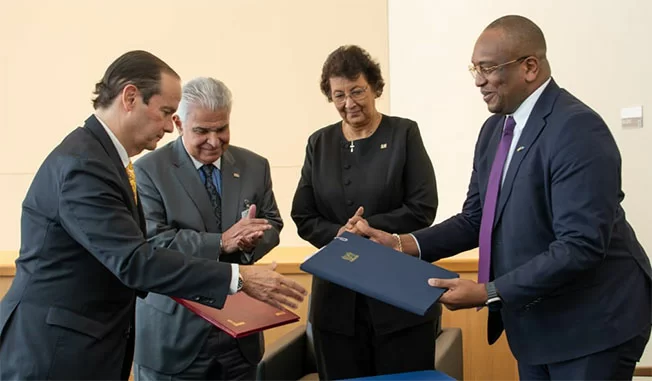
On the sidelines of the 81st United Nations General Assembly in New York, Suriname President Jennifer Simons and her Panamanian counterpart José Raúl Mulino Quintero held a high-level meeting to advance bilateral relations between the two Caribbean and Central American nations, agreeing to a sweeping agenda of cooperation covering travel facilitation, political dialogue, climate action and economic integration.
Following the discussions, the foreign ministers of both countries formalized one key agreement by signing a Memorandum of Understanding that establishes a permanent structured political consultation mechanism. This new framework will create a regular channel for Suriname and Panama to align their positions on bilateral, regional and multilateral issues, laying a solid institutional foundation for long-term engagement.
Travel liberalization emerged as a top priority on the meeting’s agenda. Suriname has already completed all domestic parliamentary procedures for a visa waiver agreement for holders of diplomatic and service passports, and leaders are working to finalize remaining formalities to extend visa-free access to all ordinary national passport holders from both countries. The ultimate goal of this reform is to remove longstanding barriers to cross-border movement, making travel far more accessible for ordinary citizens of both nations.
Another key topic of discussion was the strategic value of the air route connecting Suriname’s capital Paramaribo and Panama’s capital Panama City. President Simons noted that this connection is far more than a commercial air corridor; it serves as a critical gateway for Suriname to access other markets across North, Central and South America. Suriname aims to leverage this route more effectively to grow bilateral trade, boost tourism, attract foreign investment, expand cargo operations and deepen business-to-business connections between the two countries. Simons added that Panama’s unique position as a global logistics and commercial hub makes it an ideal strategic platform for Suriname to expand its economic and political outreach across Central America and the wider Latin American region.
Climate change cooperation was also a central focus of the talks, as both nations share a unique status as part of a small global group of carbon-negative countries. Currently, Suriname and Panama collaborate on climate action within the G-Zero Alliance alongside Bhutan and Madagascar. Simons called for the alliance to move forward by setting clearer collective priorities and expanding membership to include other like-minded nations committed to ambitious climate action.
“We need to take the next step: identifying our shared priorities within the G-Zero Alliance, reaching out to like-minded partners across all regions to support this initiative, and deliver tangible outcomes,” Simons stated. Beyond internal alliance coordination, Suriname views this partnership as a platform to advocate for a more equitable global climate finance system, one that gives developing nations greater flexibility to pursue economic development while upholding their climate and environmental responsibilities.
Closing the meeting, Simons emphasized that the two nations now have a historic opportunity to translate their already positive diplomatic relations into tangible benefits for their populations. “We currently have the chance to convert our excellent bilateral relations into greater connectivity, stronger trade and investment flows, closer political dialogue, and practical cooperation that delivers real results for our people,” she said, confirming her commitment to working closely with President Mulino to continue deepening the bilateral partnership between Suriname and Panama.