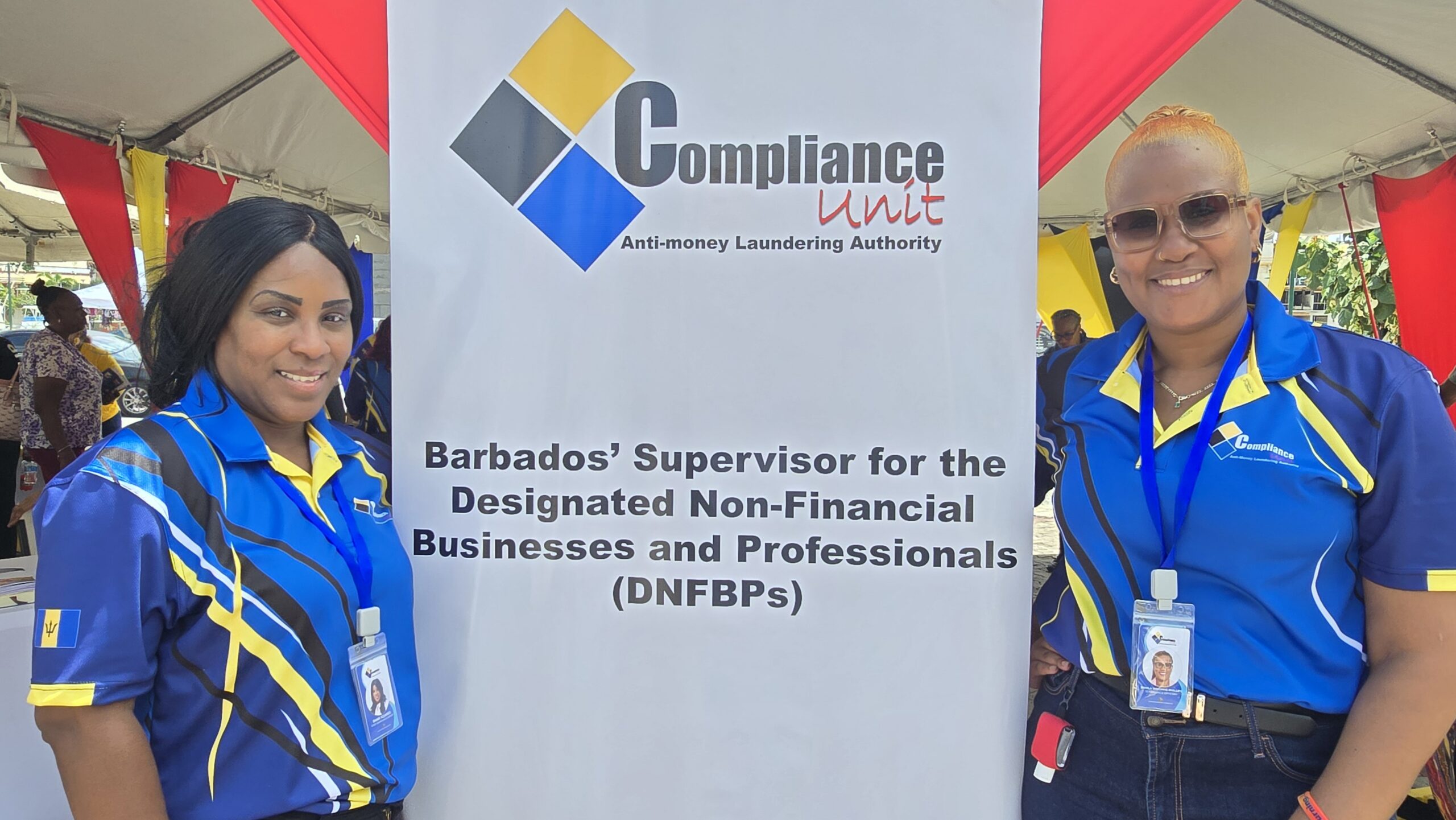
Five years after its official launch, Barbados’ dedicated compliance unit under the national Anti-Money Laundering Authority has marked steady progress in bringing regulated businesses into line with anti-money laundering (AML) protocols — but officials are now warning that persistent non-compliance will no longer go unpunished.
Compliance Officer Jamila Williams-Phillips shared the update during the unit’s first public open day, hosted Friday at National Heroes Square to coincide with the upcoming Compliance Officer Day on Saturday. Speaking on the unit’s enforcement strategy, she confirmed that no regulated businesses have faced financial or regulatory penalties to date, as the body has prioritized a warning-first approach that has delivered strong results. A standard warning letter clearly outlines the potential sanctions and losses a business faces if it fails to address documented deficiencies, and Williams-Phillips noted that this nudge is almost always enough to push entities to complete required remediation work.
“So far, we have not had to penalise any person like that, but going forward, if it is that businesses are not responsive, we will be implementing that process,” she told reporters.
To date, responses from regulated businesses to official warnings and requests for updates have been overwhelmingly positive. The highest concentration of non-compliance issues has been found among real estate agents and legal professionals, Williams-Phillips explained, a trend that simply reflects the size of these two sectors within the unit’s remit. The body oversees Designated Non-Financial Businesses and Professions (DNFBPs), a category that also includes accountants and dealers in precious metals and stones, and real estate and legal services make up the largest share of registered entities.
The unit’s compliance process begins with sending detailed questionnaires to all supervised businesses, after which internal teams conduct risk assessments of submitted responses. Based on those risk scores, businesses are then selected for either on-site inspections or desk-based reviews. Any gaps or deficiencies uncovered during these reviews are documented in an official report, after which the unit’s monitoring team collaborates with the business to develop a tailored corrective action plan. After the business completes the outlined steps, the unit schedules a follow-up review to confirm that changes are actually implemented, not just promised on paper.
“ We follow up to ensure that you didn’t just say [you’re complying] to get us out of your face, that you’re literally doing these things correctly, ” Williams-Phillips said.
Established at the end of 2019 and launched for operations in 2020, the unit has overseen clear cultural shift in how regulated businesses approach AML compliance, according to Williams-Phillips. In the early days of the unit’s work, many businesses failed to recognize money laundering as a relevant risk to their operations. For example, common lapses included processing transactions on behalf of un identified third parties, allowing illicit funds to enter Barbados’ financial system undetected.
Today, businesses are far more receptive to compliance requirements, Williams-Phillips reported, and many firms inspected this year already had partial compliance frameworks in place, even if they still required adjustments to meet full regulatory standards. “ So it’s becoming easier as the years go on now that they’re more aware, ” she said. The unit has worked systematically to embed core AML practices across regulated sectors, including repeated training on mandatory know-your-customer protocols, full identity verification requirements, and standardized customer due diligence processes.
To sustain this progress, the unit holds annual mandatory training sessions for all four DNFB P sectors. The upcoming 2024 training session is scheduled for October 1 and 2 at the Wyndham Grand Barbados, and all 150 available spots are nearly filled. Williams-Phillips emphasized that the training is not just a procedural formality, but a hands-on opportunity to update firms on evolving regulatory requirements. She also clarified a key point about regulatory roles: suspicious transaction reports (STRs) are never sent to the compliance unit, and are instead filed directly to the Financial Intelligence Unit (FIU), which handles all analysis of potential illicit activity. The compliance unit does not take part in STR investigations as a regulator, she said.
Chief Compliance Officer Shari Squires explained that Friday’s open day — the unit’s second overall, but first open to the general public — was designed to demystify the unit’s work for ordinary Barbadians. The event featured distribution of “Know Compliance” informational flyers, alongside complementary health checks, interactive photo booths, and educational games about AML regulation. A broader public outreach campaign is running through September and October, including a weekly segment on the local Mornin’ Barbados television program that breaks down AML requirements sector by sector.
The coming month will also focus on public education around two key updates: new AML legislation that passed the House of Assembly last week and cleared the Senate this week, and a new streamlined registration system for all DNFBPs.
Squire used the open day to send a message to the general public: when a legal professional or real estate agent requests photo ID, proof of address, or documentation to confirm the source of funds, clients should not hesitate or feel inconvenienced. These requests are not arbitrary — they are required by law, and they play a critical role in protecting Barbados’ financial system. “ By your providing information to what we call the gatekeepers, the attorneys, real estate agents, to those entities, that is helping us to protect Barbados from any money laundering activities happening in our financial system, ” she said.