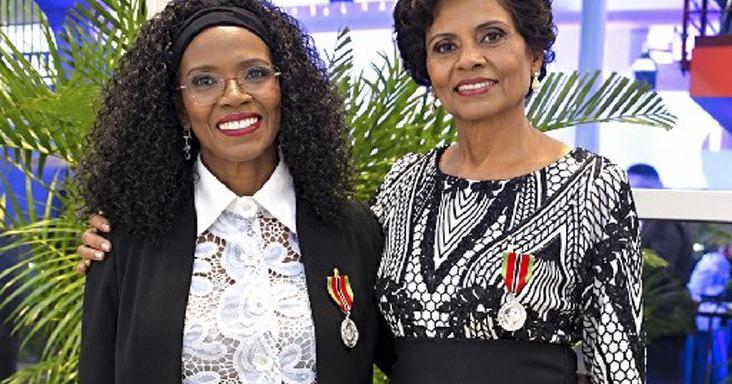
On Trinidad and Tobago’s Republic Day, two iconic, long-serving journalists from the Trinidad Express took home one of the nation’s highest honors, the Chaconia Medal (Silver), in recognition of their transformative contributions to local journalism over more than four decades of work.
Omatie Lyder, who retired as the newspaper’s editor-in-chief in February after 43 years at the outlet—15 of which she spent leading the newsroom—now serves as a consulting editor for the Express. Her award citation highlights two key pillars of her career: her steady, visionary leadership of the newsroom and her lifelong commitment to mentoring dozens of emerging journalists who have gone on to shape Trinidad and Tobago’s media landscape.
Accepting the award, Lyder shared that she received the national honor with profound gratitude and humility. She emphasized that for her entire career, the work of journalism itself, rooted in serving the public good, has always been its own greatest reward. “Journalism, at its best, is a public service—and for 43 years, it has been my privilege to serve,” Lyder said. She framed the medal not just as a personal honor, but as a broader recognition of the critical role that independent, ethical journalism plays in democratic society, and a tribute to all professionals who have dedicated their careers to the craft.
Lyder also extended warm congratulations to her long-time colleague Ria Taitt, who shared the award with her, praising Taitt’s decades of rigorous work in political reporting. “Ria has brought a wealth of experience and knowledge to political and parliamentary reporting, and her work has made an important contribution to our understanding of public affairs. I am delighted to share this honour with her,” she said.
Reflecting on her career path, Lyder paid tribute to the mentors and leaders who shaped her journey, including former editors Owen Baptiste, Keith Smith, Lennox Grant, and Sunity Maharaj, as well as former chief executives Kenneth Gordon, Shida Bolai, the late Craig Reynald, and Dawn Thomas—who ultimately appointed her as editor-in-chief. “Their support and trust gave me the opportunity to grow, to lead and, most importantly, to serve,” she noted.
Lyder used the occasion of the award to address a generation of journalists currently working in traditional media, an industry facing unprecedented economic, technological, and cultural disruption. “To the journalists in traditional media who are facing immense challenges as they strive to keep our legacy alive, I say: hold your heads high,” she said. She urged current reporters and editors to remain unflinching in their commitment to the public interest, unafraid to ask hard questions and hold power to account, and unwavering in upholding core professional standards: accuracy, fairness, independence, integrity, and courage. She reminded the community that while digital evolution has transformed platforms, business models, and industry challenges, the public’s need for credible, responsible journalism has not shifted.
Ria Taitt, the Express’ former political editor, also shared her gratitude for the national honor after 42 years at the outlet. Taitt joined the Express straight out of university in September 1984, and went on to cover 11 general elections, spending roughly 20 years in the role of political editor before retiring in March. Calling her decades-long journalism career “a gift of continuous education,” Taitt noted that her work gave her unprecedented insight into every layer of Trinidad and Tobago’s society, from the intricacies of the national constitution and parliamentary process to the shifting political perspectives of communities across the country. “Most importantly, journalism has provided me with the distinct advantage of interacting with people at all levels in this society,” she said.
Like Lyder, Taitt paid tribute to the mentors who supported her early career, starting with Owen Baptiste, who hired her as a feature writer in 1984 and took a chance on the young newcomer by moving her to political reporting just a year later. “OB, as he was affectionately called, was understanding and tolerant as I navigated the steep learning curve, sometimes making mistakes. But he never lost faith in me,” she recalled. She also credited former Sunday editor Raoul Pantin for giving her creative space to grow early on, and for introducing her to local theatre—an interest that eventually led her to earn a regional acting award. Former news editor Leonard Robertson also played a key role, she said, bringing enthusiasm and joy to the demanding work of political reporting that shaped her approach to the job.
Taitt also offered high praise for Lyder’s leadership during their decades working together, calling her former editor-in-chief a steady, courageous voice amid the chaos of a daily newsroom. “Omatie has always been a steady hand and a calm and sober voice amidst the hurly-burly of the newsroom, providing exceptional leadership that is both wise and courageous,” Taitt said.
Reflecting on the realities of the profession, Taitt acknowledged that journalism is often high-pressure and demanding, but said the rewards far outweigh the challenges. “The life of a journalist is pressure-filled. But it also has its rewards—namely, the opportunity to contribute to public awareness, understanding and accountability, while affording one the benefit of lifelong learning,” she said. “It is therefore with deepest respect and love for the profession that I accept this award.”