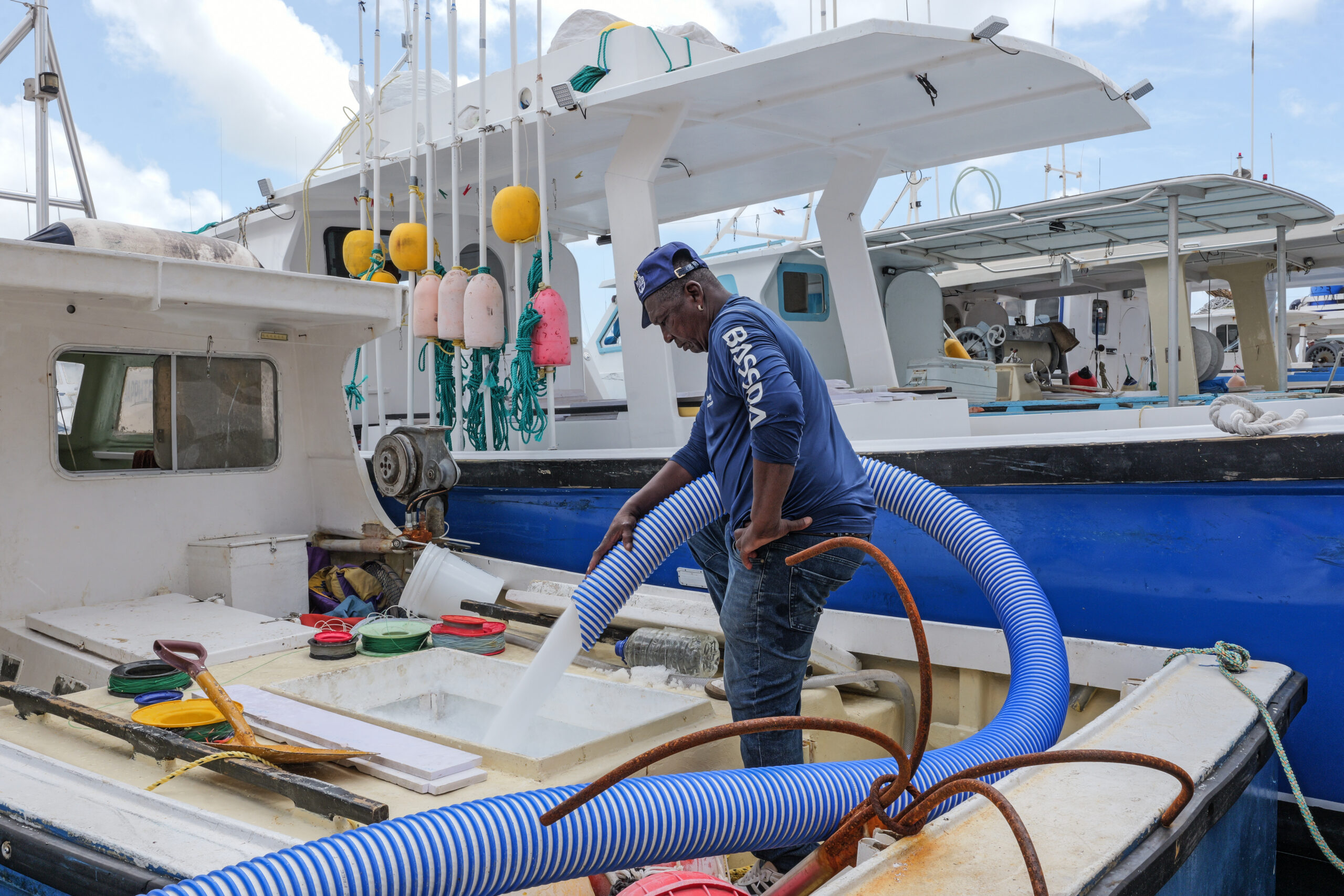
Barbadian fisheries authorities are on track to restore full functionality to the decades-old ice machine at the Bridgetown Fisheries Complex within the next 48 to 72 hours, according to senior government officials, who have also outlined a long-term plan to fully replace the ageing infrastructure with a new high-capacity unit funded through an international development initiative.
Deputy Prime Minister and Minister of Fisheries Santia Bradshaw shared the update Wednesday during a scheduled tour of several island markets, including the Millie Ifill market at Weston, Paynes Bay Market, the Berinda Cox market at Oistins, Speightstown Market and Half Moon Fort Market. During the tour, Bradshaw spoke with reporters about the dual challenges the government faces: advancing large-scale national development projects while addressing urgent day-to-day maintenance issues that directly impact the livelihoods of local fisherfolk. Among these ongoing challenges, the repeated breakdown of the 40-plus-year-old ice machine at the Bridgetown Complex has emerged as the most pressing concern for fishing operators.
“This equipment at the Bridgetown location is more than 40 years old, and it breaks down with increasing frequency,” Bradshaw explained. “We have been forced to carry out constant emergency repairs just to keep it running. We previously announced our intention to replace core components of the system to get it working reliably, but the advanced age of the entire infrastructure has created ongoing issues even after a new compressor was installed.”
To address the current crisis, Bradshaw said the government has taken two key steps: expanding the in-house technical maintenance team and contracting a private engineering firm to carry out urgent repairs. Many of the veteran technicians who long maintained the Bridgetown Fisheries Complex have retired or passed away in recent years, including a long-serving staff member, Mr. Boyce, who died just recently. That left gaps in on-site capacity that officials have moved quickly to fill, before bringing in Click Engineering to lead the complex repair work.
Jason Best, Managing Director of Click Engineering, walked reporters through the scope of the repair work on the ice machine’s two independent systems. “The first system had low oil pressure caused by a mismatch between the new compressor and the original 40-year-old piping. All the small internal orifices kept getting clogged with debris, so we carried out an extensive full oil change and replaced all filters and strainers. We got that first system up and running yesterday, and it is operating normally as of now,” Best said.
The second system presented more complicated challenges, he added. After the compressor was rebuilt, technicians found major leaks in the core shut-off valves. Teams attempted to reseat the old valves to fix the leaks, but the age of the components made that solution unworkable. “Right now, we are in the process of replacing those damaged valves,” Best said. “We have welders on site to install the new components, which should take another one to two days. Once that work is complete, we will recommission the system, and we expect it to be fully operational within another two days.”
Bradshaw noted that while emergency repairs will resolve the immediate shortage, the government has been working for several months to secure a full replacement of the outdated machinery. The process requires first finalizing technical specifications for the new unit and securing dedicated funding before procurement can begin. Officials are also conducting a full audit of all existing equipment at the complex — from processing rakes to weighing scales — to ensure that all on-site infrastructure works reliably once the new ice machine is installed.
To mitigate disruption for fisherfolk while repairs are ongoing, Bradshaw said the government has already established formal backup arrangements with two private ice producers, Wolverine and Glacier Ice, to supply ice to fishing operations. The temporary arrangement does require fisherfolk to coordinate transport of ice to their vessels, which is less convenient than accessing ice directly on site, but additional support is available to ease the process.
Michelle Wiggins, Acting Manager of the Bridgetown Fisheries Market, confirmed the machine has been out of service for three weeks, and outlined the coordination process for fisherfolk needing ice. Operators can send requests via a dedicated WhatsApp account to her or the on-duty officer, who will arrange for supply. Fisherfolk also have the option to place orders directly with Wolverine for delivery to their boats. The government has also deployed Community Vacation (CV) workers from the Ministry of Fisheries to assist with loading ice onto vessels, so fisherfolk only need to confirm their timing and quantity to access support. For orders through Glacier Ice, the Fisheries Division takes care of placing the order and covering the cost of transport to the complex, Wiggins added. As of this week, four of the 15 registered boats that regularly require ice have confirmed their needs and delivery dates, with two more expected to submit requests shortly.
Looking ahead to the permanent solution, Acting Chief Fisheries Officer Christopher Parker revealed that the government is already in the process of acquiring a 40-foot containerised ice machine, funded by the government of Japan and managed through the United Nations Development Programme (UNDP) as part of the national Coastal Resilience Project. The new unit will be installed at the Bridgetown Fisheries Complex, and officials are currently exploring whether the project’s budget can accommodate a second unit for the Oistins facility, though that additional purchase has not been finalized.
The new containerised machine will have the capacity to produce up to 20 tonnes of ice per day, Parker said. It will supplement existing ice supply and act as a reliable fail-safe to prevent future disruptions to ice access for vendors and fishing vessels operating out of Bridgetown.