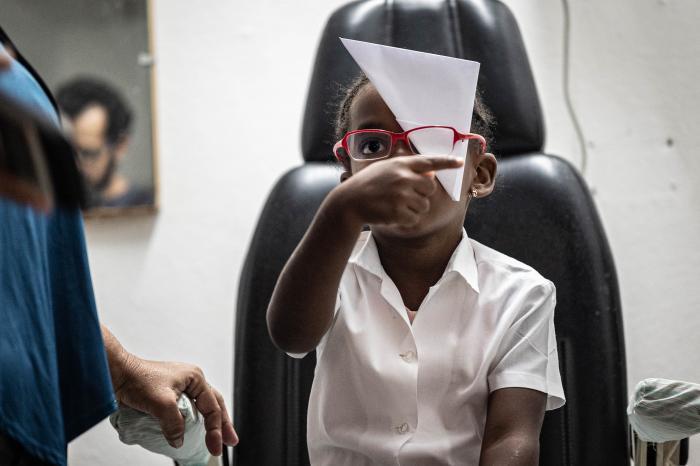
On a dim Monday morning just after 10 a.m., soft chatter echoes through the halls of Flor de la Revolución, Cuba’s leading special education school for young children with visual impairments. Inside a classroom, a teacher sits cross-legged on the floor surrounded by six young students, each at different stages of vision impairment: some wear thick corrective lenses, others have one eye covered in therapeutic gauze, and all wait for next steps in care that remain out of reach for too many.
This morning, the power is working, but that is never a guarantee. When outages hit, the naturally dim indoor light is insufficient for children with limited vision, so lessons are moved outdoors to the school courtyard, where sunlight offers just enough visibility to continue learning.
Standing barely a meter tall, a young boy in thick blue glasses can barely make out the shapes of letters and numbers on a page, yet he speaks enthusiastically of the sun, the moon, and the world he hopes to explore. He is one of more than 80 students at the school who need annual replacement of their corrective glasses — a basic need the institution cannot meet due to the long-standing economic blockade against Cuba. The full cost of these essential vision devices now falls directly on already stretched family budgets, forcing parents to source them at exorbitant prices from international sellers.
Founded specifically to serve visually impaired children across six municipalities of Cuba’s capital, Flor de la Revolución does more than deliver standard primary education. Its core mission is to integrate corrective vision therapy into every activity, with the goal of helping children improve their sight enough to transition into mainstream public schools. Serving students aged 3 to 9, the school has adapted its curriculum to smooth this transition: this academic year, students attend in-person classes at the special school Monday through Thursday, then spend Fridays at their local neighborhood primary schools to build familiarity with mainstream learning environments.
When critical commercial and medical resources became unavailable due to external constraints, the school’s teaching staff stepped in to craft their own learning and therapeutic materials from whatever limited supplies they could source. What once was exclusively done in a fully equipped on-site ophthalmology clinic now happens daily in regular classrooms. Children cut, tear, lace, and color with thick, bold primary-colored crafts designed to strengthen and focus their vision — turning simple play into life-changing therapy.
Today, the original diagnostic ophthalmology equipment is obsolete. Chronic resource shortages, worsened by the blockade, have left the school without stable electricity, basic medical supplies, adhesive tape, gauze, and even the pupil-dilating drops required for routine eye checks, affecting all 230 children enrolled at the institution. Before the COVID-19 pandemic, local polyclinics often provided supplies and specialist care for occlusion therapy that helps rehabilitate underdeveloped eyes, and on-site staff could repair broken glasses quickly. But in the years since, ongoing blockade restrictions have erased that support. Even when generous families donate what they can, the school cannot sustain consistent, high-quality rehabilitative and educational services.
Yet staff and families refuse to surrender to the shortages. “At Flor de la Revolución, we have broken down every barrier,” says primary school teacher Yanisel Santana. “Teachers strive every day to ensure our children receive instruction, that their psychological development stays on track, and that they are fully prepared to face new challenges when they move to mainstream primary school.”
Out in the courtyard, where student buses often fail to arrive due to national fuel shortages, two mothers wait to pick up their children. Yunelis León, mother of student Vanessa, says: “We face so many challenges in keeping their education going. But we’ve managed to move forward with limited resources. My daughter is very happy here.” When fuel shortages completely halt bus service, the school adapts: staff create WhatsApp groups for each class, send home customized therapy and learning activities for families to complete, and review the work once service resumes.
Shortages even touch the school kitchen, where staff now cook all meals over an open wood fire — a far cry from commercial kitchen infrastructure, but one that the team has mastered to feed 230 students and 48 staff members every day. Despite the extra work, breakfast and lunch are always served on time. Because as the school’s leadership puts it, one thing can never be blockaded: the unbreakable determination of a team that has learned to create light for its children with its own two hands.
Summing up the school’s shared hope, the staff says: “Ideally, we would have all the resources needed so that our children wouldn’t face so many difficulties in life. There would be more time for teaching — time for teachers to prepare and for students to be even more joyful than they already are. Despite the challenges, we always welcome them with a smile. There is nothing more beautiful than that.”