New data from the Central Bank of the Dominican Republic (BCRD) reveals steady expansion of the country’s labor market in the second quarter of 2026, with key structural improvements showing progress in formalizing work opportunities across the economy. Data collected through the National Continuous Labor Force Survey (ENCFT), the country’s authoritative quarterly labor market tracking survey, puts total employed workers across the Dominican economy at 5,271,005 for the April-June period. This marks a 2.9% year-on-year increase, representing 147,456 net new jobs created compared to the same quarter in 2025.
Two core labor market metrics, the employment rate (ER) and overall participation rate (OPR), landed at 63.2% and 66.8% respectively. Both figures remain near the survey’s historical highs, signaling that the Dominican economy is currently maintaining a high rate of workforce utilization.
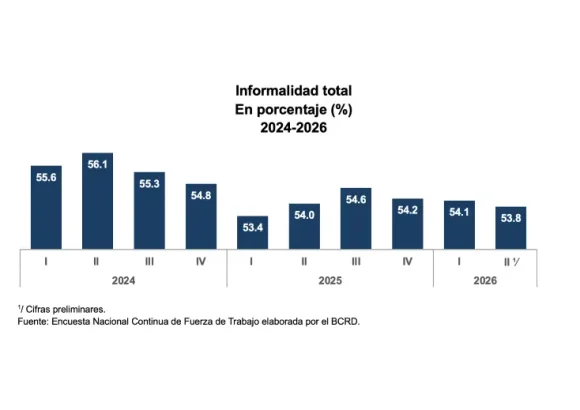
A breakdown of new job creation shows nearly even contributions from the formal and informal sectors over the 12-month period. Formal employment added 74,794 net new workers, accounting for 50.7% of total net job growth, while informal employment contributed the remaining 72,663 positions, or 49.3% of the overall increase. This balanced growth has pulled the national informality rate down to 53.8% in Q2 2026, which is 2.9 percentage points below the 56.7% historical average recorded across the ENCFT survey series dating back to 2014.
The BCRD notes that the ENCFT is a rigorously designed probabilistic sampling survey, built to generate nationally representative and regionally disaggregated data on working-age adults’ engagement with the labor market, while also serving as a key data source for tracking national monetary poverty trends. The survey collects continuous data from a quarterly sample of 8,480 households across the country’s four major regions: Ozama (Metropolitan), North (Cibao), South, and East, with a 90% confidence level for all core labor indicator estimates.
Demographic analysis of the current employed population shows 57% of workers are men and 43% are women. Notably, women accounted for the vast majority of net new job creation over the past year, taking 127,472 new positions, which represents 86.6% of all net jobs added between Q2 2025 and Q2 2026. Men contributed 19,714 net new jobs over the same period.
On the unemployment side, the open unemployment rate – defined as the share of the active labor force actively searching for work – hit 5.3% in Q2 2026, a small 0.3 percentage point increase from the 5% recorded in the same quarter of 2025. The broader labor force underutilization rate SU3, a metric that includes both unemployed job seekers and workers available for work who are not actively searching (formerly called the expanded unemployment rate), also rose by 0.3 percentage points year-on-year to 8.7%.
Analysis of labor market transition dynamics between Q2 2025 and Q2 2026 shows high stability for currently employed workers: 92.6% of people holding jobs in the second quarter of 2025 remained employed one year later. 5.9% of employed workers left the labor force to become economically inactive, while just 1.5% transitioned from employment to unemployment over the 12-month period.
For unemployed workers, 44% successfully transitioned into paid employment within a year, 28.3% remained unemployed, and 27.7% exited the labor force to become inactive. Among the economically inactive population (people outside of the labor force), 81.3% retained their inactive status over the 12-month period, 15.9% transitioned directly into employment, and 2.8% began actively searching for work, driving small growth in the overall size of the country’s active labor force.