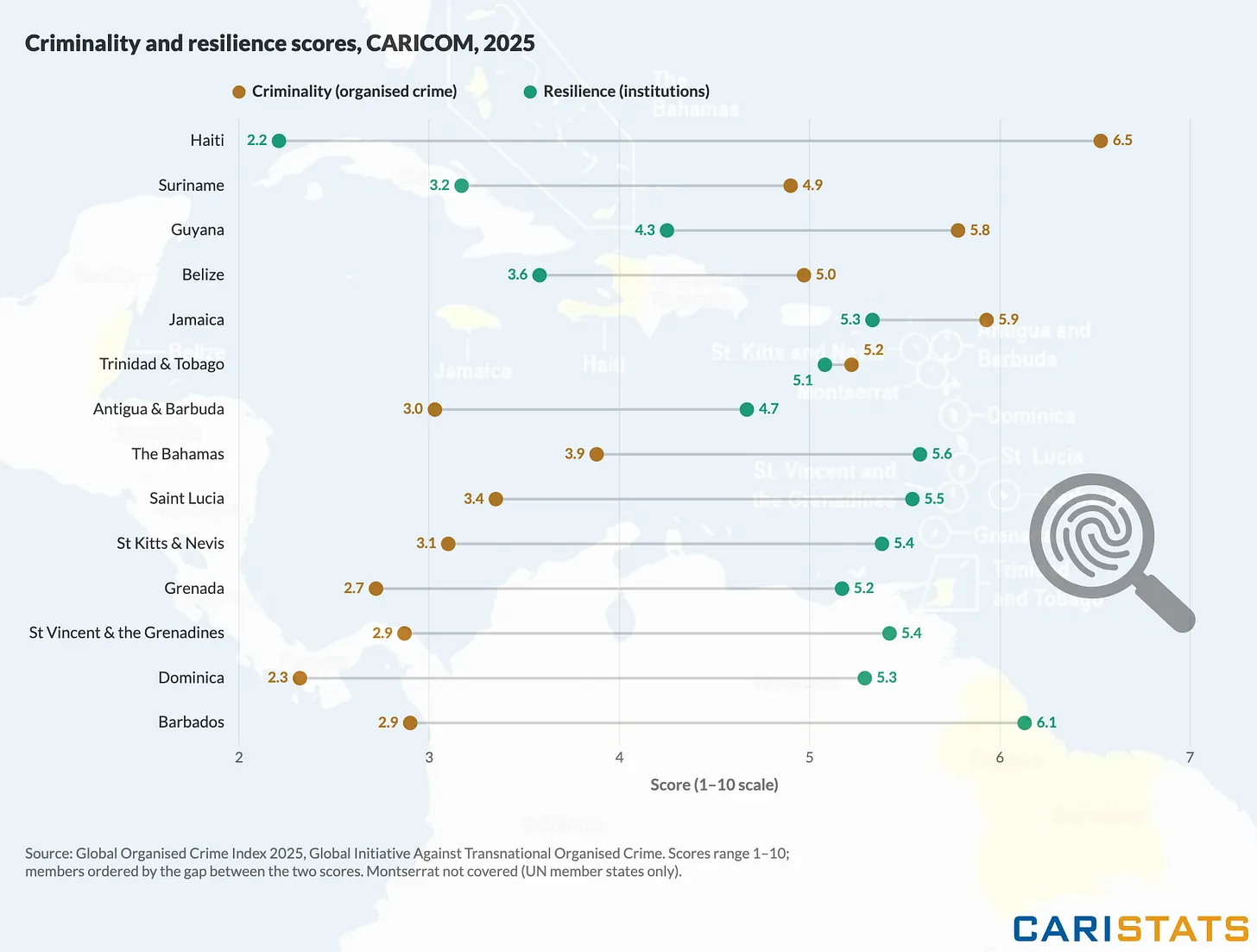
Organised crime is far more than a public safety challenge—it is fundamentally an economic burden that undermines long-term growth, discourages foreign and domestic investment, skews competitive market dynamics, and siphons billions in public resources that would otherwise fund critical infrastructure, social programs, and community development. While the overall prevalence of criminal activity is an important metric to track, experts emphasize that the true scale of damage a nation sustains from organised criminal networks depends not on crime levels alone, but on the ability of public and governmental institutions to counteract and contain these groups.
To capture both dimensions of this complex issue, the Global Organised Crime Index developed by the Global Initiative Against Transnational Organised Crime measures two key metrics for every nation: a criminality score that ranks the scale and scope of organised criminal activity on a 1 to 10 scale, and a resilience score that assesses the strength of anti-crime institutions, also on a 1 to 10 scale. A new 2025 analysis of CARICOM (Caribbean Community) member states reveals a sharp divide across the bloc, with many nations seeing stark gaps between their criminality levels and institutional resilience.
The 2025 data shows that most CARICOM member states fell into a low-risk category in 2025, combining relatively low levels of organised criminal activity with reasonably strong institutional resilience. Barbados posted a criminality score of just 2.9 alongside a resilience score of 6.1, with neighboring Grenada, Dominica, and other smaller Eastern Caribbean states recording nearly identical profiles. For higher-risk states including Jamaica, which scored 5.9 for criminality and 5.3 for resilience, and Trinidad and Tobago, which notched 5.2 for criminality and 5.1 for resilience, elevated crime levels were offset by strong institutional performance: both nations posted resilience scores above the regional average, keeping their institutional capacity roughly aligned with the threat they face.
However, a second, far higher-risk group of CARICOM nations faces the dangerous combination of elevated organised criminal activity and severely underdeveloped institutional resilience. This group includes Haiti, which recorded a 6.5 criminality score and just a 2.2 resilience score; Guyana, with 5.8 criminality and 4.3 resilience; Belize, at 5.0 criminality and 3.6 resilience; and Suriname, with 4.9 criminality and 3.2 resilience.
This particular pairing is what generates the most severe long-term consequences for affected nations. When institutional capacity cannot keep pace with the growth of organised criminal networks, these groups gradually embed themselves into both the formal economy and the structures of state power, becoming a chronic, systemic problem that is far more difficult and costly to root out than it would have been to prevent in its early stages.
Overall, the 2025 Organised Crime Index data offers targeted insight for policymakers across the Caribbean, identifying regions where organised crime is most likely to become deeply entrenched rather than merely highlighting where criminal activity is most prevalent. This framework allows regional and international stakeholders to direct targeted support to high-need nations, addressing institutional gaps before they lead to irreversible systemic damage.