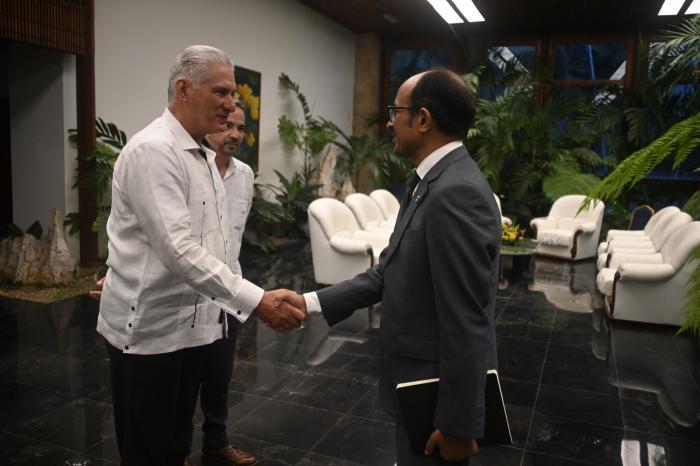
On a Wednesday morning in September 2026 at Havana’s Palace of the Revolution, Cuba’s highest-ranking leader Miguel Díaz-Canel Bermúdez, First Secretary of the Central Committee of the Communist Party of Cuba and President of the Republic, welcomed Kamal Kishore, Special Representative of the UN Secretary-General and head of the United Nations Office for Disaster Risk Reduction (UNDRR), for high-level talks focused on disaster risk management, global solidarity, and the ongoing impacts of the U.S. blockade on Cuba’s crisis preparedness capacity.
Opening the dialogue, Kishore framed his visit around two core purposes: advancing collaborative work on disaster risk reduction, and demonstrating explicit solidarity with the Cuban people amid their long-standing challenges. He confirmed that UNDRR consistently adds its voice to the UN Secretary-General’s annual report on the harm caused by the blockade, documenting the policy’s tangible far-reaching repercussions for Cuban communities. “We are fully aware of the devastating effects this blockade has, and we recognize the pain and hardship it imposes on the Cuban people,” Kishore stated. He emphasized that the United Nations stands firmly alongside Cuba during this difficult period, and that UNDRR will leverage all available resources to support Cuban efforts to strengthen disaster resilience and advance national development priorities.
During the conversation, Kishore also offered public recognition of Cuba’s significant achievements in building out early warning systems and community-level population protection frameworks. He noted that Cuba’s experience, developed even under severe resource constraints, serves as a valuable model for nations across the globe.
In his welcoming remarks, President Díaz-Canel underscored the profound importance of Kishore’s visit to Cuba at this critical juncture, and extended gratitude for the consistent technical and institutional support UNDRR has provided to the country over the years. He acknowledged Kishore’s personal commitment to advancing global disaster risk reduction and scaling evidence-based best practices across the world.
Díaz-Canel went on to outline the extraordinary challenges Cuba currently faces, as the long-standing U.S. blockade has been significantly intensified, particularly a de facto energy blockade that ripples through every sector of the country’s economic and social life. He described the blockade as an unexaggerated “genocidal and criminal policy” that directly undermines Cuba’s ability to invest in and maintain disaster risk reduction infrastructure and systems. For Díaz-Canel, the UNDRR chief’s visit amid these struggles stands as a meaningful gesture of international support and understanding of Cuba’s reality.
The Cuban leader reaffirmed Cuba’s unwavering commitment to the UNDRR mandate and the Sendai Framework for Disaster Risk Reduction, the landmark global agreement adopted in 2015 at the Third World Conference on Disaster Risk Reduction in Sendai, Japan. Endorsed by the UN General Assembly, the Sendai Framework centers on a core goal: cutting disaster-related losses of life, livelihoods, health, and economic, social, cultural and environmental assets substantially, while affirming that states hold the primary responsibility for reducing disaster risk within their borders.
Against the backdrop of growing global climate impacts, Díaz-Canel stressed that both the Sendai Framework and UNDRR play an increasingly critical role in protecting vulnerable communities worldwide. He confirmed that Cuba remains eager to collaborate with UNDRR, drawing on the Caribbean nation’s decades of on-the-ground experience in disaster management to advance shared global goals.
Díaz-Canel emphasized that Cuba stands as a global example: even under extreme material constraints, the constant pressure of external aggression, and the crippling impact of the decades-long blockade, strong political will and intentional organizational investment can deliver major progress in disaster risk reduction. He explained that this progress is possible when national policies prioritize protecting people, critical infrastructure, and key assets, and build robust capacity for both disaster response and post-event recovery.
As a case in point, the president noted that during the current Atlantic hurricane season—one of the most recurrent and dangerous natural hazards facing the island—Cuba has rolled out full early warning and protection measures for people, property and critical resources, exactly as it would under normal operating conditions, despite the widespread hardships caused by the intensified blockade and ongoing energy restrictions.
In line with Sendai Framework commitments, Díaz-Canel added that Cuba has recently updated its national institutional and regulatory frameworks for disaster risk reduction, including a national coordination platform that extends all the way to the grassroots, reaching local defense zones and community-level organizations. The country has made major investments in expanding early warning infrastructure and establishing dedicated disaster reduction centers, and has integrated cutting-edge science and innovation into its national governance program focused on risk mitigation.
“Our country has built up practical experience that we are fully willing to share, and we have already shared much of it with fellow nations across the Caribbean region,” the president stated. This includes training for regional personnel, open access to research from Cuba’s landmark Tarea Vida (Life Task) initiative, which addresses climate change-driven sea level rise and coastal adaptation, and full transparency around the methodologies and operational procedures that underpin Cuba’s national disaster risk reduction platform.
The meeting was attended by senior officials from both sides. Accompanying Kishore were Nahuel Arenas, Head of the UNDRR Regional Office for the Americas and the Caribbean, and Saskia Carusi, Deputy Head of the regional office. Cuban attendees included Division General Ramón Pardo Guerra, Chief of the National Civil Defense General Staff; Anayansi Rodríguez Camejo, Deputy Minister of Foreign Affairs; and First Colonel Luis Ángel Macareño Véliz, Deputy Chief of the National Civil Defense General Staff.