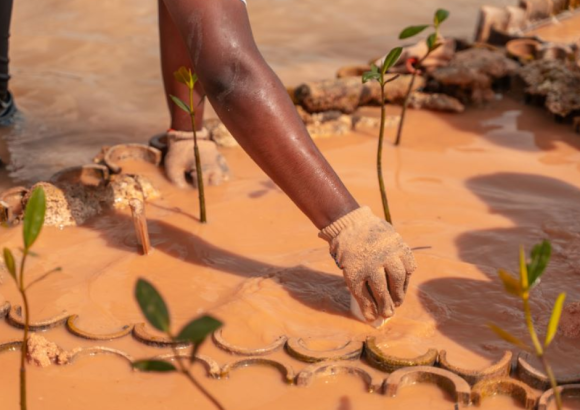
A year after more than 400 mangrove seedlings were planted in the Boca Chica Reef Lagoon of the Dominican Republic as part of a collaborative coastal restoration initiative, DP World Dominican Republic and the Deep Green Foundation have announced promising early results: an 86% survival rate for the young vegetation. To track the project’s progress and reinforce local conservation efforts, the two partners recently hosted a new volunteer monitoring event, bringing together environmental advocates and technical experts to assess how the young mangroves have adapted to their new habitat.
During the on-site evaluation, environmental technicians and leadership representatives from both organizations documented key signs of healthy growth. Beyond the high overall survival rate, the team found that 48% of the surviving seedlings have already developed distinct aerial roots – a critical morphological milestone that signals successful long-term adaptation to the coastal wetland environment. Even more encouraging are the early ecological changes already observed in the area: project biologists have confirmed the return of diverse native marine life, including mollusks, crustaceans, and juvenile fish, to the restored mangrove zone. This early recolonization confirms that the growing mangrove forest is already beginning to deliver on its core ecological purpose: providing critical shelter and feeding habitat for local coastal species.
This on-the-ground restoration work forms a local component of DP World’s global sustainability framework, “Our World, Our Future,” a company-wide strategy centered on preserving critical natural ecosystems and minimizing the environmental footprint of global trade operations. Manuel Martínez, Chief Executive Officer of DP World Dominican Republic, emphasized that meaningful economic progress does not need to come at the cost of environmental health, arguing that the two goals can and must advance hand in hand. Tasha Gough, CEO of the Deep Green Foundation, outlined the long-term vision for the partnership: the organizations aim to plant a total of 1,000 mangrove seedlings across the Boca Chica Reef Lagoon by the end of 2026, expanding the restored habitat and amplifying its ecological benefits.
Looking ahead, the two partners will continue regular maintenance of the site and carry out periodic technical monitoring to support the mangroves’ ongoing development. Beyond supporting marine biodiversity, the project is designed to deliver tangible coastal resilience benefits: mature mangrove forests improve sediment retention along coastlines, which in turn strengthens natural defenses against storm surges, sea level rise, and other hydrological threats facing low-lying Caribbean coastal communities.