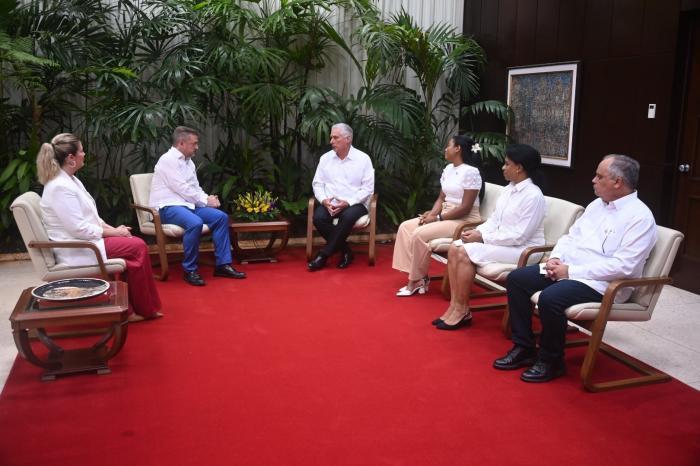
On a Monday afternoon in September 2026, Cuba’s highest leader, Miguel Díaz-Canel Bermúdez, who serves as First Secretary of the Central Committee of the Communist Party of Cuba and President of the Republic, hosted two senior leaders from the global Paralympic movement at Havana’s Palace of the Revolution: International Paralympic Committee (IPC) President Andrew Parsons and Michele Melissa Formonte, the IPC’s Director of Development for the Americas.
Opening the meeting, Díaz-Canel framed the IPC leadership’s visit to the Caribbean island nation as both a deeply appreciated gesture and meaningful encouragement for Cuba’s entire sports ecosystem, particularly at a challenging moment. He acknowledged that the broader socioeconomic challenges facing Cuba have created disproportionate strains on the national Paralympic sports program. Even amid these difficulties, the Cuban president used the gathering to deliver a clear, formal reaffirmation of the Cuban government’s unwavering political commitment to growing and supporting Paralympic sport across the country.
Díaz-Canel emphasized that this commitment is rooted in one of the core guiding principles of the Cuban Revolution: a commitment to social justice that prioritizes inclusion and equal opportunity for all people. “We stand with you in this fight to ensure Paralympic sport gains greater global recognition and full social inclusion, and we will continue to champion this cause,” he told the visiting delegation. He went on to highlight that Cuba’s Paralympic athletes have long been a source of enormous national pride, consistently delivering exceptional competitive results on the world stage, making continued investment in the movement a national priority.
To advance collaborative work moving forward, Díaz-Canel offered Cuba’s existing institutional resources to support the broader Paralympic movement across the region. This includes opening access to Cuba’s Sports University, which the IPC delegation is scheduled to tour the day after the meeting, as well as sharing the specialized sports science expertise developed by Cuba’s state-led sports research centers, with a specific focus on knowledge specific to Paralympic training and competition. The Cuban president also expressed explicit interest in developing joint collaborative projects between Cuba and the IPC that would strengthen national training infrastructure for Cuban Paralympic athletes and advance broader development initiatives for the national program.
Responding to Díaz-Canel’s remarks, Parsons said it was a profound honor for him and Formonte, both of whom are Brazilian, to visit the island. Parsons framed the trip as an extension of the longstanding brotherly friendship between the Cuban and Brazilian people, and noted the visit itself is a deliberate gesture of support for both Cuba and its national Paralympic movement. He also shared moving impressions from his earlier stop that same day at the Solidaridad con Panamá school, a facility he praised for successfully integrating education, art, sport, and inclusive programming for disabled students. A particularly meaningful moment for the delegation, Parsons added, was visiting the running track where Cuban Paralympic star Omara Durand Elías has trained for her record-breaking career.
Durand Elías, a multiple-time Paralympic and world champion who also serves as president of the Cuban Paralympic Committee (CPC), attended the meeting at the Palace of the Revolution. Parsons praised her as a trailblazing role model for athletes across the globe, especially for women athletes, and confirmed that when Durand Elías extended an invitation to visit Cuba, the IPC leadership accepted immediately. He added that he and Durand Elías had already held productive talks earlier that day about upcoming events, ongoing programs, and potential avenues for the IPC and Americas Paralympic Committee to expand support for the Cuban Paralympic movement.
Joining President Díaz-Canel for the Cuban delegation at the meeting were Deputy Prime Minister Inés María Chapman Waugh and Osvaldo Vento Montiller, head of Cuba’s National Institute of Sports, Physical Education, and Recreation (INDER).