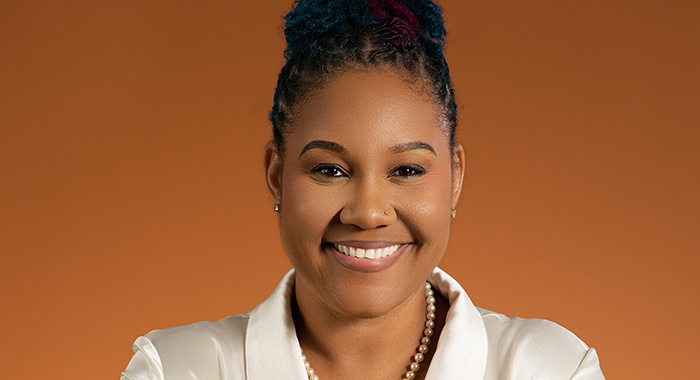
St. Vincent and the Grenadines has made a landmark appointment to its public communications landscape, naming 37-year-old communications veteran Tedra Kirby as the country’s first-ever chief government communications executive, and the youngest leader in recent history to head the rebranded Agency for Public Information (API), formerly the Government Information Service.
The Ministry of Information made the appointment official in a public announcement last Friday, tasking Kirby with a three-year initial term in this newly restructured, strategy-driven role. As a senior advisor to the national government, her portfolio covers public relations, media outreach, public engagement, and the development of strategic communications policy, placing her work at the intersection of governance, public information dissemination, and media relations.
In an exclusive interview with iWitness News, Kirby acknowledged that she takes up the historic role fully aware of the heavy expectations and extensive work ahead. “I know there is a lot of work to be done but it is a challenge that I am looking forward to and that I am embracing immediately,” she said, noting that her youth at appointment is a rarity for a senior government leadership post in the country. Reflecting on the milestone, she joked, “When I look at the people who have come before me, I’m not sure if a director has ever been appointed that young.”
Kirby framed her relatively early entry into this senior role as a double-edged sword. On one hand, her appointment aligns with a growing global push to bring younger generations into senior government roles, leveraging their specialized expertise in fast-evolving areas such as digital communications. On the other, she recognizes that skepticism may arise: “People may say, ‘But you are this age. Do you really have what it takes to lead an agency at this level, given the requirements of the undertaking that you’ve really been appointed to lead?’”
Her appointment comes as part of a broader government initiative to revamp national public communications, with the stated goal of building “a more coordinated, responsive and contemporary government communications system,” per an official press release. A core priority of Kirby’s tenure will be transforming the API’s long-standing reputation and operating model: for years, the agency has positioned itself as a producer of “superior journalism” and operated as a competitor to independent private media outlets, leading to strained relations and criticism that it functions more as a partisan political tool than a neutral public information hub.
Kirby made clear that her approach will mark a clear break from this history, prioritizing collaborative partnership over rivalry. “I definitely think relationship building is one of the most important skills that a leader in any institution, including the API, needs to have,” she emphasized. “Given the responsibilities of the media on a whole, which include things like keeping governments accountable, ensuring that information in general is shared, utilising various platforms, I do think that it is extremely important for the overall success of the API to form closer relationships with the media and view that relationship as a partnership rather than competition.” She added that the API retains a unique role sharing public information that does not fit standard news formats, creating space for complementary work alongside private outlets.
Proactive public outreach, expansion of digital and multimedia content, and consistent media engagement round out Kirby’s core mandates. She brings more than 15 years of cross-sector experience to the role, spanning strategic corporate communications, broadcasting, media engagement, and education. Most recently, she spent three years as Network Communications Manager at the British High Commission in Barbados, leading communications strategy, public information campaigns, and regional media engagement across Barbados and the Eastern Caribbean. Kirby says that this external regional experience has given her valuable insight into global best practices that she plans to adapt to improve St. Vincent and the Grenadines’ government communications framework.
A well-credentialed professional, Kirby is a 2018 Chevening Scholar who holds a Master of Arts in corporate communications, marketing and public relations, a Postgraduate Diploma in secondary education for English instruction, a Professional Development Certificate in digital marketing, and a Bachelor of Arts in Communication Studies and History. Her career trajectory began in broadcasting, where she started working unpaid at local station Hitz FM before moving to Hot 97, where she hosted the popular solo Sunday morning program “Woman Is Boss” and co-hosted the weekday “Afternoon Kickout” show. She later transitioned to television, hosting a long-running weekly Sunday evening discussion show on SVG TV that made her a well-known public figure across the country. Beyond her core communications and education experience, she holds certification in sports event announcing and is currently pursuing project management certification.
Kirby steps into leadership at a time of internal transition at the API: many long-tenured staff have been transferred or requested reassignment following years of internal tensions with previous senior leadership. She says she welcomes respectful challenges to her leadership, and plans to build a collaborative work culture that empowers staff. “As a leader, we have to expect to be challenged, or we should expect to be challenged. We should, as leaders, empower our employees to not just do the work, but to also question what we do,” she explained.
Recognizing that building trust with existing staff will be a gradual process, Kirby says she is fully committed to nurturing that trust, and upskilling communications personnel across all government ministries, not just the API. She says capacity building is a core part of her mandate, and is already developing new frameworks, guidelines and policies to leave the agency and national government communications stronger than she found it. “When I leave the post, people are better equipped to do their job than when I got there,” she said.