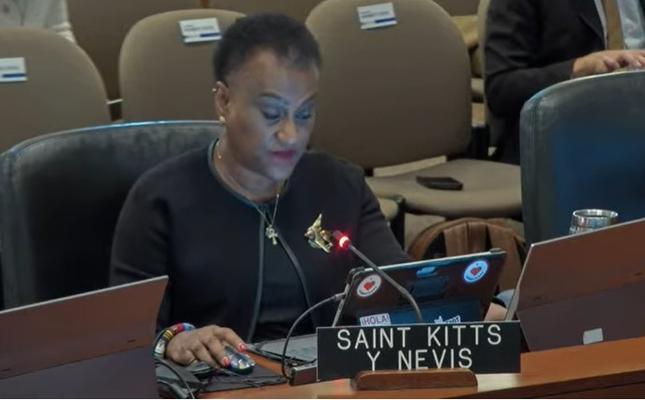
In an international forum hosted in Washington D.C., the Federation of St. Kitts and Nevis has placed its long-term sustainable development strategy in the global spotlight, outlining a clear roadmap to build a more resilient, self-sufficient island nation by 2040.
Jacinth Henry-Martin, the country’s permanent ambassador to the Organization of American States (OAS), delivered a comprehensive update on the national Sustainable Island State Agenda (SISA) during a recent sitting of the Inter-American Council for Integral Development (CIDI), sharing the federation’s progress and priorities with regional representatives from across the Western Hemisphere.
Since the Drew administration took office in 2022, the SISA framework has anchored the government’s top policy priorities, designed to strengthen the small island nation’s capacity to adapt to shifting global geopolitical conditions and maximize the utility of its constrained natural and economic resources. Already, targeted investments are flowing into seven critical priority sectors: utility-scale renewable energy development, national water security, climate-adapted smart agriculture, disaster-resilient housing, expanded public health infrastructure, and the transition to a circular economy that cuts waste and boosts reuse.
Speaking to the council, Ambassador Henry-Martin emphasized that the success of St. Kitts and Nevis’s agenda depends on collaborative international partnerships to bridge the persistent gap that small developing states face between policy ambition and on-the-ground implementation. She noted that required support extends far beyond traditional direct financing, highlighting that access to green technology, specialized technical expertise, support for early-stage project preparation, and cross-institutional partnerships are equally critical to advancing the country’s goals. Where financing is needed, she called for innovative, flexible funding structures tailored to the unique constraints of small island developing states, rather than one-size-fits-all models that do not align with local context.
The ambassador also made a pressing appeal to international partners to revise how development needs are assessed, arguing that relying solely on per capita income masks the unique vulnerabilities of small island nations. “It bears repeating that for small island developing states such as St Kitts and Nevis, a single external shock can have an economy-wide impact, while the per capita cost of building resilient infrastructure is disproportionately high,” she told attendees.
Her presentation at the CIDI forum forms part of a sustained diplomatic push by the St. Kitts and Nevis government to build a global coalition of partners aligned with the SISA agenda, and to secure the blended technical, institutional, and financial resources required to deliver on the federation’s 2040 sustainable development targets.