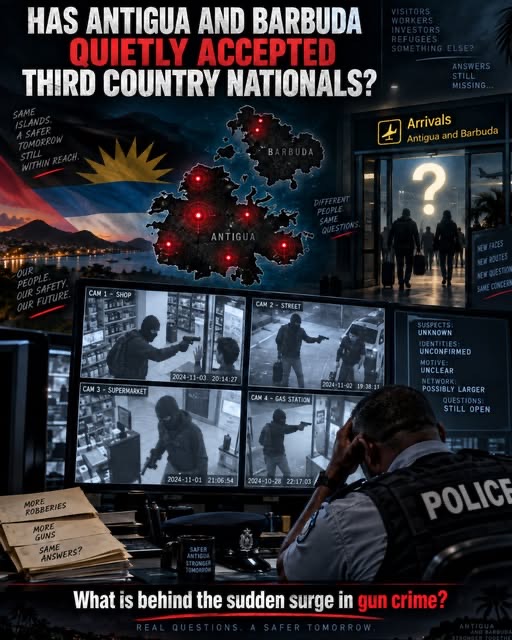
A sharp, unprecedented spike in violent firearm-related crime across Antigua and Barbuda has ignited fierce public criticism of law enforcement and government transparency, with a local commentator raising unsettling questions about potential unreported entry of third-country nationals (TCNs) into the twin-island nation.
In just one recent week, the country recorded at least one daily gun-enabled crime – a rate that local commentator Yves Ephraim says marks a worrying break from historical patterns. The question now hangs over communities: is this surge an unexpected anomaly, or the dangerous new reality residents must adapt to?
Graphic videos of criminal acts circulating widely on social media have amplified public fear, with many describing the current climate as one of pervasive terror. While public closed-circuit camera installation was previously framed as a key solution to rising crime, an abundance of private surveillance footage capturing recent violent incidents has failed to yield any investigative breakthroughs. Data on unresolved offences across the country paints a damning picture: the national police service has performed abysmally in solving cases, leaving residents stunned that clear camera footage has not led to the arrest of identifiable perpetrators.
Criminals are increasingly carrying out attacks in broad daylight, openly defying police authority. Even when offenders conceal their faces, Ephraim argues that distinctive physical characteristics must be recognizable to members of the public, making it inexplicable that suspects are able to disappear back into local communities without detection.
Ephraim is calling for immediate accountability from the Attorney General and top police leadership, accusing senior officials of negligence in overseeing public safety. Routine stop-and-search operations, he says, are a superficial, inadequate response to the deepening crisis. Outlining alternative tactics he would implement as police commissioner, Ephraim proposes targeted, continuous patrols of known crime hotspots, timed to align with historical data on high-incidence hours. He also suggests overlapping patrol routes to guarantee a police response within 10 minutes of any emergency call.
A key gap in the government’s response to the crime wave, Ephraim argues, is the complete absence of any mention of police training. While officials repeatedly announce purchases of new equipment and technology to combat crime, there has been no push to improve the human capital of the police force. Ephraim draws a sharp comparison: giving untrained officers modern crime-fighting tools is equivalent to handing a Corvette sports car to a toddler – a dangerous mismatch that will inevitably end in damage.
Visible signs of under-resourcing and poor maintenance, such as the damaged, poorly kept state of police vehicles on public roads, further back up his critique of systemic mismanagement. Recently, a high-profile gun-related case was thrown out of court due to insufficient evidence, highlighting a core failure of policing: even if officers catch suspects, they lack the skills to compile evidence that meets court standards. Increasing penalties and extending prison sentences, Ephraim argues, is a hollow gesture when law enforcement consistently fails to apprehend offenders and build prosecutable cases.
This culture of systemic failure has not gone unnoticed by criminals, Ephraim claims. Offenders are fully aware that police have a abysmal track record of solving even minor thefts, leading many to treat Antigua and Barbuda as a lawless “wild west” where they can operate with impunity.
Ephraim cites his own 2006 experience with police incompetence as a early warning sign of deeper issues. After his company’s van was stolen, he reported the theft to police and checked in on the investigation for six months before abandoning hope of recovery. Months later, a friend contacted him to say his stolen van was listed for auction in an official government gazette. Police had recovered the vehicle, stripped for parts in a remote bush location, and held it at their American Road headquarters – but the Criminal Investigation Department (CID) leading the theft investigation never learned of the recovery. It took a private citizen and a public notice to solve the case, and no one was ever arrested for the theft.
Shifting to the broader context of the current crime surge, Ephraim notes that many recent gun crimes bear the hallmarks of organized gang activity, with groups deliberately marking territory in a deliberate show of force. The rapid influx of hardened criminal elements, he suggests, may have been driven by rumors that Antigua and Barbuda is a welcoming destination for foreign offenders, raising the alarming possibility that the country has quietly admitted third-country nationals without public knowledge or oversight.
While Ephraim acknowledges the theory could be a product of overactive imagination, he notes that the timing of the sudden surge in violent gun crime is suspicious, at the very least not a coincidence. The process of considering TCN admissions has been shrouded in secrecy from the start, with the public given no updates on negotiations since parliament voted to move forward with the issue. Across the Caribbean, multiple governments have quietly begun accepting TCNs one after another, leading Ephraim to question whether Antigua and Barbuda has already allowed entry – particularly for dangerous, undesirable individuals.
Ephraim concludes that the potential link between unreported TCN admissions and the rising gun crime wave cannot be ruled out, reminding the public that government has misled residents on key issues in the past.