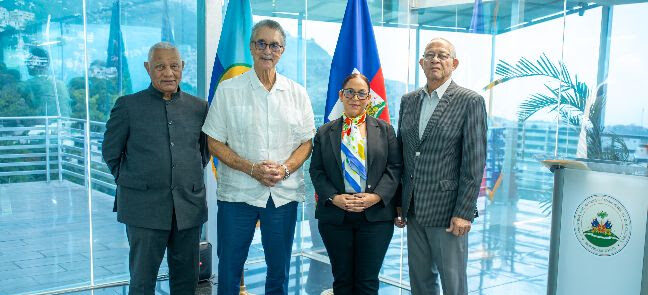
As Haiti enters the final stretch of preparations for its December 13, 2026 general elections, the Caribbean Community (CARICOM) has deepened its diplomatic and facilitation work to stabilize the crisis-battered nation, with its high-level Eminent Persons Group (EPG) currently on the ground holding talks with a broad cross-section of Haitian stakeholders.
In a formal address delivered September 3, 2026 to the Permanent Council of the Organization of American States (OAS), CARICOM Secretary-General Dr. Carla Barnett outlined that the EPG — a three-member panel of former prime ministers established in 2023 — is currently meeting with a diverse range of actors involved in the upcoming electoral cycle, including newly formed political parties, emerging electoral coalitions, and civil society leaders. This on-the-ground visit is part of CARICOM’s long-running mission to foster inclusive dialogue between Haiti’s fractured political and civic groups, and to back a homegrown resolution to the country’s years-long governance and security crisis.
Barnett’s address marked a historic moment: she noted it is believed to be the first time a sitting CARICOM Secretary-General has addressed the OAS Permanent Council, a milestone that underscores the growing coordinated regional push to support Haiti. The trip by the EPG builds on a high-level inter-American and international fact-finding mission to Haiti held August 16 to 19, in which CARICOM took part at the invitation of OAS Secretary-General Albert Ramdin. That mission was organized under the OAS’s flagship Haiti initiative, *Towards a Haitian-Led Roadmap for Stability and Peace with Regional and International Support*.
According to Barnett, the August visit delivered multiple key outcomes. It allowed participating international and regional actors to exchange on-the-ground experiences and lessons from past interventions, improved cross-partner coordination, and helped identify the most urgent unmet needs facing Haiti. Most critically, it sent a clear message to the Haitian public: despite the country’s years of overlapping political, security and humanitarian crises, the regional and international community has not abandoned them.
Security remains the most pressing barrier to peaceful, credible elections, and Barnett emphasized that both CARICOM and the OAS strongly back an extension of the mandate for the multinational Gang Suppression Force (GSF), deployed to combat Haiti’s powerful armed gang networks that control large swathes of the country. However, she warned that pledges made by international partners to provide the GSF with critical personnel, funding, military equipment, and logistical support have yet to be fully honored. Strengthening support for the GSF, Barnett argued, is non-negotiable to rolling back gang control of territory, reducing widespread violence, and creating the secure conditions required for Haitians to cast their ballots freely in December.
As the electoral process moves forward, Barnett added that independent election observation will grow in importance to underpin Haiti’s return to constitutional democratic rule. She noted that CARICOM and the OAS have a proven track record of collaborating on election monitoring in Haiti, and stand ready to partner again on this critical task.
Looking beyond the upcoming vote, CARICOM will continue its close collaboration with the OAS and other international partners to support Haiti, with a long-term focus on attracting sustainable investment, creating much-needed jobs, and expanding access to essential public services for Haitian citizens. Barnett drew special attention to the daily toll of criminal violence on ordinary Haitians, noting that pervasive insecurity has disrupted livelihoods, shuttered schools, blocked access to life-saving medical care, and restricted freedom of movement for millions across the country.
In closing, Barnett reaffirmed that CARICOM’s core objective remains centered on empowering Haitians to lead their own path out of crisis, enabling the country to build long-term stability and improve quality of life for all its people.