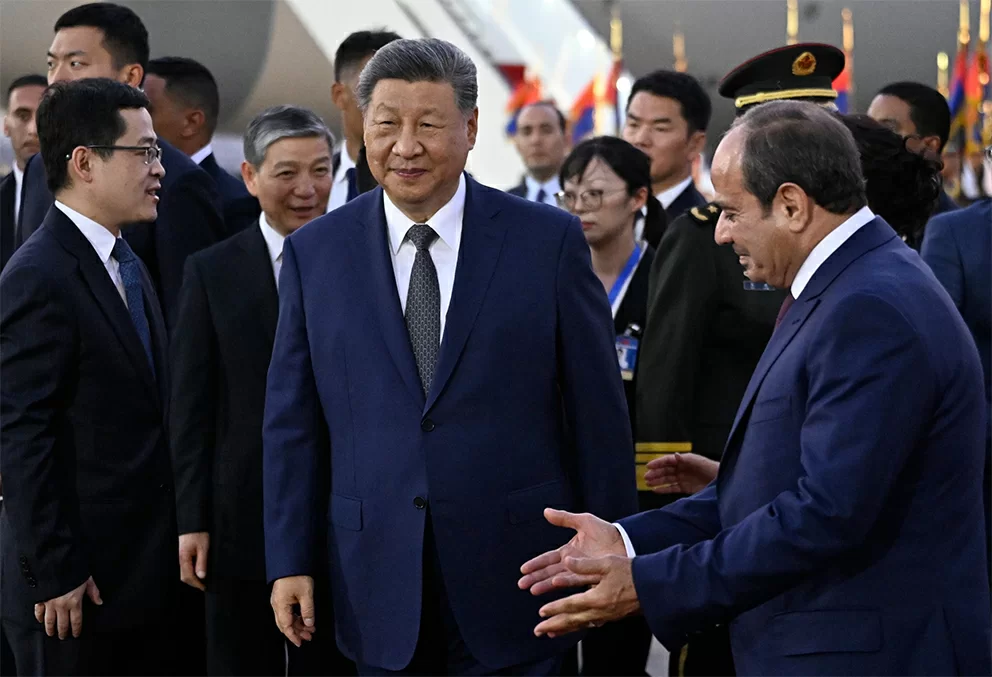
On a crisp Tuesday evening in Cairo, Chinese President Xi Jinping touched down at Cairo International Airport, greeted with a full official welcome by Egyptian President Abdel Fattah al-Sisi and a military honor guard. The visit marks Xi’s first return to the Middle East region since his 2022 trip to Saudi Arabia, and while on the surface it is framed as a standard diplomatic mission to strengthen economic and people-to-people ties between the two nations, regional analysts and diplomatic insiders say the meeting carries far broader geostrategic weight at a moment of shifting global power dynamics.
This year marks the 70th anniversary of formal diplomatic relations between Beijing and Cairo, a milestone both leaders have highlighted as a foundation for deeper cooperation. For China, the growing partnership with Egypt – a longstanding key ally of the United States in the Middle East – represents a major step forward in its campaign to position itself as a viable alternative global power to Washington, and to expand its footprint across a region undergoing rapid political and economic change.
During wide-ranging talks with al-Sisi, Xi emphasized that China and Egypt must align to push back against unilateralism and what he called “bullying behavior” in global affairs, while calling for the construction of a more just and equitable framework for international collaboration. For Egypt, deepening ties to Beijing serves a clear strategic goal: diversifying its network of global partnerships beyond its traditional reliance on Western powers. In 2023, Egypt received an invitation to join the BRICS bloc, a coalition of major emerging economies led by China, Russia and India that was formed to counterbalance Western-dominated global institutions such as the G7.
Economic ties between the two countries have already grown far deeper than many outside observers recognize. To date, China has committed more than $10 billion in direct investment to Egyptian infrastructure and development projects, including a new central business district east of Cairo and a high-capacity electric freight railway serving industrial hubs across the Nile Delta. Annual bilateral trade between the two nations is currently estimated at $20 billion – a figure that already outpaces the $15.7 billion in annual trade between the United States and Egypt recorded in 2025. Even with this growing economic alignment with Beijing, Egypt retains its status as a critical regional security partner for Washington, a balancing act Cairo has carefully maintained for decades.
This visit is not an isolated step for China in the Middle East. Back in 2023, Beijing brokered a landmark deal to restore diplomatic relations between Iran – one of China’s key regional allies and top oil suppliers – and Saudi Arabia, another long-standing U.S. partner in the region. While tensions between Riyadh and Tehran have re-escalated amid new regional conflicts since the deal was signed, the breakthrough demonstrated Beijing’s growing ambition to shape regional outcomes and build diplomatic capital across competing blocs.
Egypt’s unique strategic position, which includes full control over the Suez Canal – one of the world’s most vital global shipping chokepoints – has added extra urgency to China’s outreach amid current regional disruptions. With oil shipments through the Strait of Hormuz facing severe disruption from ongoing conflict linked to Iran, the Suez Canal has emerged as an even more critical alternative route for energy shipments out of the Middle East. Regional security experts widely view China’s deepening partnership with Cairo as a calculated move to secure reliable access to Arab and African markets at a time when Washington has shifted much of its strategic focus away from the Middle East to other global priorities.
Beyond economic and diplomatic cooperation, security ties between Beijing and Cairo have also expanded in recent months. The two countries recently held their first joint air force exercises, which saw Chinese J-16 fighter jets train alongside Egyptian Rafale fighter aircraft in shared operational drills. Xi’s visit to Cairo comes directly on the heels of a recent summit of the Shanghai Cooperation Organization (SCO), a political and security bloc increasingly seen as a counterweight to U.S.-led regional security architectures, which brought together leaders from Russia, India, Pakistan, Iran and other member states.
The shifting alignments in the region come as the United States continues to ramp up economic pressure on Iran, maintaining sweeping sanctions aimed at isolating Tehran from global commercial networks. China, which import more than 80% of Iran’s total oil exports – most currently moving through indirect shipping channels – has repeatedly stated that all of its trade with Iran adheres to international law and norms, pushing back against U.S. claims that its trade violates Washington’s unilateral sanctions regimes.