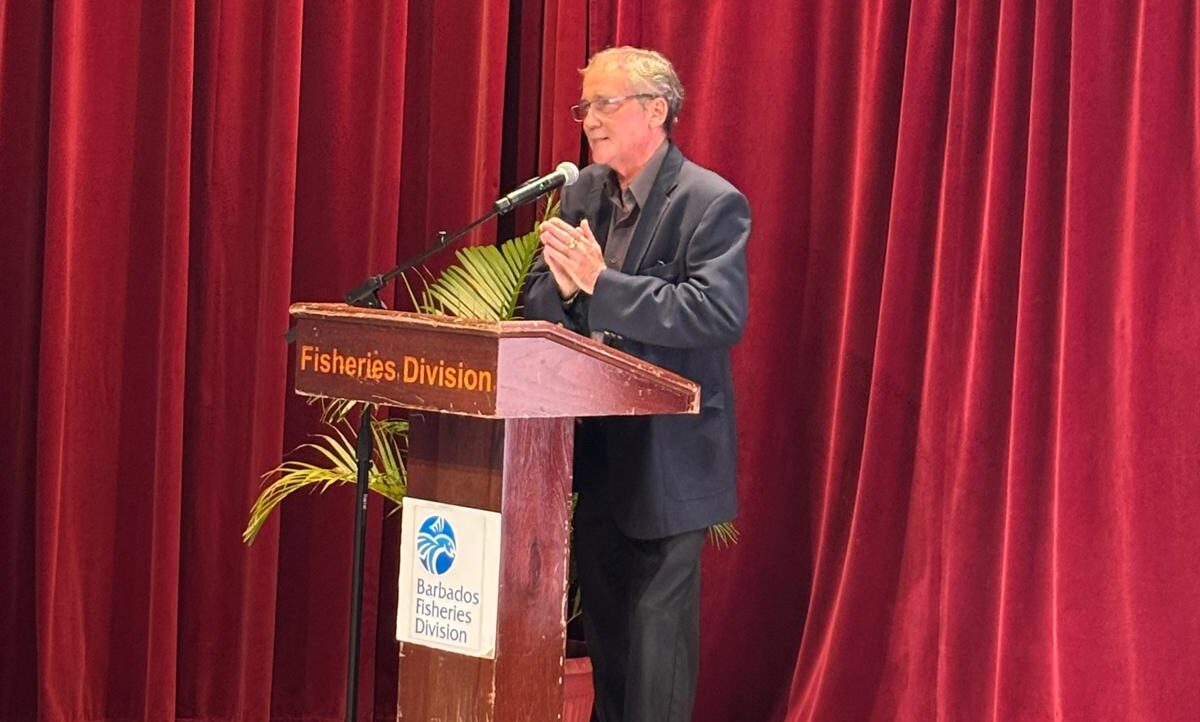
Barbados is set to become a regional leader in sustainable fisheries management with a groundbreaking new regulation that will require all horizontal longline vessels operating in its territorial waters to swap traditional J-hooks for specially designed circle hooks. The policy, rooted in years of locally conducted scientific trials, marks a step beyond basic international compliance, aiming to both boost target fish catches and drastically improve survival rates for vulnerable non-target species released back into the ocean. The regulation was formally announced alongside the launch of a national public outreach campaign, “Transformative Change: Fish Smart, Hook Right”, hosted by the Barbados Fisheries Division on Friday, which seeks to prepare local fisherfolk, seafood vendors, and the general public for the industry-wide transition.
Unlike J-hooks, circle hooks feature a distinct circular shape, with their point bent perpendicularly back toward the shank. This simple design alteration drives a major improvement in conservation outcomes: multiple studies, including the local trials completed by Barbados’ fisheries team, confirm that circle hooks are far more likely to hook fish in the mouth rather than the gut or internal organs. This difference dramatically cuts down on injury and mortality for non-target species, including endangered sea turtles, sharks, and other protected marine life that are commonly caught accidentally as bycatch and released by longline vessels.
The transition to circle hooks is not a new global requirement: as a contracting party to the International Commission for the Conservation of Atlantic Tunas (ICCAT), Barbados has been obligated since 2022 to adopt measures such as circle hook or finfish bait use to reduce sea turtle bycatch. But acting Chief Fisheries Officer Dr. Christopher Parker emphasized that the country’s approach sets a new precedent for the Caribbean region, going far beyond the basic commitments required by ICCAT. No other member state of the Caribbean Community (CARICOM) or the Caribbean Regional Fisheries Mechanism has combined locally generated, evidence-based trial data, a structured financial support scheme for fisherfolk, and formal binding domestic legislation to implement the change all at once. If successful, Dr. Parker noted, Barbados will establish a replicable model for other small island developing states across the region to follow, outpacing even the relatively basic requirements already implemented in the United States.
The policy itself defies the common framing of conservation as a trade-off with fishing productivity, Dr. Parker explained. Instead, it delivers on three core goals: better catch rates for target species, higher survival for released non-target species, and a more sustainable future for Barbados’ fishing industry as a whole. The regulatory change followed years of collaborative research between the Fisheries Division and the REBYC-III CLME+ project, a regional initiative focused on reducing bycatch in Caribbean fisheries. Nia Browne, project coordinator for the REBYC-III CLME+ team in Barbados, shared that the team ran two separate field trials on local longline vessels to test two common circle hook models: C16 and C18.
Both circle hook variants outperformed traditional J-hooks on key metrics, but the C16 configuration stood out for its impact on target species catches. When controlling for fishing time and location, trials found that C16 circle hooks delivered a statistically significant increase in catches of yellowfin tuna, Barbados’ primary target tuna species for longline fishing. Beyond higher yields, the trials confirmed the conservation benefits of the design: 90% of hooked ETP (endangered, threatened, and protected) species were hooked in the corner of the mouth, compared to just 30% for J-hooks, making safe release far more likely and drastically boosting post-release survival rates.
To address widespread concerns among local fisherfolk about the higher upfront cost of circle hooks, the Fisheries Division has rolled out a targeted support scheme. A box of circle hooks currently retails for roughly US$200, compared to US$120 for an equivalent box of J-hooks, a price difference that creates a barrier for many small-scale fishing operations. To offset this, the division has partnered with REBYC-III CLME+ to launch a gear-exchange program that allows fisherfolk to trade in their old J-hooks for discounted circle hooks. The team has also negotiated discounted bulk rates with local fishing gear suppliers to bring down costs further for participants.
“I am asking you to be part of this change not because the government demands it, but because the evidence of the gear trials shows it is good for your catch, good for the ocean, and good for the next generation of Barbadians,” Dr. Parker told attendees at the campaign launch.
The launch event also included contributions from legal and conservation stakeholders: Makayla Williams, legal consultant for the Fisheries Division, walked attendees through the binding legislative framework under the Sustainable Fisheries Development and Management Act that formalizes the mandate, while Nikola Simpson of regional conservation group Sustainable Caribbean outlined the broader implications of the policy for regional ocean health. The event closed with cultural tributes and campaign materials: a custom campaign jingle performed by singer Reniece Bonnett, an educational skit outlining the hook transition, and a saxophone tribute by Darren Watson to the late former Chief Fisheries Officer Dr. Shelly-Ann Cox, who championed sustainable fisheries reform in Barbados before her passing.