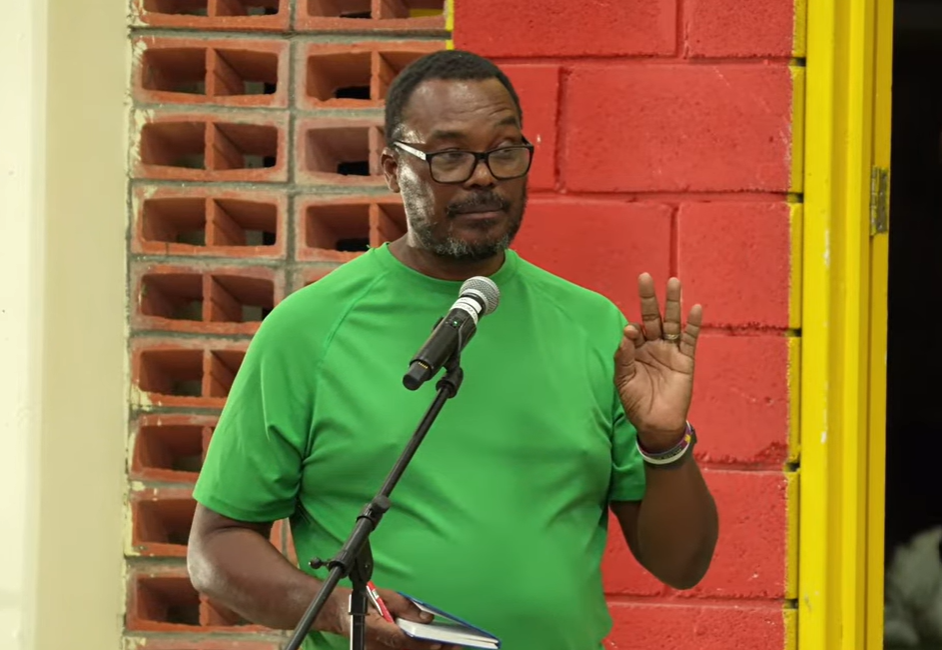
At Thursday evening’s St Andrew Ideas Forum, a 36-year veteran of law enforcement made a forceful case for expanding supervised rehabilitative programs for young people charged with low-level offences, warning that permanent criminal convictions create lifelong barriers to economic and personal advancement.
Jonathan Best, who retired after a decades-long career in policing, laid out a structured alternative model for handling minor youth offending that would keep young people out of prison and free of permanent criminal records. He used a common example of a young person involved in a first-time physical altercation to illustrate his proposal: instead of immediate conviction and sentencing, the young person would be released to supervised home custody with clear conduct requirements, and their court case would be adjourned for a 90-day probationary period.
During those three months, Best explained, the young person would be required to return to school or another learning program, or secure stable employment, with magistrates able to connect participants to pre-vetted job openings through court support staff. If the young person meets the requirements after the initial three-month period, the case would be extended for an additional three months. After a full year of consistent positive progress – no reoffending, steady enrollment in education or full-time work – the case could be dismissed entirely, leaving the young person with no permanent criminal conviction on their record.
Best emphasized that even minor, decades-old convictions continue to derail young people’s lives long after they have turned away from crime. He shared firsthand observations of young people who were fired from jobs after employers discovered old minor convictions on their police clearance certificates, and others who were blocked from employment and international travel entirely due to their criminal records. “For petty offences, people should be given multiple chances,” Best argued. “We talk about second chances, but we should be willing to give third, even fourth chances if that is what it takes. I know it sounds unusual coming from a former police officer, but locking young people out of opportunity for minor mistakes only pushes them deeper into a cycle of crime. We do not want a 16-year-old ending up involved in violent armed offending because we closed off every other path to them.”
In response to Best’s proposal, Attorney General Wilfred Abrahams clarified that the current government already follows a diversion-first philosophy for minor youth offending, and has rejected the practice of issuing permanent convictions for simple mistakes that would ruin young people’s life prospects. Abrahams noted that a range of existing social programs, including the Youth Advanced Corp, already work to divert at-risk young people away from the criminal justice system entirely, rather than pushing them into conviction and punishment. He confirmed that diversion programs would not be extended to serious violent offences, however – anyone caught with a firearm, or involved in a shooting, regardless of age, would face full criminal prosecution and penalties.
“This government is not seeking to stain anybody’s record and cripple them for life over something that is just a mistake,” Abrahams said. “Our policy is to divert people out of the traditional criminal justice system and into rehabilitative, corrective, nurturing environments that help them get back on track. We recognize that not every young person has the same stable family support that many of us took for granted growing up, so we need to meet them where they are.”
Abrahams added that the government is currently building new dedicated facilities to accommodate youth diversion programming, which is focused on intervening early with at-risk young people still in the school system, providing targeted support before they end up involved in crime or in conflict with the law.