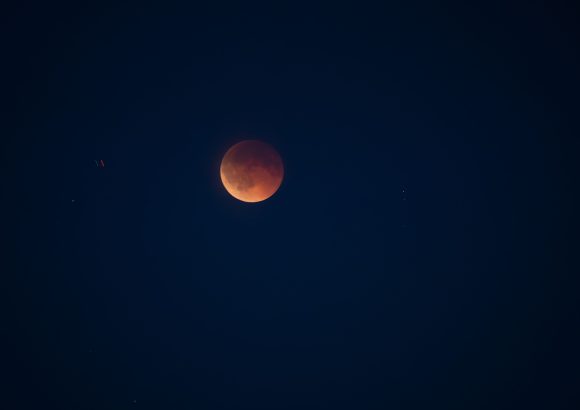
Stargazers and astronomy enthusiasts across the Dominican Republic are marking their calendars for a striking celestial event in late August 2026, when a deep partial lunar eclipse will glide across the night sky, fully visible across the country if weather conditions cooperate. This astronomical showcase, which unfolds across the night of August 27 and into the early hours of August 28, will offer one of the most dramatic lunar events visible from the Caribbean nation in recent years.
The eclipse follows a clear, step-by-step timeline for viewers based in the capital city of Santo Domingo, with the first subtle phase of the event kicking off at 9:23 p.m. local time on August 27. This opening stage is the penumbral eclipse, when the Moon begins to enter Earth’s faint outer shadow, a change that is often barely perceptible to the untrained eye. Roughly an hour later, at 10:33 p.m. the same night, the partial eclipse officially begins: the Moon starts moving into Earth’s darkest, central shadow, called the umbra, creating a distinct, gradually growing dark bite across the lunar surface.
The peak of the event, known as maximum eclipse, is scheduled for 12:12 a.m. local time on August 28. At this exact moment, nearly 93% of the Moon’s entire diameter will be tucked inside Earth’s umbra, turning that portion of the lunar disk a deep, coppery red for observers. Following the peak, the partial eclipse concludes at 1:51 a.m., when the Moon exits the umbra, and the final penumbral phase wraps up entirely by 3:01 a.m.
In total, the full sequence of the eclipse from the start of the penumbral phase to the end stretches approximately 5 hours and 38 minutes, with the partial phase — the most visually striking portion of the event — lasting roughly 3 hours and 18 minutes. For viewers in Santo Domingo, the geometry of the event adds to its viewing appeal: at the time of maximum eclipse, the Moon will sit roughly 61 degrees above the horizon in the south-southeast direction, a position that creates ideal viewing conditions as long as skies remain clear of cloud cover.
While the Dominican Republic is positioned perfectly to watch the event, it is far from the only region with front-row seats. According to NASA data, the eclipse will also be visible across most of North America and South America, as well as portions of western Europe and western Africa. Astronomy groups across the Caribbean are already encouraging casual observers to head to locations with minimal light pollution to get the clearest view of the rare deep partial eclipse, which will bring a dramatic celestial display to skywatchers across the hemisphere.