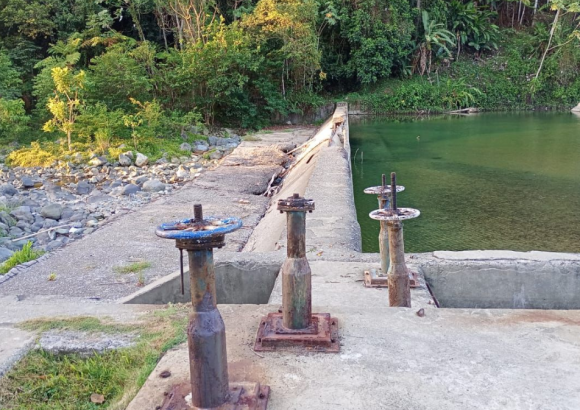
A severe climate-driven water crisis is unfolding across Greater Santo Domingo, where the El Niño phenomenon has triggered a sharp decline in rainfall that has crippled drinking water production across four major regional aqueduct networks, according to the Santo Domingo Water and Sewerage Corporation (Caasd).
Since May, the key river watersheds that feed the region’s water infrastructure—including the Haina, Isa, Mana, Duey, Isabela and Nizao rivers—have received far less precipitation than historical averages, draining the natural water reserves that supply local distribution systems. The most dramatic drop has been recorded at the Haina-Manoguayabo Aqueduct, where output has plummeted 68% from its standard 91 million gallons per day to just 29 million gallons daily. The nearby Isabela Aqueduct has fared similarly poorly, seeing a 65% production reduction that brings its daily output down to 3 million gallons from the usual 9 million. Even the Isa-Mana and Duey aqueducts have each sustained production cuts of more than 60% amid the ongoing drought conditions.
These sharp reductions in water output have translated to widespread service disruptions for dozens of communities across the region. Affected areas include the municipalities of Los Alcarrizos, Pedro Brand, Pantoja, and multiple neighborhoods along República de Colombia Avenue, along with large swathes of the National District south of John F. Kennedy Avenue. Populations served by the Haina-Manoguayabo system, including the central districts of Gascue, Zona Universitaria, El Cacique, and 30 de Mayo, are also grappling with interrupted water access.
In response to the growing crisis, Caasd has rolled out emergency mitigation measures to reallocate water resources and bring relief to hard-hit neighborhoods. The agency is diverting additional water from the Valdesia-Santo Domingo Aqueduct to affected zones; while the Nizao River (a key source for the Valdesia system) has also seen lower flows, the two reservoirs feeding the network hold enough reserve water to maintain full normal operations, making it the region’s most stable water source at present.
To expand last-mile distribution to underserved communities, Caasd has also boosted its fleet of water tanker trucks. The agency recently purchased 40 new dedicated tankers, 16 of which are already active on routes, with the remaining 24 set to join the fleet within the coming week. Complementing this public fleet, 76 additional privately contracted tankers are currently delivering emergency water supplies to residential areas facing the most severe outages.
Moving forward, Caasd announced it will maintain continuous monitoring of El Niño’s evolution and its projected impact on local rainfall and water reserves, working closely with forecast data from the Dominican Institute of Meteorology (Indomet) to adjust mitigation strategies as conditions change.