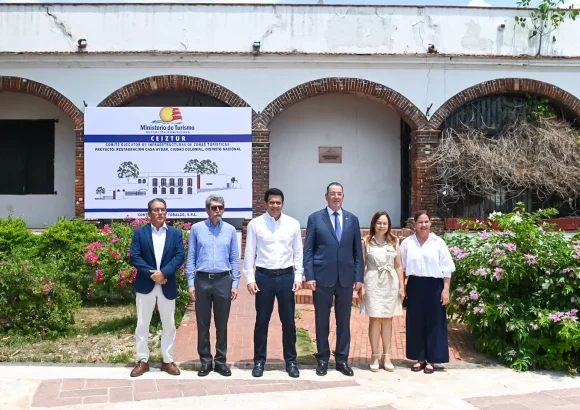
Santo Domingo, Dominican Republic – A major milestone in cultural heritage preservation and tourism development has been reached in the Dominican capital, as Tourism Minister David Collado formally opened the fully restored Casa Aybar, a landmark historic property located in Santo Domingo’s iconic Colonial City. The $102.3 million Dominican peso restoration project was designed not only to rescue the aging building from deterioration but also to reimagine it as a multi-purpose hub for culture, government administration and visitor engagement.
The comprehensive rehabilitation initiative addressed a wide range of structural and aesthetic needs of the centuries-old property. Restoration teams carried out full structural consolidation of the building, carefully refurbishing original architectural features including its exterior facades, roof systems, original flooring, wooden doors and window frames. The project also resolved longstanding issues of moisture infiltration and roof leaks that had threatened the building’s integrity, reinforced weakened walls and degraded structural components, and fully upgraded outdated electrical, plumbing, heating and cooling, and fire safety systems to meet modern building codes.
According to Minister Collado, the Casa Aybar restoration forms a core part of the national government’s ongoing, large-scale strategy to revitalize the Colonial City – the Dominican Republic’s premier historic and cultural district, and one of the most significant remaining colonial urban centers in the entire Americas. Over the course of the revitalization campaign, Collado explained, the area has grown steadily in popularity among international travelers, with current data showing that roughly 13% of all tourists arriving in the Dominican Republic now include a visit to the Colonial City in their itineraries.
Following its restoration, Casa Aybar will deliver expanded cultural and tourist services to both local and international guests. The fully renovated historic building will host institutional offices, public cultural and tourism service areas, a centralized ticketing counter, tourist information pavilions, and flexible spaces for rotating temporary art and history exhibitions. A newly constructed auxiliary building on the site will add public amenities including visitor restrooms and a public cafeteria.
Beyond the boundaries of the Casa Aybar property itself, the project included surrounding neighborhood improvements, most notably the full rehabilitation of nearby La Atarazanas Street. Work there included repaving the roadway, resurfacing sidewalks, updating curbs, restoring historic stone steps, and installing an improved stormwater drainage system to reduce flooding risk in the area. All construction and restoration work is being overseen by the Executive Committee for Infrastructure in Tourist Zones (CEIZTUR), the country’s specialized body for tourism-related infrastructure development.
Minister Collado noted that to date, the Dominican Ministry of Tourism has allocated nearly $10 million U.S. dollars to revitalization projects across the Colonial City. This funding has supported the restoration of multiple historic landmarks and public gathering spaces, including the completed Museum of the Sea, Ozama Fortress, Cathedral Museum, and Gate of Mercy. Additional completed work includes interior and exterior renovations for more than 12 historic churches, and widespread infrastructure upgrades to sidewalks and curbs across the district.
Looking forward, Collado emphasized that sustained public investment in the Colonial City is guided by two core goals: protecting the district’s irreplaceable cultural heritage for future generations, and making the historic area more accessible, welcoming, and attractive to local residents, Dominican domestic travelers, and international visitors alike.