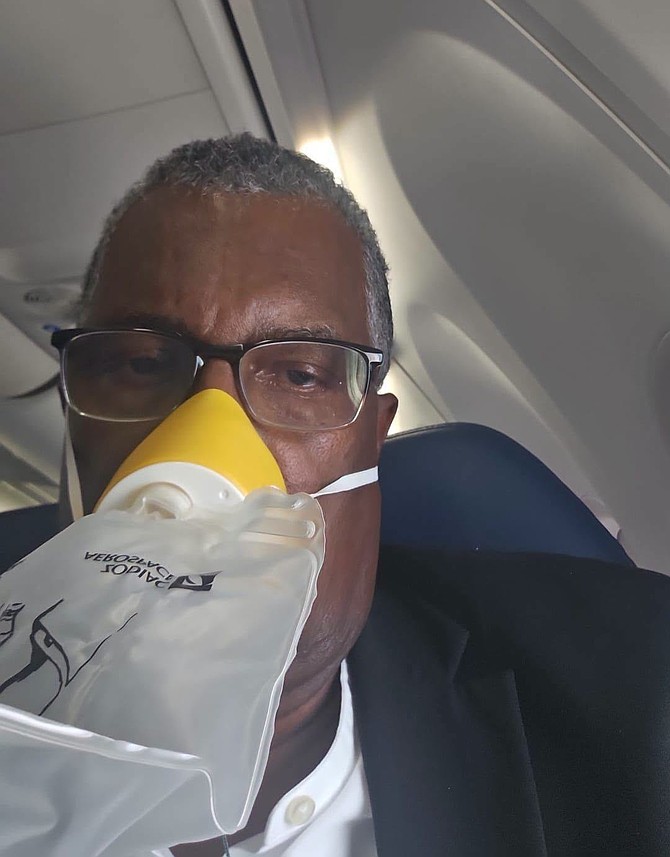
An international flight carrying top Bahamian diplomatic officials made an unplanned safe return to its departure point in Atlanta Friday following an unexpected in-flight emergency that forced activation of the aircraft’s oxygen mask system. Among the passengers on the Delta Air Lines Flight 1938, bound for Nassau from Hartsfield-Jackson Atlanta International Airport, were Bahamas Foreign Affairs Minister Fred Mitchell and the country’s ambassador to Qatar, Tony Joudi. Minister Mitchell shared firsthand details of the incident with the public in a post to his official Facebook page shortly after the aircraft landed safely back in Atlanta. According to Mitchell’s account, roughly 20 minutes after the flight departed, passengers felt the aircraft begin a sudden descent. Moments later, all oxygen masks deployed from their overhead compartments, and the pilot informed the cabin that the crew would implement standard emergency protocols: descending to 10,000 feet and returning to Atlanta to address the issue. Mitchell confirmed that all passengers and crew exited the aircraft without injury after landing. Aviation industry regulations from the U.S. Federal Aviation Administration (FAA) note that immediate cabin descent to 10,000 feet and activation of supplemental oxygen are standard response protocols for unplanned cabin pressurization failures at cruising altitude. At high altitudes, naturally low atmospheric oxygen levels create a serious health risk for passengers and crew if the cabin fails to maintain pressurization. On commercial aircraft, automatic oxygen mask deployment is triggered when the cabin altitude rises above pre-approved safety thresholds, though flight crews can also activate the system manually if needed. FAA certification rules require automatic activation before cabin altitude exceeds 15,000 feet to protect passenger health. As of the latest reporting, neither Minister Mitchell’s public account nor information obtained by The Tribune has confirmed the root cause of the incident, including whether the aircraft actually experienced a full loss of cabin pressure. After diverting back to Atlanta, Delta re-accommodated all passengers on a replacement aircraft, with an expected one-hour delay for the re-departure. In a subsequent update shared with The Tribune, Mitchell added that Delta provided all diverted passengers with a $12 meal voucher, and the replacement flight was scheduled to depart Atlanta at 3:10 p.m. for Nassau, which was originally scheduled to arrive at 2:00 p.m.