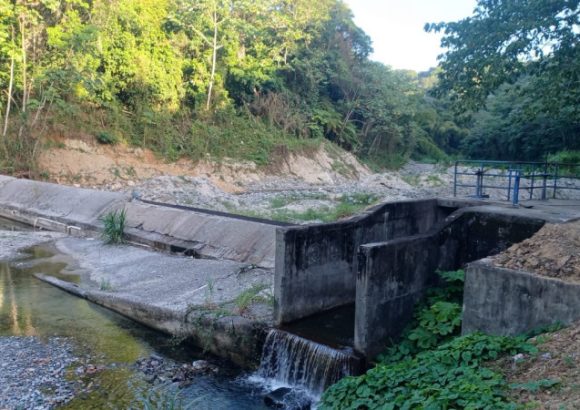
SANTO DOMINGO, Dominican Republic — A strengthening El Niño phenomenon is pushing the Dominican Republic toward one of its most severe drought events in modern history, bringing widespread cuts to water production and raising urgent concerns about long-term water security across the country, according to updated forecasts from U.S. and local meteorological authorities.
The U.S. National Oceanic and Atmospheric Administration (NOAA) confirmed in its August 13 update that there is a greater than 90% probability El Niño will continue to intensify through the coming months, reaching a peak of very high intensity. For the Caribbean region, this forecast translates to sharply elevated risks of sustained below-average rainfall and prolonged drought conditions that have already begun to upend normal water access for thousands of Dominican residents.
Since May, the key river basins that feed the country’s major aqueduct systems — including the Higüey, Isa-Mana, Duey, Isabela and Nizao rivers that supply the critical Valdesia aqueduct — have recorded dramatic drops in rainfall. Data from the Dominican Institute of Meteorology (Indomet) shows precipitation has remained well below historical seasonal averages for three consecutive months: a 46% deficit in May, a 54.5% deficit in June, and a 45.3% deficit in July.
These sustained dry conditions have gutted water production at the nation’s largest aqueduct networks, according to the Santo Domingo Aqueduct and Sewerage Corporation (CAASD). The Haina-Manoguayabo aqueduct, which is designed to output 90 million gallons of drinking water per day, was operating at just 21 million gallons daily as of mid-August, representing a 68% cut to total production. The Isabela aqueduct has seen a similar 65% reduction, falling from a normal 9 million gallons per day to just 3 million gallons daily. Both the Isa-Mana and Duey aqueducts have also endured production drops of more than 60% amid the ongoing dry spell.
The hardest-hit areas are low-income and elevated neighborhoods that already faced chronic groundwater scarcity, including the municipalities of Los Alcarrizos and Pedro Brand, and the districts of Los Peralejos, Pantoja and Los Girasoles. Multiple residential communities across the National District, including Puerta de Hierro, all three phases of Cuesta Hermosa, and areas south of Kennedy Avenue such as El Cacique, El Portal and 30 de Mayo in the university zone, are also grappling with severe service interruptions. CAASD communications director Fidel Sánchez told local outlet Listín Diario that households at higher elevations in these affected sectors face the most acute difficulties accessing consistent water service.
Looking ahead, Indomet’s seasonal projection for October through December predicts drought intensity could reach 69% — a level comparable to or exceeding the most severe dry events recorded in the country since 1950. Juana Sille, an Indomet meteorological specialist, noted that the country has a small buffer against the worst impacts: above-average rainfall in the first four months of 2025 left stored water reserves that have softened the blow of the mid-year rainfall deficit so far.
While a single hurricane during the remaining Atlantic hurricane season could bring enough precipitation to reverse current drought trends, current forecasts do not point to sufficient storm activity to ease conditions. An updated early August forecast from Colorado State University (CSU) lead researcher Phil Klotzbach projects total Atlantic cyclone activity will remain well below historical averages, with just nine named storms, four hurricanes, and only one major hurricane of Category 3 strength or higher.
As of mid-August, aggregated data from the National Institute of Hydraulic Resources (INDRHI) shows total national reservoir storage stands at 1.34 billion cubic meters of water, equal to 66.57% of total maximum capacity. Storage levels vary across the country’s major dams: the Monte Grande dam holds just 44.7% of its capacity, while Sabana Yegua and Sabaneta dams are at roughly 55% capacity. Larger dams including Hatillo and Monción hold between 80% and 88% of their maximum capacity, providing a partial buffer for the country’s long-term water needs amid the growing dry spell.