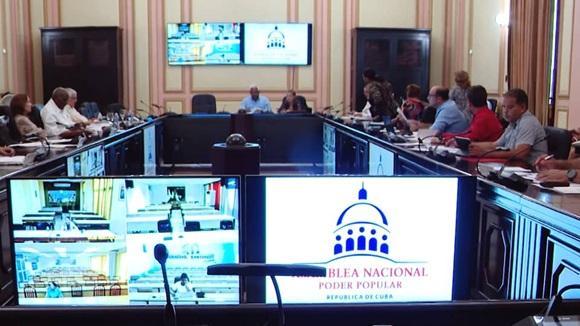
On Wednesday, Cuba’s State Council held a regular plenary session chaired by Council President Esteban Lazo Hernández, with top Cuban leader Miguel Díaz-Canel Bermúdez — First Secretary of the Central Committee of the Communist Party of Cuba and President of the Republic — in attendance. During the gathering, the council approved four new decree-laws designed to advance ongoing economic and social transformations aligned with updates to Cuba’s national economic model, alongside discussions focused on expanding grassroots citizen participation in local governance.
The first regulatory measure, presented by Lázara Mercedes López-Acea, head of the National Institute of Non-State Economic Actors, revises three existing decree-laws covering micro, small and medium-sized enterprises (MSMEs), non-agricultural cooperatives, and self-employment. The amendment targets unnecessary regulatory constraints, with the explicit goal of fostering more dynamic growth and diversity across Cuba’s entire business ecosystem by updating rules governing the approval, classification, organizational structure, operation, and operational autonomy of all economic actors.
A second decree-law, introduced by Minister of Finance and Prices Vladimir Regueiro Ale, establishes a mandatory civil liability insurance framework for all motor vehicle owners operating across Cuban public road and rail networks. The rule unifies disparate existing civil liability regimes for risks stemming from motor vehicle use, requiring all owners — whether individual or corporate, domestic or foreign — to hold a valid insurance policy, bringing regulatory practice in line with broader national economic and social changes.
Third, the new regulation on public bidding processes, presented by Minister of Economy and Planning Joaquín Alonso Vázquez, formalizes competitive bidding as the standard procedure for selecting contracting partners for all projects involving state resources. This applies to state and non-state economic actors alike across all sectors, including procurement of goods and services, public works, management of public space and production capacity, and other state resource uses, fitting into the broader framework of improving Cuba’s socialist economic and social model.
The fourth approved decree-law amends the existing Customs Tariff regulation covering non-commercial imports to Cuba. Also presented by the Ministry of Finance and Prices, the change aligns with national transformation priorities by authorizing individual travelers and non-commercial shipments to bring goods into Cuba for commercial purposes, without classifying this activity as formal foreign trade.
Beyond regulatory approvals, the session included a robust debate on expanding and strengthening the nationwide grassroots popular participation initiative “My Neighborhood for the Homeland.” The movement is organized around three core pillars: Safe Neighborhood, Productive Neighborhood, and Participatory Neighborhood, with the goal of boosting citizen engagement, facilitating collective problem-solving, and aligning local action with national priorities and community needs across all Cuban territories.
After Vice President of the National Assembly of People’s Power Ana María Mari Machado presented a report on the initiative’s progress and on-the-ground impact — which incorporated input from regional governors, municipal assembly leaders, representatives of political, mass and social organizations, and ordinary citizens — Lazo underscored the critical role of neighborhood-level community organizing in the Cuban Revolution. He emphasized that broad popular participation and mass mobilization, particularly at the district and people’s council levels, remain foundational to the country’s governance model.
During the session, José Luis Toledo Santander, Secretary of Cuba’s national legislature, outlined a slate of proposed actions for municipal people’s power assemblies to advance the implementation of ongoing national economic and social transformations. Key priorities outlined included strengthening the role of local people’s councils in assessing community-priority issues, expanding outreach for the “My Neighborhood for the Homeland” movement, and boosting popular oversight as a complement to formal administrative oversight at the local level. The session also included a review of outcomes from previous agreements to expand popular oversight and citizen participation, with participants reaffirming the importance of this work.
In addition to the core agenda items, the session included participation from chairs of all parliamentary committees and featured a routine review of agreements adopted at the State Council’s previous meetings.