In response to skyrocketing international crude oil prices stoked by escalating geopolitical tensions between the United States and Iran, the Dominican government is rolling out a new 1.312 billion Dominican peso (RD$) fuel subsidy this week to soften financial blow for local consumers, according to the nation’s Ministry of Industry, Commerce and Micro, Small and Medium Enterprises (MICM).
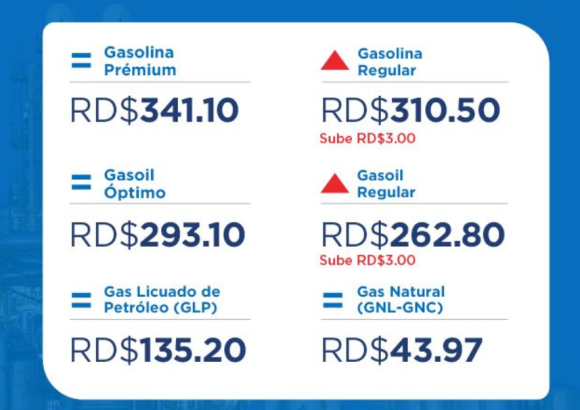
For the pricing week running from August 22 to August 28, regulatory adjustments will see retail prices for regular-grade gasoline and regular diesel rise by RD$3 per gallon respectively. By contrast, premium gasoline, premium diesel, liquefied petroleum gas (LPG) and residential natural gas will hold their current price points unchanged to avoid broader cost increases for households and businesses.
Under the Dominican Republic’s fuel pricing framework, the new subsidy covers up to RD$101.48 per gallon of fuel, offsetting a large portion of the global price surge. With this latest injection of public funding, the cumulative total of fuel subsidies disbursed by the Dominican government since the start of 2024 has now crossed the RD$27 billion mark, underscoring the sustained pressure global energy volatility has placed on the nation’s public finances.
Full adjusted pricing for the week of August 22–28 breaks down as follows: premium gasoline stays at RD$341.10 per gallon; regular gasoline climbs to RD$310.50 per gallon; regular diesel rises to RD$262.80 per gallon; premium diesel remains at RD$293.10 per gallon; aviation turbine fuel (Avtur) jumps RD$11.03 to RD$297.49; kerosene increases RD$12.10 to RD$336.70; Fuel Oil #6 gains RD$6.90 to hit RD$165.96; Fuel Oil 1%S rises RD$3.96 to RD$193.99; LPG holds steady at RD$135.20 per gallon; and natural gas stays at RD$43.97 per cubic meter.
MICM officials traced the upward pressure on global fuel prices directly to renewed hostilities between the United States and Iran, a major crude exporter that controls strategic access to the Strait of Hormuz, through which roughly a fifth of global oil supplies pass. The announcement of tougher U.S. economic sanctions on Iran, paired with the breakdown of diplomatic negotiations over security in the strait, has pushed West Texas Intermediate (WTI) crude to its highest price level in the past month, driving up costs for crude and refined petroleum products worldwide, including the gasoline and diesel that dominate Dominican energy consumption.
Even with the latest price adjustments, government authorities emphasized that current retail fuel prices remain within the bounds set by the administration’s national Anti-Crisis Plan, a policy package designed to shield Dominican consumers from global economic volatility. This framework includes the 90-day price stabilization measure announced on June 13, which has already capped sharp price increases for core fuel products through coordinated subsidy spending.