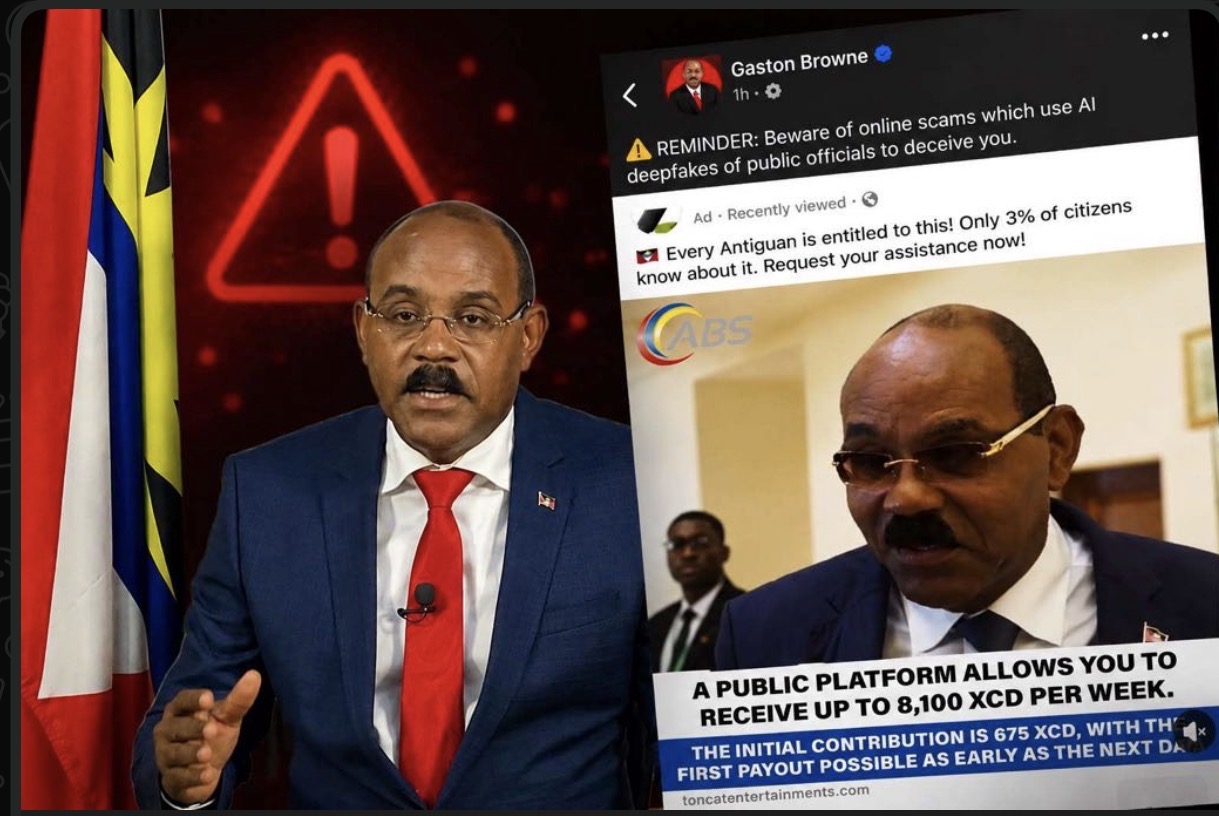
Prime Minister Gaston Browne of Antigua and Barbuda has sounded a urgent alarm for the nation’s public, cautioning residents against a rapidly spreading wave of fraudulent schemes that leverage artificial intelligence deepfake technology to impersonate high-ranking public officials. In an official address delivered this week, Browne laid out clear details of how bad actors are now using cutting-edge AI tools to create hyper-realistic fake audio recordings and manipulated video content that mimics the voices and likenesses of sitting government ministers and other senior public servants.
The schemes, which Browne confirmed have already targeted a small number of unsuspecting residents, follow a familiar but increasingly dangerous pattern: scammers reach out to individuals via phone calls, social media platforms, or email, using deepfake-generated content to convince victims that they are speaking directly with a trusted public official. Once they have built a false sense of credibility, the fraudsters pressure targets into handing over sensitive personal information, such as bank account details, national identification numbers, or make fraudulent demands for immediate cash transfers under false pretenses—often claiming the funds are needed for an emergency government service, a supposed official grant processing fee, or a private matter involving the official’s family.
Browne emphasized that this type of AI-powered fraud marks a troubling new evolution in criminal activity, one that is far more convincing to the average person than traditional scam tactics. Unlike generic phishing emails or simple phone impersonation, deepfakes can replicate facial expressions, vocal inflections, and mannerisms so accurately that even people who follow public officials closely can struggle to spot the forgery. The prime minister stressed that the Antiguan and Barbudan public must remain constantly vigilant when contacted by anyone claiming to be a government official, noting that no legitimate government representative will ever demand personal financial information or request direct cash payments via unsolicited communication.
He went on to outline steps that the public can take to protect themselves: if an unsolicited contact makes any request for money or personal data, residents should immediately end the communication and report the incident to local law enforcement and the country’s cybercrime unit. Browne also confirmed that government agencies are currently reviewing new regulatory frameworks and public awareness campaigns to address the growing threat of deepfake-enabled fraud, as officials work to stay ahead of criminals adapting new AI tools for illegal activity.
Local law enforcement officials have echoed the prime minister’s warning, noting that cross-border scam operations are increasingly turning to AI to lower their operational costs and increase their success rate. They added that anyone who has already fallen victim to one of these deepfake schemes should contact authorities immediately to limit potential financial damage and help investigators track down the responsible criminal networks.