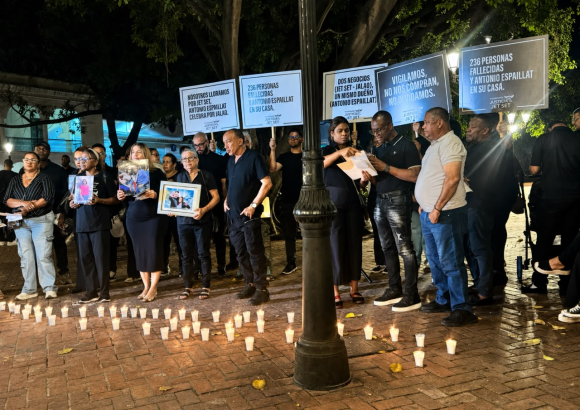
Nearly three months after the deadliest crowd disaster in Dominican Republic’s history claimed 236 lives at the Jet Set entertainment venue, grieving relatives and surviving victims gathered for a peaceful demonstration of remembrance and demand on Wednesday. The vigil took place outside Jalao, a popular nightlife spot located in the heart of Santo Domingo’s historic Colonial City, where participants carried hand-held candles and framed photographs of their lost loved ones to honor those who perished in the 2025 disaster.
Organized under the banner of the Jet Set Justice Movement, attendees drew a direct connection between Jalao and Antonio Espaillat, the businessman at the center of the ongoing legal investigation into the Jet Set collapse. Movement representatives labeled Jalao “Antonio Espaillat’s second Jet Set,” pointing out that the venue shares identical core functions with the ill-fated Jet Set: it hosts large-scale public gatherings, live musical performances, dance events, and on-site alcohol sales, operating as a major nightlife destination for locals and visitors alike.
According to timeline details shared by the movement, Jalao temporarily suspended operations on April 11, 2025, just three days after the catastrophic Jet Set tragedy unfolded. However, the venue was allowed to reopen its doors to the public barely three weeks later, on May 3, 2025, and immediately resumed hosting high-attendance events and live entertainment. This rapid return to full operation has raised sharp questions from victim families, who are challenging how an individual facing ongoing criminal investigation and formal legal proceedings tied to the country’s deadliest civilian disaster could retain the ability to operate a second, similar entertainment venue.
The core demand of the gathering extends beyond regulatory scrutiny of Jalao: participants are calling on Dominican national and local authorities to release full, public documentation of all safety inspections, operating permits, approved maximum occupancy levels, emergency evacuation blueprints, and ongoing safety control protocols that have been applied to Jalao both before its initial closure and following its May reopening. Throughout the demonstration, participants maintained a peaceful posture, with no reports of clashes, property damage, or disruptions to local activity. Movement leaders emphasized that their primary goal is not protest for protest’s sake, but to secure greater institutional transparency and ironclad guarantees that a disaster of this catastrophic scale will never be repeated in the Dominican Republic.