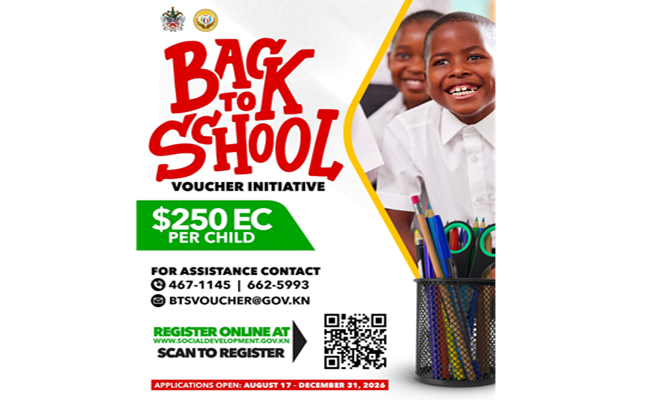
As families across the Federation of St. Kitts and Nevis gear up for the 2026–2027 academic year, the national government has launched its annual Back-to-School Voucher Programme, rolling out targeted cost-of-living relief to ease growing household financial burdens amid ongoing global economic headwinds. Announced on August 17, 2026 via a press release from the Prime Minister’s Office, the initiative will deliver EC$250 in direct assistance to every eligible child enrolled in licensed, registered educational institutions across the country, spanning pre-schools, primary schools, secondary schools, and accredited tertiary education providers.
The programme is open for applications from its launch date through December 31, 2026, and the vouchers are intended to cover back-to-school essentials ranging from school uniforms to textbooks and other required educational supplies. The policy comes as many nations across the Caribbean and the broader global economy continue to grapple with stubbornly high inflation, elevated consumer prices, and external economic shocks that have stretched household budgets thin. Against this challenging backdrop, the Drew-led administration has emphasized it will not remain passive amid public financial strain, instead committing to rolling out concrete, targeted interventions that shield families and boost their economic resilience.
Prime Minister Hon. Dr. Terrance M. Drew framed the voucher programme as a tangible demonstration of the government’s commitment to standing with the people of St. Kitts and Nevis, particularly during a season that already brings a predictable spike in household expenses. “In these challenging global times, marked by persistent inflation and rising costs, our Government remains resolute in our mission to ease the burden on our families. The 2026 Back-to-School Voucher Programme is more than just financial assistance; it is a clear signal that we stand with our parents and guardians as they invest in the education of our children – the very architects of our Nation’s future,” Drew stated.
The prime minister added that the voucher programme is being paired with two additional complementary policies: discounted value-added tax (VAT) rate days and extended duty-free concessions on school supplies, creating a three-pronged relief package designed to ensure no family is left struggling to prepare their children for the new school year. “We have created a powerful trifecta of cost-of-living relief specifically designed to ensure that no child is left behind and that every family starts this academic year with hope and economic security,” Drew said.
Far from a one-off measure, the 2026 voucher initiative is part of a broader governing strategy that balances expanding social protection for working families with careful fiscal stewardship to safeguard national economic stability. Since taking office, the Drew administration has implemented a suite of pro-household policies: it has raised the national minimum wage to the highest level among independent Organization of Eastern Caribbean States (OECS) member states, increased salaries for civil servants, introduced gratuity and pension benefits for government auxiliary employees, expanded health coverage for public workers, established a national Children’s Medical Fund, and allocated EC$1,000 to eligible children aged 5 to 18 through the ASPIRE programme. Even as it expands social support, the government has deliberately pursued policies to strengthen the national fiscal position and cut the country’s fiscal deficit substantially.
This policy approach reflects the administration’s core belief that broad economic progress must translate directly into improved financial security and expanded opportunity for ordinary citizens. The government has prioritized balancing responsible fiscal management with direct, immediate interventions to protect household disposable income, cut living costs, and prevent vulnerable communities from bearing the full brunt of global economic volatility alone.
The 2026 Back-to-School Voucher Programme is also a core component of the government’s wider 2026 Summer Support Strategy, which includes the two discounted VAT days scheduled for August 28 and 29, 2026, as well as duty-free concessions on eligible school supplies that launched July 1 and will remain in effect through September 30. Taken together, the suite of policies is designed to create extra financial breathing room for families as they prepare children for the start of classes. This year’s programme builds on the initial back-to-school voucher framework first introduced by the Drew administration in 2023, extending a proven policy of direct, practical support for household education costs.
To streamline access and speed up application processing, the programme uses a simplified online application system as its primary channel for collecting applicant information. To qualify as a main applicant, individuals must be adults aged 18 or older, listed as the parent, guardian, caregiver, or responsible contact on the child’s school official records, hold a valid contact number and email address, maintain an active JAD digital wallet (the same payment infrastructure used for previous government relief initiatives such as the Budget Boost Wallet), and consent to the verification and authorized use of submitted information for programme administration.
For children to qualify for the voucher benefit, they must be included on a complete submitted application, be enrolled or accepted for enrollment for the 2026–2027 academic year at a registered educational institution within the Federation, have their enrollment status confirmed via the official school roll or an approved alternative verification process, and not have already received the 2026 voucher benefit via another applicant’s submission.
Administrative rules stipulate that each applicant may submit only one application, which can include multiple eligible children, with benefits calculated strictly on a per-child basis. Once approved, funds are deposited directly into the applicant’s existing JAD digital wallet. Approval is conditional on successful identity verification for both the applicant and child, confirmation of the child’s enrollment status via official school records, and validation of the applicant’s active JAD wallet.