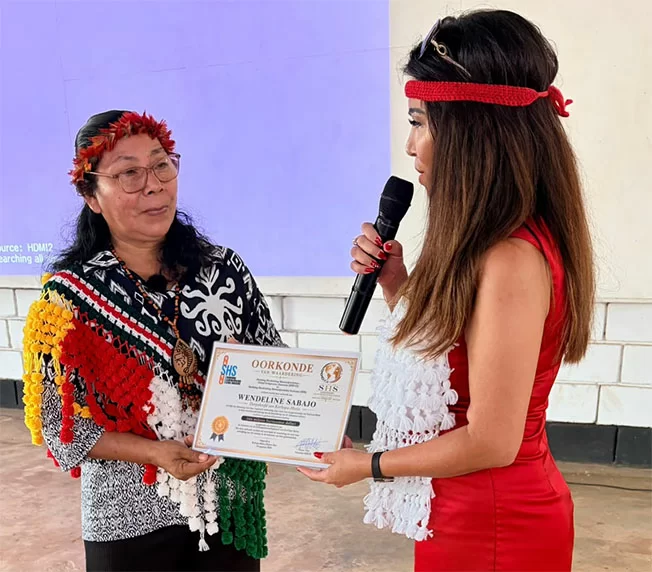
An indigenous Lokono community in Suriname, Korhopa-Matta, has taken a major step forward in community-led development after securing a 1 million Surinamese dollar grant and signing a long-term partnership framework with the Stichting Herdenking Slavernijverleden – Global Indigenous Amazone (SHS-GI) last Friday. The agreement, formalized via a signed Memorandum of Understanding (MoU), included a symbolic handover of the funding to village head Wendeline Sabajo during a public community gathering.
The grant is earmarked for the urgent renovation of Wasjikwa, the community’s central shared recreational and gathering space. Translating to “the house” in the Arawak language spoken by the Lokono people, Wasjikwa hosts a wide range of local activities, from skills training sessions and community meetings to collective cultural events. The aging structure has long been in need of critical maintenance to continue serving the village’s growing needs.
Beyond infrastructure upgrades, the newly formalized partnership covers a broad spectrum of community priorities. The MoU outlines joint work across eight key areas: cultural heritage preservation, historical documentation, academic research, youth development, digital ICT access, sports programming, and broad-based economic and social development. A core guiding principle embedded in the agreement is full community autonomy: Korhopa-Matta retains full decision-making power over all development directions, with the partnership built on values of consensus, transparency, and respect for traditional indigenous governance. SHS-GI’s role is framed as supportive, focused on providing resources and connecting the community to broader networks rather than directing initiatives.
Ahead of the MoU signing, Sabajo delivered a presentation outlining the community’s existing challenges and long-term development goals. Among these priorities are expanding economic opportunities for young residents, strengthening local economic resilience, and developing sustainable community-led tourism. Korhopa-Matta has also issued an open call to independent entrepreneurs and other potential partner organizations to explore collaborative projects that align with the community’s needs and values.
During the gathering, attendees also addressed ongoing systemic challenges facing the community. In a positive update for local education, it was announced that every Matta student who recently completed primary leaving examinations passed and qualified to advance to secondary education. Despite this milestone, significant barriers remain: reliable transportation and adequate boarding for indigenous students who must relocate to urban centers for secondary schooling continue to be unmet critical needs.
Agricultural challenges were also discussed, with the community reporting widespread cassava crop failure caused by an emerging plant disease, threatening local food security and livelihoods. The new partnership will prioritize work to build the community’s resilience to such shocks, aligned with Korhopa-Matta’s core commitment to collective self-reliance. Beyond these immediate issues, the community highlighted that many indigenous villages across the region lack basic essential services, including clean drinking water, sports infrastructure, and safe recreational spaces for children.
The gathering also centered the rights of indigenous communities in natural resource governance. Initiative leaders emphasized that indigenous villages currently bear the full brunt of environmental and social harms from extractive activities, including gold mining and logging, yet see very little of the economic benefits generated from resources on their traditional lands. The event also included a commemoration of historic indigenous resistance leaders including Kaikoesi, Tonay, Priyari, Arybare, and Sowana, drawing a clear line between the 19th and 20th century fights for land, dignity, and indigenous rights and the contemporary movement for recognition and self-determined development.
With the signed MoU now exchanged, the formal partnership has officially launched. Both parties are now moving forward to translate the agreement’s broad commitments into concrete, actionable projects for the Korhopa-Matta community. Emphasizing the transformative nature of the work, SHS-GI initiative leaders noted: “This is not charity. It is an investment in the strength, knowledge, governance capacity, and future of Korhopa-Matta.”