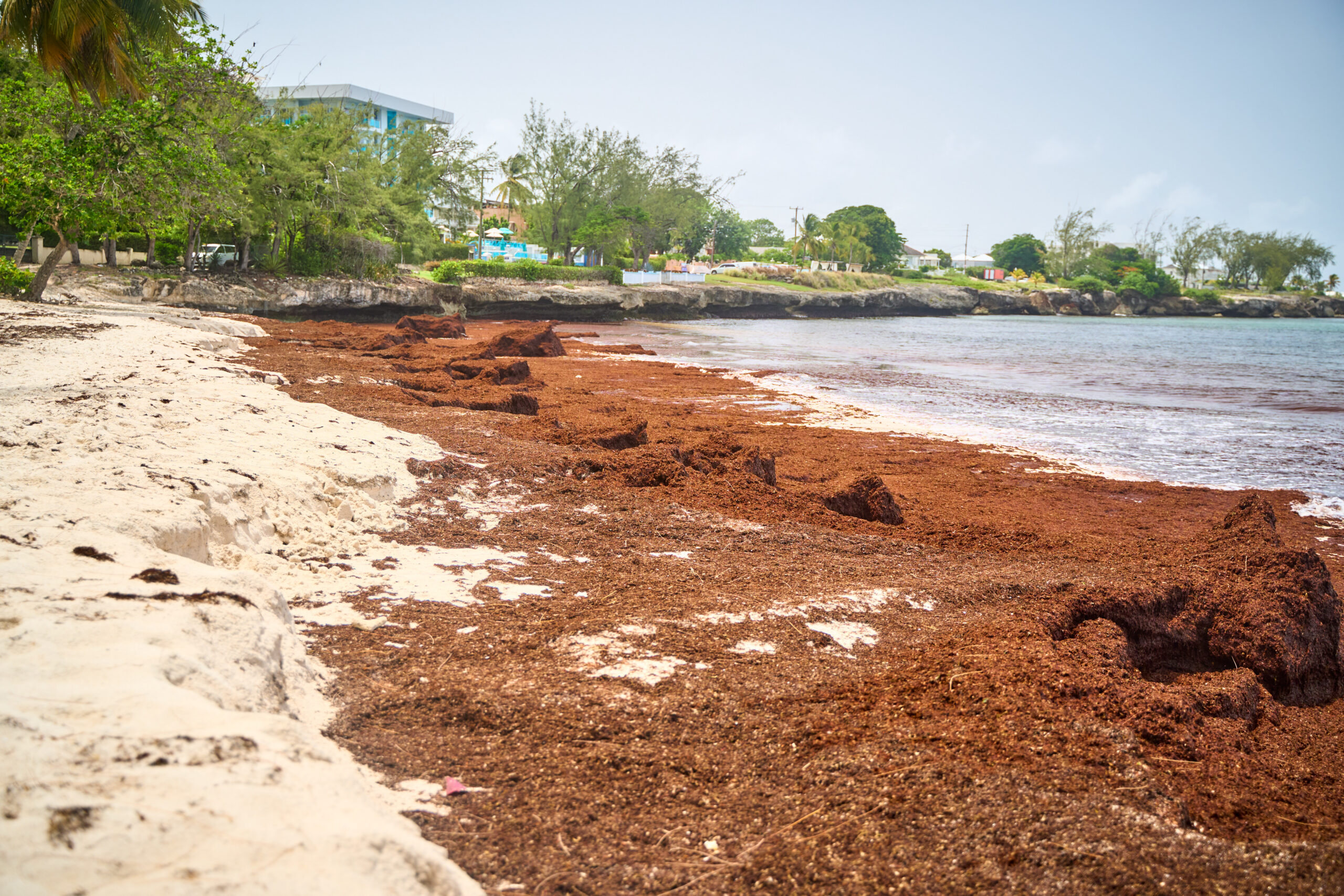
Known to locals as Miami Beach, Enterprise Beach in Oistins, Barbados has long been a beloved, tranquil coastal retreat. Today, that idyll has been completely swallowed by a thick, uncrossable mat of sargassum seaweed that has turned the once-clear shoreline murky, driven most visitors away from the water, and carved deep into the profits of local business owners who rely on beachgoing tourism.
When a reporting team from Barbados TODAY visited the site recently, the scale of the problem was immediately visible: towering piles of brown seaweed lined the entire coast and drifted in dense mats just offshore, with only a tiny handful of visitors braving the conditions to enter the water. Among the few who attempted a quick swim was one elderly local, who drew a comparison to sargassum management efforts he saw during a trip to Mexico. In Mexico, he explained, authorities deploy heavy machinery to consistently clear the seaweed, and he argued that constant, large-scale removal using tractors is the only viable solution to Barbados’ growing crisis.
For the entrepreneurs and workers who depend on Enterprise Beach for their income, the worsening sargassum accumulations have become an unavoidable threat to their livelihoods. David Knight, a chef who has run the Tacos on the Bay food truck in the area for two years after returning to Barbados following 40 years living in the United States, said the recurring bloom has already hit his bottom line hard. “The sargassum definitely slowed the business down,” Knight explained, adding that the heavy seaweed buildup is a predictable seasonal problem that typically arrives around January and February, washing in and out repeatedly through the early months of the year.
Knight and other local business owners have repeatedly appealed to authorities to address the crisis, but so far those requests have gone unanswered. He said he reached out directly to the National Conservation Commission (NCC), only to be told that part of the beach falls under a private contract, and that the agency has no plans to intervene. Knight argued that disproportionate attention and resources are directed to the more high-profile main beach at Oistins Bay Gardens, leaving Enterprise Beach to deteriorate unnoticed.
Beyond the sargassum crisis, Knight also highlighted other unaddressed issues holding the beach back, calling for increased public investment to add more vendor stalls and expand food options to attract more visitors, as well as a greater police presence, noting that three tourists have been robbed in the area since he opened his food truck. On the day of the Barbados TODAY visit, the usually popular beach was almost entirely empty of visitors, even amid peak summer travel season.
Barbados has been fighting increasingly severe annual sargassum influxes since 2011, with the recurring blooms creating widespread challenges for coastal tourism, commercial fisheries, and local communities across the island. The problem is not unique to Barbados: the Great Atlantic Sargassum Belt, the massive collection of drifting seaweed that spans the Atlantic Ocean, hit near-record levels in recent weeks, just one year after reaching an all-time historic high. Vast mats of the seaweed are currently blanketing coastlines across the Caribbean, Mexico’s Yucatán Peninsula, Puerto Rico, and parts of southern Florida. As the sargassum decays, it releases pungent hydrogen sulfide gas that smells like rotten eggs, drives away visitors, and disrupts fragile coastal ecosystems.
The Barbados government has repeatedly promised to ramp up its response to the crisis, including developing plans to collect sargassum offshore before it can wash onto public beaches. In a promising development that could turn the nuisance into an economic opportunity, scientists at the University of the West Indies (UWI) Cave Hill campus have made breakthroughs that could unlock commercial value from the excess seaweed. Dr. Bidyut Mohapatra discovered three new microorganisms living in decomposing sargassum, while a separate research team led by Dr. Legena Henry completed a successful pilot trial converting sargassum into biofuel. The breakthroughs have raised hopes that the persistent coastal problem could eventually become a valuable resource for biotechnology and energy industries in Barbados.
Barbados TODAY has confirmed that responsibility for sargassum clean-up efforts falls under the Ministry of Environment, rather than the NCC, which oversees the management of the country’s public parks and beaches. As of this report, Ministry officials have not responded to requests for comment on the ongoing crisis at Enterprise Beach.