As Suriname wraps up its 2026 Heritage Month, national leaders have announced a lasting commitment to preserving and celebrating the country’s diverse cultural roots, promising government funding for targeted academic research and cultural projects focused on Surinamese heritage after the month-long celebration concludes.
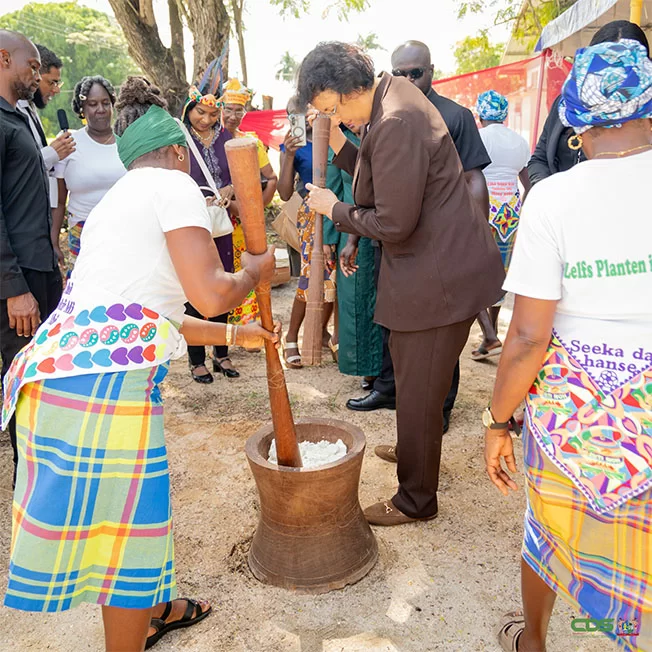
The announcement was made by President Jennifer Simons this past Friday during a student-organized mini-congress held at the Anton de Kom University of Suriname (AdeKUS), an event designed to center conversations around heritage, scientific inquiry, cultural identity, and heritage’s evolving role in modern Surinamese society. The congress, held as a core part of 2026 Heritage Month programming, was paired with a public Heritage Fest that gave attendees the chance to engage with traditional food and drink from Suriname’s many distinct cultural communities. According to the Communication Service of Suriname, the festival also featured dedicated exhibit spaces showcasing cultural artifacts and educational materials highlighting the unique heritage of each of the country’s population groups. Event photos even captured President Simons participating in traditional cassave pounding, demonstrating her hands-on engagement with local cultural practices.
In her keynote address to attendees, President Simons emphasized that Heritage Month extends far beyond a simple annual cultural celebration. For the country, the initiative serves a critical purpose: helping Surinamese people deepen their sense of shared responsibility for the nation’s future. Greater public awareness of personal history, ancestral origins, and collective national identity, she argued, is a foundational building block for mutual understanding and cross-cultural respect across communities.
“Heritage Month aims to help every person better understand themselves, and learn to respect themselves — because if you respect yourself, you can extend that same respect to others,” Simons told the audience. The president stressed that Suriname draws its core national strength from its longstanding cultural diversity, and that cross-generational collaboration is essential to building a society that actively values and protects differences between communities.
Looking beyond the 2026 celebration, Simons outlined next steps for the initiative: following the conclusion of this year’s Heritage Month, an official post-event report will be compiled to guide preparations for the 2027 iteration. Crucially, the national government will allocate dedicated funding to support academic research, artistic expression, and community-led heritage projects in the months between annual celebrations.
“After this year’s event, the government will make funding available for scientific research, artistic projects, and a wide range of initiatives centered on themes put forward by Surinamese civil society,” Simons said. She explained that the long-term goal is to keep young people, researchers, and cultural organizations actively engaged in heritage-focused projects throughout the year, so that their work can contribute to more robust and inclusive future Heritage Month programming. The president issued a special call to university students, urging them to deepen their exploration of both Suriname’s rich history and its dynamic contemporary society, noting that this knowledge will foster a stronger, more cohesive national community.
Education, Science and Culture Minister Dirk Currie echoed the president’s remarks, focusing his address on the critical role that academic institutions like AdeKUS play in advancing heritage preservation. Currie argued that the university’s mission goes far beyond simply transmitting existing knowledge to students; it also has a responsibility to generate new, evidence-based insights to solve pressing social challenges.
“A university does not only have the job of passing on existing knowledge. It also has a responsibility to create new knowledge,” Currie stated. The minister noted that durable, effective public policy can only be developed when it is rooted in rigorous research, community-derived data, and on-the-ground insights from across Suriname. He encouraged all Surinamese people to take ownership of the country’s national unity, framing cultural diversity not as a source of division, but as one of the nation’s greatest assets. Currie concluded by emphasizing that the country’s history, collective identity, and shared heritage must be protected through scientific inquiry and documented by the Surinamese people themselves.