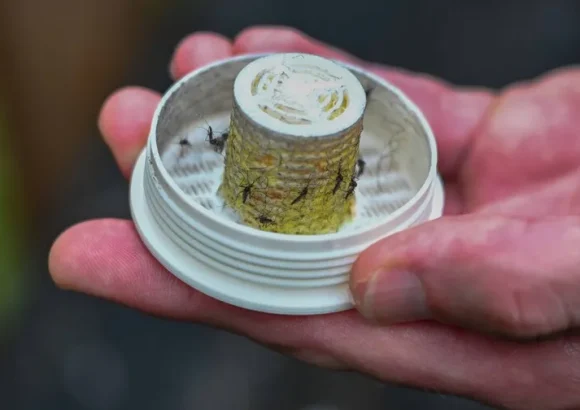
Against a backdrop of rising temperatures driven by climate change that are expanding the active season for disease-transmitting insects, the United States has launched its first ever residential pilot program deploying non-biting male mosquitoes infected with the naturally occurring bacterium Wolbachia to curb mosquito-borne disease spread.
On a recent afternoon just outside of Washington D.C., Todd Montgomery, 32-year-old founder of the private firm Bee Safe Mosquito Control, twisted open the cap of a small tube and released hundreds of specially modified mosquitoes into a suburban residential yard.
Unlike common pest control methods that rely on pesticide spraying, this approach targets the Aedes albopictus, or tiger mosquito, an invasive species that acts as a vector for dangerous diseases including dengue. The tactic leverages a unique biological mechanism: the released males carry a specific strain of Wolbachia that naturally occurs in some insects, and when they mate with wild, uninfected female tiger mosquitoes, their eggs fail to hatch, gradually suppressing the local population over time. The service, branded “ZAP Males,” is the first initiative of its kind offered to private residential homeowners across the country. By the end of the summer, the company plans to release a total of 600,000 modified mosquitoes across the region.
Montgomery, a former electrical engineer who launched the company in 2023, framed the effort as a critical response to growing risks tied to climate change. “With climate change, we are facing a ticking time bomb,” he told AFP. Rising average temperatures across most of the U.S. have extended the stretch of warm, humid conditions that disease-carrying mosquitoes need to thrive, lengthening their active season and increasing public exposure to mosquito-borne illness. The urgency of the issue has been amplified locally by the recent confirmation of the first locally acquired case of dengue in Northern Virginia.
The pesticide-free approach fills a growing demand from homeowners who are wary of chemical fumigation, which many avoid due to links between some common pesticides and increased cancer risk. For 67-year-old breast cancer survivor Sandra Marquardt, the program offered a solution to a dilemma: she refused to spray chemicals on her lush property, but was frustrated by constant mosquito infestations that left her unable to enjoy the large garden she tends each year. Marquardt told reporters she has been impressed with the results, calling the Wolbachia mosquito intervention “surprisingly effective.”
So far, 25 residential customers have signed up for the program. Each participating property receives 1,500 modified males per week over 16 weeks, adding up to the full 600,000 mosquitoes the company will release by the end of the pilot. The method has already been deployed at large scale in other parts of the world: Singapore runs the world’s largest public sector Wolbachia program, which launched in 2016 and now releases more than 10 million modified mosquitoes weekly. A peer-reviewed study published in the *New England Journal of Medicine* found that the approach reduced the Aedes mosquito population by a substantial margin, cutting the risk of dengue transmission by more than 70%.
Still, results have varied for early participants in the U.S. pilot. April Chunko, a 44-year-old mother of a young child from Silver Spring who joined the program immediately due to her distrust of harsh chemicals around her son’s backyard sandbox, says she has not yet noticed a major reduction in biting mosquitoes. Chunko noted her property sits adjacent to a dense stretch of trees, which may complicate the program’s local effectiveness.
Experts note that outcomes of the Wolbachia suppression method do depend on local geographic and environmental conditions. Marcelo Jacobs-Lorena, an emeritus professor at Johns Hopkins University who specializes in mosquito-borne disease research, explained that wild mosquitoes can travel with wind currents, meaning results vary based on local landscape features.
Jacobs-Lorena also highlighted an alternative approach to leveraging Wolbachia that focuses on disease blocking rather than population reduction. Instead of only releasing infected males to suppress populations, this method releases both males and females that carry the same Wolbachia strain. This allows eggs to hatch normally, leading the bacteria to spread through the entire local mosquito population. Since Wolbachia naturally blocks the replication and transmission of viruses that cause dengue, Zika, and chikungunya, mosquitoes can still bite humans but no longer spread these dangerous diseases.