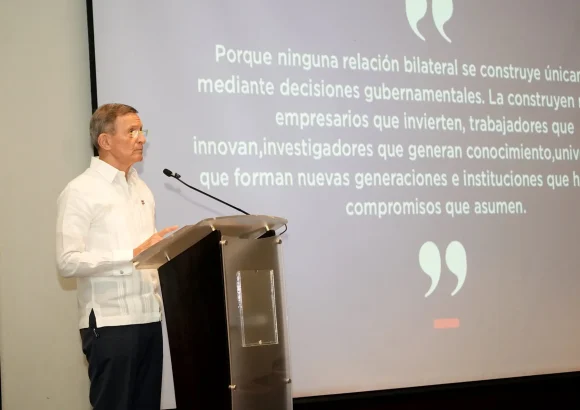
Speaking at an industry gathering in Santo Domingo, Dominican Republic’s top diplomat has laid out a clear vision for expanded economic collaboration between his country and Mexico, centered on leveraging complementary industrial strengths to unlock shared global market opportunities.
Foreign Minister Roberto Álvarez made his remarks at a working luncheon hosted by the Dominican-Mexican Chamber of Commerce and Investment (Cadomex), where he framed the Dominican Republic’s growing manufacturing output as a strategic asset that can reshape bilateral commercial and investment ties for long-term mutual benefit.
Álvarez argued that the combination of Mexico’s well-established industrial base, extensive regional supplier network, and decades of global manufacturing experience, paired with the Dominican Republic’s agile, fast-growing manufacturing sectors, favorable geographic position near major North American markets, preferential trade access to dozens of global economies, consistent macroeconomic stability, and ongoing institutional improvements, creates a uniquely favorable landscape for scaling up bilateral economic engagement.
A core part of Álvarez’s proposal is deeper supply chain integration between the two nations. He explained that weaving Mexican raw materials, manufactured components, and specialized industrial processes into Dominican production lines would boost the global competitiveness of goods from both countries, creating new pathways for the two nations to jointly enter and serve fast-growing international markets that neither could access as effectively working independently.
Beyond trade and manufacturing, the foreign minister emphasized that the decades-long bilateral relationship between the Dominican Republic and Mexico is rooted in deep mutual trust and diplomatic maturity. This solid foundation, he said, creates space to expand cooperation into other high-priority strategic areas, including tackling shared regional environmental challenges such as the widespread economic and ecological damage caused by massive sargassum blooms across the Caribbean.
Álvarez also highlighted Mexico’s already significant economic footprint in the Dominican Republic, noting that Mexico ranks among the country’s top sources of foreign direct investment. Cumulative Mexican investment in the Dominican Republic has surpassed $3 billion, spread across major operating firms including Claro Dominicana, Bepensa, Sigma Alimentos, and The Palace Company.
In closing, the minister credited the private sector as a central driving force behind the strengthening of bilateral ties, noting that business leaders have been instrumental in developing cross-border supplier networks, fostering innovative industrial partnerships, and building durable economic connections between the two countries. He closed by issuing a call to private sector leaders from both nations to engage actively in shaping and advancing the next phase of the Dominican-Mexican economic partnership.