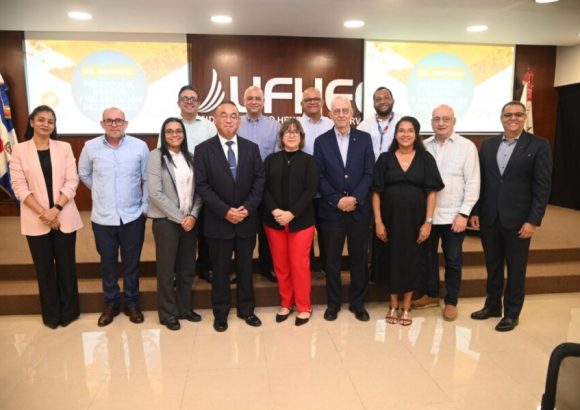
In Santo Domingo, the Dominican Republic, an unprecedented collaborative gathering is advancing a radical rethinking of one of the Caribbean’s most pressing environmental headaches: massive, recurring sargassum blooms that choke coastlines, damage tourism, and disrupt coastal ecosystems. The Federico Henríquez y Carvajal University (UFHEC) recently played host to the inaugural SARGARD Network Symposium, a landmark event that brought together Dominican and international research communities to share breakthrough work that reframes the invasive macroalgae from a costly problem into a catalyst for inclusive, circular sustainable growth.
The symposium was organized as a core feature of the Ministry of Higher Education, Science and Technology (MESCyT)’s annual Dominican Science and Technology Week, a platform designed to showcase the nation’s growing research capacity and foster global academic connections. The event opened with a keynote address from Professor Satoshi Nakai of Japan’s Hiroshima University, setting a collaborative, forward-looking tone for the proceedings. Following Nakai’s talk, researchers from five leading Dominican higher education institutions — UFHEC, the Instituto Tecnológico de Santo Domingo (INTEC), Pontificia Universidad Católica Madre y Maestra (PUCMM), ISA University, and Universidad APEC (UNAPEC) — took the stage to present their latest findings across a diverse range of sargassum-focused research areas.
Attendees were treated to presentations spanning cutting-edge practical and technical applications of sargassum utilization. Research topics ranged from improved sargassum monitoring and forecasting systems, which help communities prepare for incoming blooms and coordinate collection efforts, to innovative approaches for converting the biomass into valuable goods. Experts shared progress on developing bioenergy from sargassum, creating natural agricultural biostimulants to boost crop yields, and advancing biotechnological processes that extract high-value biomolecules. These extracted compounds show significant promise for use across multiple commercial sectors, including pharmaceuticals, cosmetics, nutraceuticals, and mainstream food production. Other highlighted innovations included microwave-assisted pyrolysis for biomass conversion and the development of sargassum-based hydrogels for industrial and environmental uses.
The cross-sector nature of the symposium underscored the complexity of the sargassum challenge and the need for coordinated action beyond academic walls. Attendees included representatives from key Dominican government bodies, such as the Ministry of Environment, the national Sargassum Control Cabinet, the National Maritime Authority (ANAMAR), and the Dominican Institute of Civil Aviation (IDAC), alongside private sector stakeholders from the Dominican Republic, Japan, and Italy. This multi-stakeholder turnout reinforced widespread commitment to co-developing scalable, innovative management and utilization strategies for the macroalgae.
In his opening remarks, Darwin Muñoz, UFHEC’s Vice Rector for Science, Technology and Innovation, stressed that no single institution or nation can address the far-reaching impacts of sargassum blooms alone. The excess macroalgae, which has increasingly inundated Caribbean coastlines in recent years, inflicts widespread damage across the region: it harms coastal ecosystems, cuts into tourism revenue, and disrupts small-scale fishing livelihoods. Muñoz’s call for cross-border, cross-sector joint research echoed the consensus that emerged from the symposium: rather than treating sargassum as waste to be disposed of, the global community should frame it as an abundant, valuable biomass resource. Under a circular economic framework, proponents argue, sargassum can be transformed into renewable energy, sustainable agricultural inputs, and high-value industrial materials — turning a persistent crisis into an opportunity for long-term, inclusive economic growth across the Caribbean.