Against a backdrop of mounting global economic instability, Barbados has recorded a notable slowdown in economic expansion during the first half of 2026, according to an official announcement from the Central Bank of Barbados released Thursday. While domestic economic fundamentals have remained surprisingly resilient, simmering geopolitical tensions, soaring global inflation, and rising interest rates have cast a long shadow over the island nation’s medium-term growth outlook.
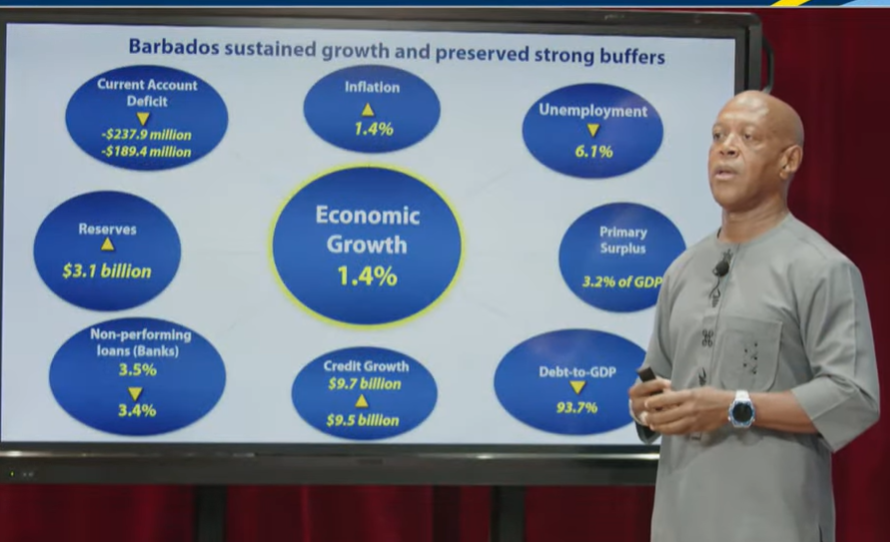
Central Bank Governor Dr. Kevin Greenidge outlined the latest GDP figures during a press briefing for the bank’s quarterly economic review, noting that year-on-year real GDP growth hit 1.4% in the first six months of 2026, down from the 2% expansion recorded in the same period a year earlier. Compared to the first half of 2025, real growth dipped by 0.6% on an adjusted basis. At the close of the first quarter of 2026, growth stood at 1.7%, and the bank had previously projected annual growth between 2% and 3% for the remainder of the year and over the medium term. That outlook has shifted considerably since that initial projection, Greenidge explained, as the global operating environment has grown “steadily more uncertain.”
Two major geopolitical flashpoints are the primary drivers of this heightened uncertainty, Greenidge confirmed: the ongoing conflict in the Middle East, which has roiled global oil markets and tightened global supply chains, and the protracted war in Ukraine, which has added additional braking pressure to global and local growth alike. These disruptions have fueled persistent global inflation, which has eroded household purchasing power worldwide and altered consumer spending patterns in Barbados’ key trading partner economies. The spillover effects have also reached global financial markets: inflation expectations have climbed over the past six months, pulling benchmark interest rates higher across major economies, including the United States.
As borrowing costs rise globally, government budgets are coming under increasing strain, Greenidge noted. Leading economic analysts expect interest rates to continue climbing over the medium term, a trend that will constrain both public and private investment – and Barbados is not insulated from these global pressures, the governor emphasized.
Despite these mounting external headwinds, Greenidge moved to reassure domestic stakeholders that the Barbadian economy has held up far better than many peer economies, absorbing successive global shocks while maintaining positive growth and robust reserve levels. This resilience, he argued, is the product of targeted policy buffers built up over recent years, including deliberate government actions to shield households and businesses from the full impact of sky-high global oil prices, which have remained elevated since the latest wave of geopolitical disruption.
Looking ahead, Greenidge outlined the core policy priorities to preserve stability and strengthen long-term growth: efficient public expenditure management, continued improvements to tax administration, and targeted fiscal savings to rebuild the nation’s “rainy day” contingency funds, which will enable a rapid policy response if global conditions deteriorate further. The government must also deliver critical planned investments in public infrastructure, digital connectivity, healthcare, and education, all while keeping public debt on a firm downward trajectory. A declining debt-to-GDP ratio remains the key benchmark for long-term fiscal sustainability, Greenidge stressed, and the government remains committed to continuing this downward trend.
Breaking down domestic performance for the first half of 2026, the non-traded domestic sector led overall growth, expanding by 1.5% year-on-year. Business services and other service industries drove this expansion, with wholesale and retail trade also contributing positively, and the construction sector recording modest growth. The traded sector also notched a 0.4% expansion.
Tourism, which accounts for roughly half of Barbados’ traded economic output, remained near its 2025 level, with a small uptick in long-stay visitor arrivals offset by shorter average trip lengths that left total visitor nights largely unchanged. Agriculture contributed to overall growth, while manufacturing output held steady compared to a year earlier.
Labor market indicators remained broadly positive through the first half of the year, Greenidge reported, though the most recent data only extends through the end of March. Unemployment stood at 6.1% at that point, a 0.2 percentage point drop from 2025 levels, and new unemployment claims fell 3.7% between January and June. The overall labor force shrank by 2,700 people over the period, driven largely by rising retirements, meaning the lower unemployment rate reflects both fewer unemployed workers and a decline in labor force participation.
Inflation has climbed from its recent historic lows but remains contained due to proactive government policy. The 12-month moving average inflation rate hit 1.4%, while point-to-point inflation reached 2% in May, driven by higher prices for food, education, housing, utilities, and transport. Government policy interventions have successfully softened the pass-through of global cost increases to domestic consumers.
Barbados’ external financial buffers remain strong, further reinforcing the nation’s ability to withstand external shocks. International reserves rose by $91.8 million between the end of December 2025 and June 2026, reaching a total of $3 billion, enough to cover 25.9 weeks of imports – well above the internationally accepted adequacy threshold. The current account deficit narrowed to $189.4 million over the period, as stronger net current transfers and a smaller income deficit more than offset a widening merchandise trade deficit and a modestly smaller services surplus.
On the fiscal front, the government comfortably exceeded its primary balance target under the 2026 BERT economic program. It maintained substantial primary surpluses even while increasing spending on public goods, services, institutional support, and capital projects. While both total and primary surpluses narrowed slightly year-on-year, the primary surplus remained well above the program’s required floor. Sustained primary surpluses and ongoing economic growth have continued to pull down public debt: gross public debt stood at $15.1 billion at the end of June, $250.8 million below the ceiling set under the BERT 2026 program. The debt-to-GDP ratio fell 1.1 percentage points year-on-year to 93.7%, down from 94.8% in 2025.