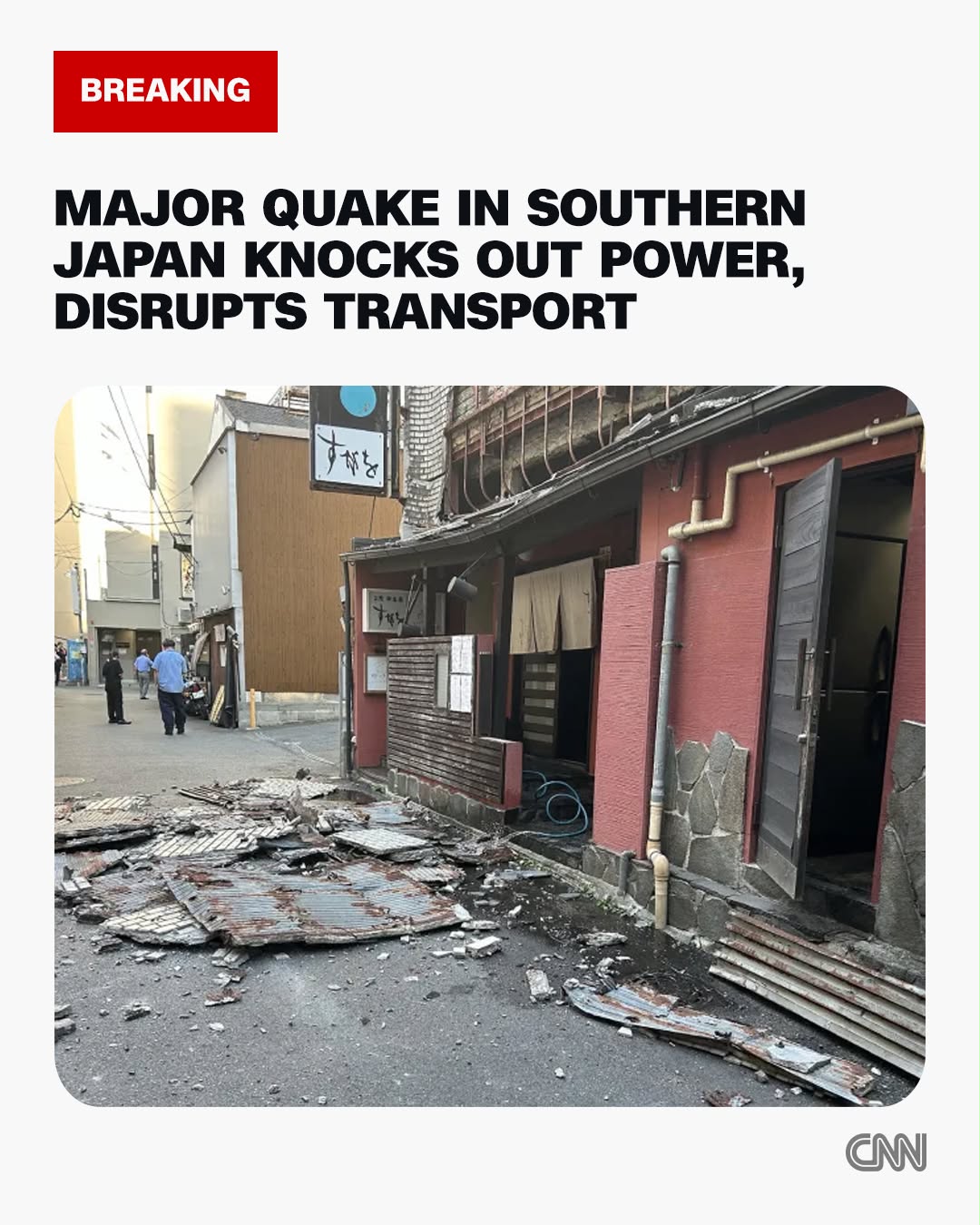
On Tuesday, a powerful 7.1-magnitude earthquake struck Japan’s southern Kumamoto Prefecture, leaving a trail of destruction across the Kyushu region that has injured at least 50 people, cut power to tens of thousands of households, and damaged critical infrastructure. In the hours after the tremor, assessments of full casualty and damage counts are still ongoing, according to Japanese Prime Minister Sanae Takaichi, who addressed reporters from her Tokyo office Wednesday.
“We have already confirmed multiple injuries,” Takaichi told reporters. “Power outages and small blazes have broken out in several communities, alongside damage to roads and bridges, and multiple reports of partial building collapses.”
Public broadcaster NHK was first to report that a local hospital had recorded more than 50 quake-related injuries, while Japan’s leading financial newspaper Nikkei added that several passengers on a high-speed bullet train traveling through the region at the time of the tremor were also hurt. Visual footage from the disaster zone shows collapsed exterior walls on commercial buildings in central Kumamoto City, and multiple damaged structures across the prefecture. Among the damaged sites is an Aeon Co. shopping mall, where NHK reported a small explosion; the company has not yet issued a public statement on the incident. Multiple other structures have been recorded as partially collapsed or engulfed in small fires in local broadcaster footage.
Critical transport networks have been heavily impacted by the tremor: large cracks have opened on major arterial roads including a key elevated highway, a freight train derailed shortly after the quake hit, and all regional rail services—including Kyushu Shinkansen high-speed routes—have been suspended indefinitely while infrastructure inspections are carried out. Kumamoto Airport closed its main runway immediately after the quake, prompting airlines to divert incoming flights and cancel dozens of scheduled services.
Major global manufacturers with production facilities in the affected region have moved quickly to evacuate staff as a safety precaution. Taiwan Semiconductor Manufacturing Company (TSMC), the world’s largest contract chip manufacturer, confirmed it had evacuated all personnel from its Kumamoto-area plant. Leading Japanese electronics giant Sony and photographic material firm Fujifilm also evacuated staff from their local facilities, with Sony noting that teams are still conducting full assessments of potential facility damage.
Japan’s Disaster Management Agency announced that more than 150,000 residents across high-risk areas have been ordered to relocate to designated emergency evacuation centers as of Wednesday morning. Officials from the Japan Meteorological Agency (JMA) have issued urgent warnings to residents in areas that experienced the strongest shaking: the agency warned that aftershocks of similar or greater intensity could strike the region over the next seven days, and residents also face elevated risks of deadly landslides in hilly areas already weakened by the initial tremor.
Japan sits along the Pacific Ring of Fire, the geologically active zone that produces roughly 20% of all global earthquakes of magnitude 6.0 or higher, making it one of the most earthquake-prone countries on Earth. In response to Tuesday’s tremor, Japanese authorities issued emergency earthquake alerts across seven southern Kyushu prefectures: Kumamoto, Nagasaki, Kagoshima, Fukuoka, Saga, Oita, and Miyazaki. The JMA initially issued a tsunami warning for a potential 1-meter wave, but canceled the warning within hours after no abnormal sea level changes were recorded.
As of Wednesday, Kyushu Electric Power reported that roughly 40,000 households across the region remain without power. Major Japanese telecom providers KDDI and NTT Docomo have also reported widespread mobile service disruptions, caused by downed transmission lines and outage-related power cuts at network infrastructure sites. Japan’s Nuclear Regulation Authority has confirmed that no abnormalities have been detected at any nuclear power facilities operating in the Kyushu region, easing fears of a major radiological incident.
The earthquake marks a devastating repeat of a 2016 catastrophic quake that hit the same region: that disaster killed 275 people, injured more than 2,700, and destroyed thousands of structures, including large sections of Kumamoto Castle, a iconic national historic site and top tourist destination that was still undergoing restoration work. Castle officials confirmed Tuesday that additional portions of the castle’s historic stone walls collapsed during the latest tremor.
This is a developing breaking news story, and updates will be issued as more damage and casualty information becomes available.