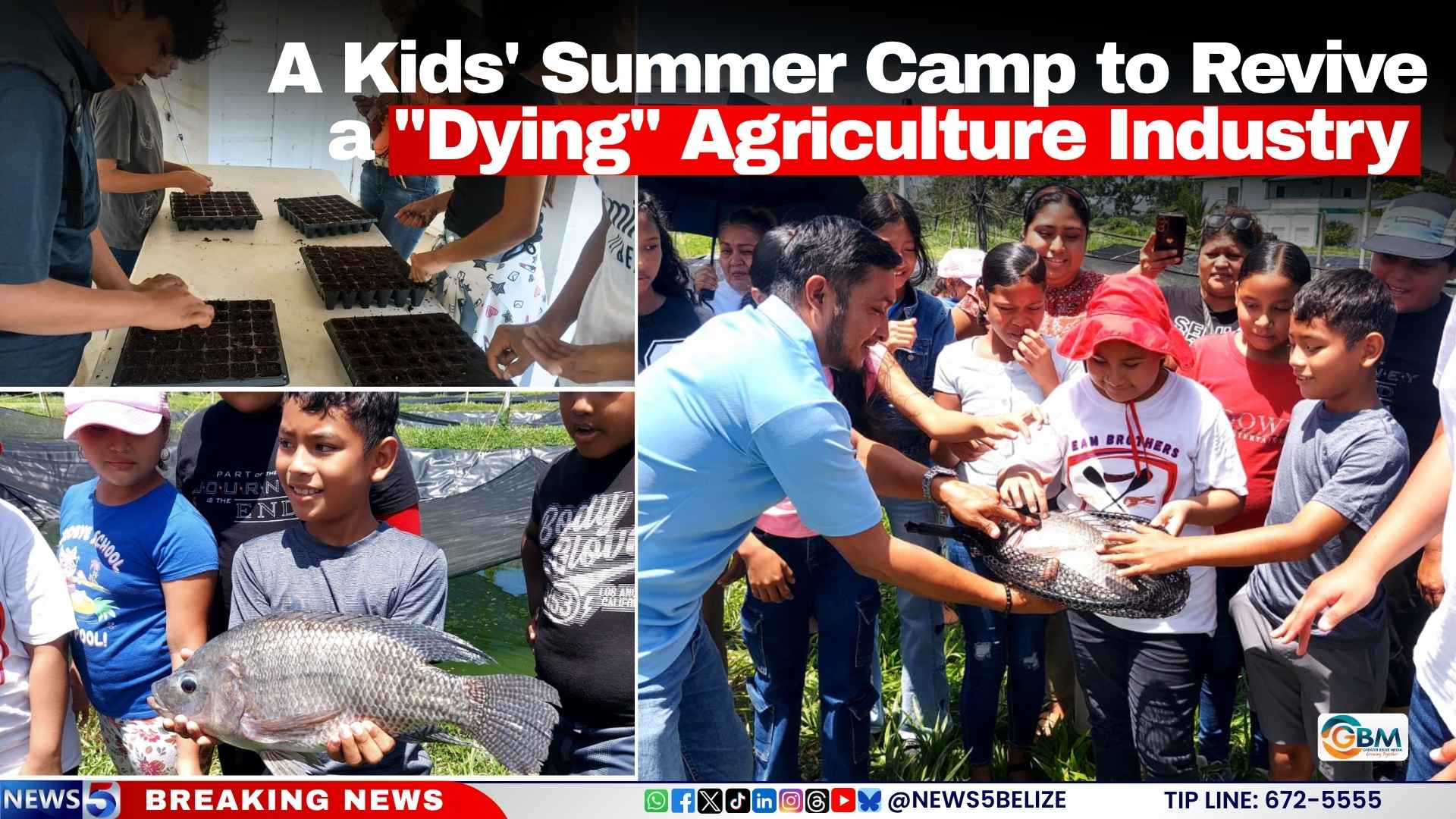
Across Belize, a quiet crisis has been unfolding in the agriculture sector: fewer and fewer young people are stepping forward to take up farming as a lifelong career, leaving the industry at risk of gradual decline as the current farming population ages. But one grassroots initiative at Central Farm is working to turn this tide, engaging children early through an immersive summer camp designed to spark lasting interest in agricultural careers.
The Cayo Central Youth in Agriculture Summer Camp concluded its 2026 session last Friday with a celebratory certificate distribution ceremony, closing out a week of hands-on learning that gave 116 young participants direct exposure to a wide range of agricultural disciplines. Over the seven days, the campers traded traditional classroom desks for interactive lessons at fish ponds, working vegetable gardens, and livestock pens, donning custom green camp t-shirts as they moved through the Central Farm compound to learn practical skills in crop cultivation, livestock management, aquaculture, agro-processing, and beekeeping.
Alex Balona, the Area Representative for Cayo Central and Minister of State in Belize’s Ministry of Agriculture, shared that this year’s participation numbers exceeded all organizing expectations. “Last year we had 103 campers, and this year we welcomed 116 participants by the end of the week. So I am very happy,” Balona noted. The steady uptick in turnout is particularly encouraging for the camp’s core mission, he explained, at a time when Belize is facing a growing shortage of new farmers to replace retiring producers.
“Interest in agriculture is dying, and there are many factors contributing to that trend,” Balona explained. “Without farmers, our tables will not be set for us. That is why I am pushing to sensitize our children early, so that by the time they enter adolescence and move on to high school, they will consider choosing agriculture as a viable career path.”
For many of the young campers, the hands-on approach opened their eyes to opportunities in agriculture they had never considered before. Twelve-year-old Gabriella Hall counted tilapia farming as the highlight of her week, noting that the experience left her open to building a future in the sector. “We got to see the different types, like the red and the grey tilapia, and they were really beautiful,” she said. “I can definitely see myself pursuing agriculture down the road.”
Another participant, Rayanne Requena, left the camp already considering new career paths in marine biology or veterinary science, sparked by the camp’s aquaculture modules. “I enjoyed the aquaculture, and I loved the agro-processing sessions,” she said. “The camp showed you how you can turn one simple thing into something much more valuable than it originally is. That adds value to a basic product, and I think that’s pretty cool.”
Even for campers like Aquim Canto, who grew up in a farming family, the program reinforced his commitment to carrying on his family’s tradition. “Planting is important because you get to produce more fruits and vegetables so people can buy and eat,” Canto said. “That’s why I came to learn more, and now when I go home, I’m even more motivated to keep going.”
Organizers have already announced plans to expand the camp for 2027, with Balona confirming that the team is working to bring the Belize Agricultural Health Authority (BAHA) on board next year to add specialized training on livestock veterinary care. For returning and future participants, the verdict is clear: camper Nayanni Maree is already encouraging more young people to sign up for next year’s session. “It’s great, and you will enjoy it here, and you should come,” Maree said. “You’re gonna learn something new, and it will be so much fun.”
The 2026 camp program was sponsored by RF&G Insurance Ltd., whose slogan is “It Pays to Get it Right.”