Thirty years ago, when a young computer scientist first wrote code on early Macintosh systems, computing resources like memory and processing power were scarce commodities that demanded careful, intentional management. Today, those same complex infrastructure-heavy tasks can be completed with a single line of code — a dramatic shift that underscores just how far digital technology has advanced in just three decades.
Over the course of my career, I have watched paradigm-shifting technological transformations reshape global society. The mainstream adoption of the internet rewrote how humans connect and exchange information, while cloud computing eliminated the need for organizations to build and maintain their own bulky, expensive on-site physical server networks. Today, we stand on the cusp of a far more radical revolution: the rise of autonomous agentic artificial intelligence.
Too often, public discussion of AI reduces the technology to little more than a generative chatbot that answers user questions. In reality, we have already entered the era of agentic AI: systems engineered not just to generate text or respond to prompts, but to carry out complex multi-step workflows, analyze real-time data streams, and act independently without continuous human oversight. This transformation carries well-documented risks to existing employment models, but for small island developing states like St. Vincent and the Grenadines (SVG), it also offers an unprecedented opportunity to leapfrog decades of incremental development and address longstanding structural gaps in the national economy.
As a computer scientist based in SVG, I see this technological shift through a dual lens: I witness the breakneck speed of global innovation, while also seeing the stark digital gaps that hold my country back. Today, nearly every Vincentian carries a smartphone, connecting the population as digital consumers, but core national digital infrastructure lags dangerously behind. Most routine government transactions still require citizens to travel to the capital, Kingstown, and wait in long paper-based lines. Public administration remains overwhelmingly reliant on physical documentation, chronic traffic congestion worsens across the capital amid persistently high fuel prices, and game-changing digital solutions to these problems remain largely unused.
Beyond streamlining public administration, agentic AI holds the potential to revolutionize the core sectors that anchor SVG’s long-term economic sustainability:
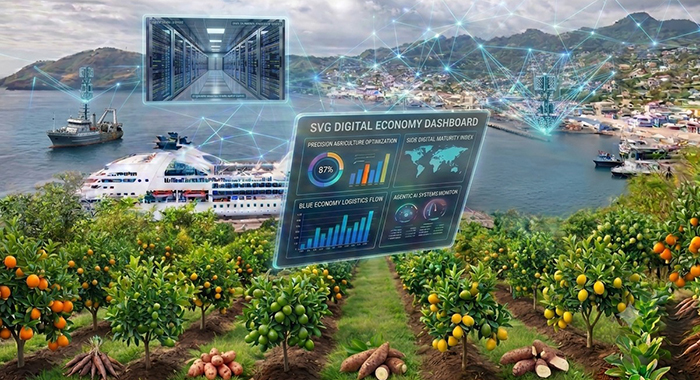
**Agriculture and food sovereignty**: SVG currently relies heavily on food imports, leaving the country exposed to global supply chain disruptions and volatile price swings. Autonomous AI agents can integrate real-time data from soil sensors, weather forecasting models, and global market trends to guide precision agriculture practices, boosting crop yields. Smart AI-powered supply chain agents can also connect local producers directly to buyers including local hotels, regional markets, and export partners, cutting intermediary costs and drastically reducing the national food import bill.
**Tourism and hospitality**: In an increasingly competitive regional tourism market, agentic AI can power 24/7 hyper-personalized concierge systems that handle end-to-end multi-island travel logistics, process instant bookings, and deliver custom guest experiences — all without the massive administrative overhead required by traditional service models.
**The blue economy**: SVG’s marine territory is nearly 90 times larger than its total landmass, making sustainable management of ocean resources a national priority. Autonomous AI marine agents can process continuous streams of oceanographic data, track illegal fishing activity, monitor coral reef health, and support data-driven sustainable fisheries management to protect this critical national asset.
**Government efficiency**: Routine public sector tasks from processing land transfers and issuing professional licenses to updating citizen records and answering public inquiries can be managed seamlessly by AI-powered digital agents. This would allow Vincentians across all parts of the multi-island nation to complete government transactions in minutes from their smartphones, eliminating the need for costly, time-consuming trips to the capital.
Critics may dismiss these applications as out-of-reach futurism for a small island nation, but they are not unachievable pie-in-the-sky ideas. Fifty years ago, a prediction that most Vincentians would carry a personal connected phone in their pocket by 2024, and no longer need to visit a post office to send a letter, would have sounded equally implausible. In today’s digital age, the scope of technological possibility is effectively limitless. It is only a matter of time before these use cases become accessible, practical solutions even for small economies like SVG, including applications to address pressing local challenges such as crime.
For all its opportunities, this AI transition also carries significant risks, particularly for small developing economies that fall behind in preparation. As AI becomes embedded across core sectors including banking, agriculture, healthcare, education, logistics, government services, and general commerce, the digital divide between technologically prepared nations and late adopters is set to widen dramatically. Caribbean nations already rely heavily on foreign-owned external systems for critical services including correspondent banking, digital payments, telecommunications, and international trade. As these systems evolve into AI-driven ecosystems that demand advanced technical integration and local expertise, nations that have not invested in readiness could find themselves locked out of full participation in the global economy.
This raises a critical question that SVG and other Caribbean nations must answer now: Who will build and manage this local AI transition? If we delay modernizing our national digital infrastructure and training our local workforce, we will create a crippling skills gap. When the pressure to integrate autonomous AI systems becomes unavoidable, local institutions will be forced to look abroad for talent. Highly skilled foreign workers will fill these high-value local roles, leaving Vincentians sidelined in their own national economy. The early introduction of ATMs and coaxial cable computer networks in SVG holds a clear lesson: delayed preparation leads to missed local opportunities.
This transition also poses an immediate challenge to SVG’s public sector, where the government is the nation’s largest employer in a system already widely recognized as bloated and resource-strained. What will happen when evolving international standards force the adoption of autonomous AI into government operations? Agentic AI systems prioritize speed and accuracy, and if they are forced onto an unprepared public sector without a human-centered transition strategy, the resulting disruption will be painful. But that outcome is not inevitable. If national leaders act proactively and early, AI does not have to equal mass job displacement. Early preparation allows for systematic retraining of existing civil servants to move into higher-value roles, shifting administrative workers into positions focused on data governance, digital system orchestration, and specialized citizen service management. Far from displacing the public workforce, automation can elevate it — but only if we lay the necessary foundational infrastructure and training today, rather than delaying action.
Across the Caribbean, there are early encouraging signs of growing awareness of this moment. Trinidad and Tobago’s ongoing exploration of a large-scale national data center reflects a growing recognition that future economic power depends on data sovereignty and core digital infrastructure. But infrastructure alone is not enough. SVG urgently needs a coordinated national AI strategy focused on three core priorities:
First, build inclusive digital public infrastructure: Transition all paper-based public services to secure, automated digital portals that eliminate mandatory trips to Kingstown and streamline processes to cut operational costs.
Second, pursue sector-specific AI integration: Deploy AI-powered smart tools across agriculture, fisheries, and tourism to boost local production and reduce the nation’s reliance on costly foreign imports and services.
Third, implement targeted workforce retraining: Update national technical education curricula and launch upskilling programs for current civil servants to equip them to manage autonomous AI workflows long before external forces force rapid adoption.
The core concern for SVG is not that AI is coming — it is already here. The question is whether SVG and the wider Caribbean are moving fast enough to prepare, to ensure our citizens remain competitive, productive, and prosperous in a global economy increasingly shaped by data and autonomous intelligent systems. The choices we make today on digital infrastructure and workforce education will define our place in the modern global economy. Making only incremental, nominal changes to keep current systems running will not be enough. To let future generations of Vincentians claim their place as creators and managers of the emerging digital economy, we need bold, immediate action. If we delay, we risk spending the next 30 years playing catch-up, with a gap that will eventually widen beyond our ability to close it.