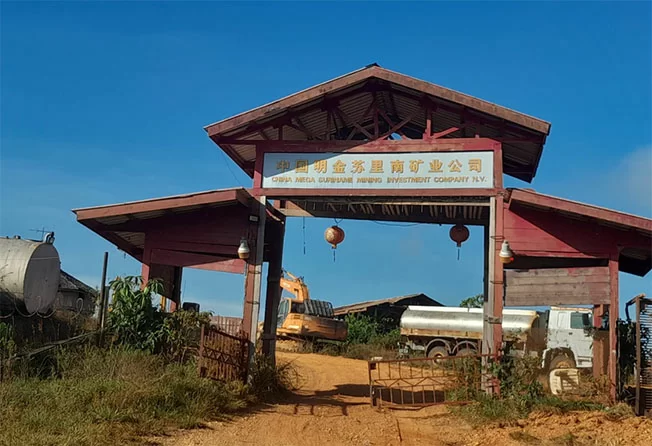
A high-profile joint police and military operation targeting 16 Chinese employees at a Surinamese gold concession has pulled back the curtain on a bitter, years-long simmering conflict over control of one of the country’s large-scale mining assets. The July 14 operation, which made international headlines over claims of an unauthorized armed Chinese presence, is far more complex than initial public reports suggest, according to senior management at Sarakreek Resource Corporation – the Canadian-founded concession holder that partners with China Mega Suriname Mining Investment Company on the 22,500-hectare project. In an exclusive interview with local outlet Starnieuws, the firm’s leadership painted a full picture of a dispute stretching back to 2022, marked by legal battles against the Surinamese state, unregulated encroachment by illegal gold miners, and allegations of behind-the-scenes political influence shaping the crisis.
Sarakreek management emphasized that the Chinese employees at the site are legally employed by the joint venture between the firm and its Chinese mining partner. A majority of the workers already hold valid residency and work permits, while the remaining applicants are in the final stages of administrative processing, a status the company says it fully disclosed to authorities early in the investigation. The firm also confirmed it holds a legal license to possess firearms for security purposes on the concession – a standard arrangement for major mining concession holders across Suriname’s gold sector. It did acknowledge, however, that the armed new employees who arrived in Suriname only on July 7 and 9 had not yet completed official weapons registration, and that the team deployed firearms out of urgent necessity amid the site’s steadily worsening security crisis. The company also admitted that gunfire discharged during an on-site training exercise at its base camp was an avoidable safety lapse, adding that the decision to conduct training there was incorrect in hindsight.
The July 14 raid marks only the latest escalation of a conflict that has unfolded gradually over half a decade. After Sarakreek scaled back mining operations several years ago to prepare for a major expansion restart, the concession’s massive size and limited on-site presence created an opening for large groups of unlicensed illegal gold miners to occupy large swathes of the territory. The company says it has long documented ties between these encroaching miners and influential political figures connected to Suriname’s ruling coalition. In one documented incident, an illegal miner openly told police he had secured permission to mine on the concession after paying a bribe to a relative of ABOP party leader Ronnie Brunswijk, one of Suriname’s most powerful political figures.
The root of the formal dispute dates back to 2022, when Sarakreek submitted an application to renew its expiring mining concession rights. Though the firm filed the application well ahead of the expiration deadline, the Ministry of Natural Resources rejected the request, claiming the company was in conflict with local Indigenous and riverine communities. Sarakreek refutes this claim, noting its concession territory sits 27 kilometers from the nearest permanent village, and that multiple negotiation sessions with community representatives were held with Ministry officials in attendance. The company says local demands escalated over time, ultimately requiring a $100,000 compensation payment and the transfer of half of the company’s concession rights to local stakeholders. When no agreement could be reached on the non-negotiable demands, the dispute moved to Suriname’s courts. The judiciary ruled in Sarakreek’s favor, ordering the state to extend the concession and imposing daily coercive fines for non-compliance.
Despite the court victory, the security situation on the ground continued to deteriorate. In October 2025, Sarakreek formally notified the Ministry of Natural Resources in writing that illegal miners were actively blocking all preparations to restart full mining operations. On June 26, a police inspection team visited the concession to review the Chinese workers’ residency, work authorization and weapons compliance, accompanied by a reconnaissance team from Suriname’s border surveillance operation. Sarakreek says it fully cooperated with the inspection and submitted all requested documentation to police within three business days, and no additional information requests were received between June 29 and the July 14 raid.
Tensions boiled over on July 13, when a verbal clash broke out between Chinese employees and a group of illegal miners occupying the concession. Within hours, clips claiming an unauthorized “Chinese army” was operating in the area spread rapidly across Surinamese social media. The miners involved openly claimed that a single phone call to Brunswijk would be enough to force the Chinese team off the land. Just 24 hours later, two helicopters carrying joint police-military units landed at the concession’s base camp to launch the raid. During a brief FaceTime call between Sarakreek management and the regional police commander, the commander confirmed the operation was investigating compliance with immigration and firearms law – before the call was abruptly cut off by a bystander shouting in Sranan that 15 people would be taken away for processing and three would remain to guard the camp.
Sarakreek describes the raid itself as chaotic and abusive. As police searched the camp, illegal miners were allowed to remain on site to observe the operation and heckle the Chinese staff. All 16 employees were forced to lie on the ground in humiliating conditions, and two sleeping workers were dragged out of their bunks. Management also alleges that one Chinese worker was beaten in the head by a local resident while being transported to the extraction helicopter, knocking him unconscious. Footage circulated on social media showed Brunswijk pointing at the unconscious worker tied to the back of an all-terrain vehicle (ATV), but the clips do not show the prior assault, according to the company. All 16 workers were released from custody by the Public Prosecution Service the following day.
After security forces withdrew from the camp, Sarakreek conducted an inventory and found more than $8,800 in cash, 45,000 Surinamese dollars, fuel, legally held firearms, work clothing, other company equipment and four ATVs had gone missing. The company filed a formal theft report with police in Brokopondo, and two of the ATVs were later returned. Sarakreek says the return offer came that same evening through a Chinese intermediary, who requested the company allow two of Brunswijk’s security staff to drop off the vehicles. The firm rejected the offer, noting that a formal police report had already been filed and it expects a full official investigation into the missing property.
Brunswijk’s presence at the scene of the raid has raised additional questions for Sarakreek’s leadership. Social media clips showed local bystanders cheering and thanking Brunswijk for leading the operation against the Chinese workers, with the footage published publicly by ABOP Member of Parliament Geneviévre Jordan. Suriname’s Minister of Justice and Police Harish Monorath has denied Brunswijk commanded the operation, stating it was led by the regional police commander for central Suriname as a joint police-military mission, and Brunswijk only alerted authorities after receiving reports of armed Chinese men in the area.
For Sarakreek, however, the incident is far more than an isolated check of immigration and firearms compliance. The company says the raid must be understood as the latest turn in a years-long battle over control of the concession, driven by illegal encroachment, competing political and economic interests, and a dispute that has already been settled in court but remains unresolved on the ground. “The public has only heard part of the story,” Sarakreek management told Starnieuws.