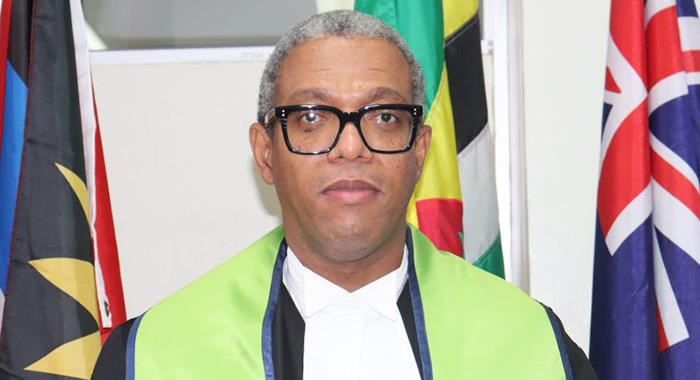
A landmark legal ruling from the Eastern Caribbean Supreme Court (ECSC) has upended the appointment of a senior appellate judge, while leaving his controversial prior decision on a high-stakes COVID-19 vaccine mandate in place, sending ripples through legal and political circles in St. Vincent and the Grenadines (SVG).
In a written judgment delivered July 7, High Court Justice Raulston L. A. Glasgow annulled the January 8, 2024 appointment of St. Lucian jurist and academic Eddy Ventose to the ECSC’s Court of Appeal. The ruling confirmed that at the time Ventose wrote a key 2025 majority verdict overturning a lower court’s nullification of SVG’s national COVID-19 vaccine mandate, he did not legally hold the position of Justice of Appeal.
The vaccine mandate case at the center of broader public and legal debate traces back to March 2023, when then-High Court Justice Esco Henry — now elevated to the appellate bench — ruled the mandate implemented by SVG’s ruling Unity Labour Party (ULP) was unconstitutional and void. The government appealed the decision, and in February 2025, a 2-1 majority of the ECSC appellate panel led by Ventose overturned Henry’s ruling. Appellate Justice Paul Webster joined Ventose’s majority opinion, while Justice Gerhard Wallbank issued a dissent saying he would have upheld the lower court’s ruling and dismissed the government’s appeal.
The validity of Ventose’s appointment was first challenged in December 2025, when former Grenada Attorney General and King’s Counsel James A.L. Bristol filed an application for judicial review with the ECSC, targeting the Judicial and Legal Services Commission (JLSC)’s approval of Ventose’s appointment. Bristol argued Ventose failed to meet two core statutory qualifications for appellate court office laid out in Section 5(2) of the ECSC Courts Order: first, he had not served a cumulative total of at least five years as a judge of an unlimited jurisdiction court in the Commonwealth, and second, he had not accumulated the required 15 years of experience practicing as an advocate before a qualifying court.
Ventose had sought to dismiss Bristol’s challenge outright, arguing the court lacked jurisdiction to hear the matter and labeling the application an abuse of process. The court rejected this preliminary motion in December 2025, clearing the way for a full merits trial of the challenge.
In his final judgment, Justice Glasgow confirmed that Ventose’s appointment fails to meet the statutory qualifications mandated by law. Citing Section 101 of the Grenada Constitution Order 1973, Glasgow ruled Ventose’s appointment is “unconstitutional, null, void and of no effect” due to his failure to satisfy the eligibility criteria in Section 5(2) of the Courts Order. Critically, however, the judgment explicitly clarifies that the ruling casts no shadow over Ventose’s professional legal standing: the court confirmed no questions have been raised regarding Ventose’s competence, extensive legal expertise, or widely acknowledged professional accomplishments, a position Bristol himself reaffirmed during oral arguments.
Glasgow noted that all relevant stakeholders — including the JLSC, Ventose, the ECSC, the appointment search committee, and the public Ventose served — operated under the shared assumption that Ventose’s appointment was valid until the search committee raised formal concerns. There is no evidence to conclude Ventose knew or reasonably should have known he occupied the office unlawfully, the judge added.
This finding cleared the way for Glasgow to apply the de facto officer doctrine to all proceedings Ventose participated in and all rulings he issued during his tenure. “Those proceedings and judgments are therefore not rendered invalid by reason only of the defect in his appointment,” the judgment reads. This means Ventose’s February 2025 ruling overturning the lower court’s voiding of the vaccine mandate, along with all other rulings he issued during his time on the bench, remain in effect unless overturned by a higher court.
The core legal dispute centered on interpretation of the statutory language governing appellate qualifications. All parties to the challenge agreed Ventose did not meet the first eligibility requirement of five years of prior judicial service in a Commonwealth unlimited jurisdiction court. The disagreement turned on whether he met the second requirement: 15 cumulative years of practice as a qualified advocate before such a court. The JLSC defended its appointment, asserting it had properly verified that Ventose met the 15-year requirement and had complied fully with all statutory rules. Ventose echoed the JLSC’s position, affirming he meets the constitutional eligibility criteria and that his appointment was lawful.
The vaccine mandate case is now pending final review by the London-based Privy Council, SVG’s highest appellate court. Legal analysts note the recent ruling on Ventose’s appointment is expected to reignite fierce public debate in SVG over the controversial mandate, which political observers say played a decisive role in the ULP’s landslide 14-1 defeat to the New Democratic Party (NDP) in the November 2025 general election. The mandate led to the termination of hundreds of public sector workers who refused vaccination, though most have since returned to their positions under transition arrangements negotiated between the outgoing ULP administration and the incoming NDP government.